Ampicillin Price Trend Analysis 2026: Historical Prices, Price Drivers, Latest News, Market Insights & Supply Demand Analysis

Pragati Agarwal profile photo
Written ByPragati Agarwal

Procurement Resource Database

Laptop screen

Turn price intelligence into action with the Procurement Resource Database. Log in or subscribe to unlock live price trends, historical charts, supplier databases, cost curves, and analyst-backed insights across chemicals, agriculture, energy, packaging, and more. Use these tools to benchmark your contracts, plan budgets with confidence, and stay ahead of market moves on every product you buy.

0

+

Products

0

+

Regions

0

+

Subscriptions

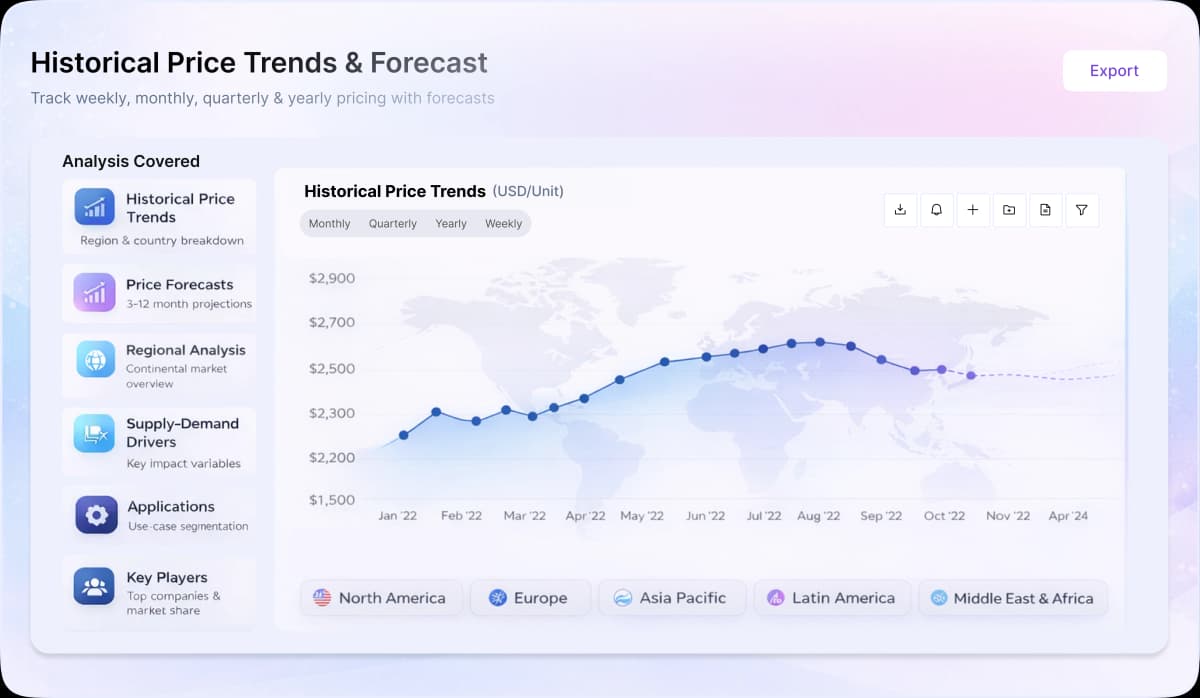
In the fourth quarter of 2024, the global Ampicillin market witnessed a generally stable but slightly increasing price trend. Early in the quarter, the market was characterized by weak demand, particularly in regions like Asia, where sluggish consumption from key sectors limited market activity. This was compounded by rising freight costs, which affected supply chains and contributed to supply tightness. However, as the quarter progressed, prices began to rise due to improved demand in the pharmaceutical sector, especially in Europe and North America, as companies sought to replenish stockpiles in anticipation of potential supply disruptions. Logistical challenges, such as port congestion and rising shipping costs, continued to exert upward pressure on prices.

The European market, in particular, saw more significant price movements as companies adjusted their strategies to cope with supply chain difficulties and stockpiling efforts. Similarly, in North America, a strong recovery in consumer confidence contributed to increased buying activity, which further supported price increases in the later months.


About Ampicillin

Ampicillin belongs to the penicillin group of antibiotics that affects both gram-positive and gram-negative bacteria. It inhibits bacteria production via destruction of bacteria’s cell walls and thus can be used in various skin, respiratory, and urinary tract infections. Due to ampicillin's susceptibility to enzyme breakdown, ampicillin-resistant bacterial species have emerged. It is an effective weapon for battling bacterial infections since it is a-lactam antibiotic that works by inhibiting bacteria's production of their cell walls.


Ampicillin Product Detail

Hs Code
30041020
Chemical Formula

C16H18N3NaO4S

Cas Number
69-52-3
Molecular Weight
349.406 g/mol

Regional Coverage

Asia Pacific

China, India, Indonesia, Pakistan, Bangladesh, Japan, Philippines, Vietnam, Iran, Thailand, South Korea, Iraq, Saudi Arabia, Malaysia, Nepal, Taiwan, Sri Lanka, UAE, Israel, Hongkong, Singapore, Oman, Kuwait, Qatar, Australia, and New Zealand

Europe

Germany, France, United Kingdom, Italy,Spain, Russia, Turkey, Netherlands, Poland, Sweden, Belgium, Austria, Ireland Switzerland, Norway, Denmark, Romania, Finland, Czech Republic, Portugal and Greece

North America

United States and Canada

Latin America

Brazil, Mexico, Argentina, Columbia, Chile, Ecuador, and Peru

Africa

South Africa, Nigeria, Egypt, Algeria, Morocco

CurrencyUS$ (Data can also be provided in local currency)

Supplier Database AvailabilityYes

Customization ScopeThe report can be customized as per the requirements of the customer

Post-Sale Analyst Support360-degree analyst support after report delivery

Note: Our supplier search experts can assist your procurement teams in compiling and validating a list of suppliers indicating they have products, services, and capabilities that meet your company's needs.

Ampicillin Production Processes

  • Ampicillin Production from penicillin

In the first step of the process, penicillin is converted into 6-amino penicillanic acid via immobilized enzymes or chemical synthesis. In the next step, 6-APA is silylated with the help of D9-alpha-phenylo glycine chloride hydrochloride. To get ampicillin trihydrate crystals, silylated 6-APA is condensed and hydrolyzed with an alkali solution. Then these crystals are dissolved in propyl alcohol to give ampicillin anhydrous. In the last step, ampicillin trihydrate crystals are dissolved in sodium hydrozide solution and are then filtered and distributed to lyophilizators to give the final product.

Frequently Asked Questions

Ampicillin pricing is expected to remain range-bound through the remainder of 2026, as expanding domestic penicillin G capacity in India and steady Chinese fermentation output keep supply balanced. Year-round antibiotic consumption and a seasonal respiratory demand uptick anchor demand, while eased energy and freight costs support softer production economics. The outlook holds unless logistical disruptions, energy-driven cost spikes, or tighter regulatory price ceilings shift the balance.
Ampicillin prices are driven mainly by penicillin G and 6-APA costs and availability, alongside D-phenylglycine-based side-chain inputs. With upstream penicillin and 6-APA capacity concentrated largely in China, operating rates and supply conditions there strongly influence global costs, while India remains an important manufacturing market. Energy, freight and fermentation costs add further pressure, while GMP, environmental and import regulations can constrain production or raise compliance costs. Human and veterinary antibiotic demand, including seasonal respiratory use, provides the demand pull. Tight supply or stronger demand lifts prices, while ample production and softer procurement ease them.
China and India are the principal ampicillin-producing and exporting countries, holding most global fermentation and active-ingredient capacity, with India scaling up domestic penicillin G capacity under incentive-linked manufacturing programmes to add supply resilience. Europe and North America are the main consuming and importing regions, with European buyers typically paying a premium for longer logistics chains and stricter compliance. The heavy concentration of active-ingredient capacity in Asia is the key supply-security consideration for global buyers.
Ampicillin is produced via two main routes. The first starts from penicillin G or V, enzymatically converted to 6-APA, then crystallized, filtered, washed, dried, and packed. The primary route silylates 6-APA in a solvent with a catalyst, then condenses it with D(-)-α-phenylglycine chloride hydrochloride and a base to form ampicillin trihydrate crystals. These dissolve in propyl alcohol for anhydrous ampicillin, or treat with sodium hydroxide for sterile injectable sodium. Finished API serves oral capsules and suspensions, sterile hospital injectables, veterinary formulations, and ampicillin-sulbactam combinations for resistant infections.
Ampicillin demand is driven by its use across the pharmaceutical industry to treat bacterial infections, including respiratory-tract, urinary and genitourinary, gastrointestinal, meningitis and lung infections, and its acid-resistant oral formulation broadens accessibility. Year-round antibiotic consumption anchors baseline demand, while seasonal surges in respiratory infections create periodic uplift. Veterinary formulations and ampicillin-sulbactam combinations for resistant infections add further pull. Because these are essential, largely non-cyclical medical uses, ampicillin demand is steady, moving mainly with penicillin G feedstock costs and Asian supply availability.
Procurement Resource assesses ampicillin price trends through a structured, data-driven methodology that combines primary engagement with producers, suppliers and traders, secondary market data, monitoring of feedstock and input costs, trade-flow and inventory tracking, and exchange or spot benchmarks. These inputs are validated and translated into a transparent price assessment and outlook. The detailed methodology is available on the Procurement Resource website.

Our Price Analysis Methodology

About the Author

Pragati Agarwal profile photo

Pragati Agarwal

Senior Business Insights Analyst

Delivering price trend analysis and procurement market insights at Procurement Resource, with expertise in identifying commodity patterns, supporting purchasing strategies, and improving cost efficiency through actionable market intelligence.

Schedule Demo

Schedule a demo

Experience how Procurement Resource transforms raw material price data into clear, decision ready intelligence. Optimise your performance with reliable, expert market data and analysis. Schedule your demo today to experience a live walk-through where our experts will showcase interactive price charts, forecasted prices, and insights driving the prices for your key commodities, tailored to your workflows. Contact us now!

Our Team will be happy to assist you

We are just a text away

+1

Still Need Help?

Europe & Africa

+44 7573 171117

[email protected]

USA & Canada

+1 307 363 1045

[email protected]

APAC

+91 8850629517

[email protected]

Unlock full access to Procurement Resource's price databases, interactive charts, and short-term forecasts for thousands of commodities. Elevate your sourcing decisions by comparing prices across regions, downloading historical data, and layering in analyst-backed insights, all with our flexible plans that scale as your portfolio grows.

Still have any Questions

Contact Us
Mastercard
Wire
VISA
Stripe

Why Procurement Database

Commodity Market Intelligence

Commodity Market Intelligence

Track prices, market movements, supply-demand dynamics, and industry developments across hundreds of commodities through a centralized intelligence platform built for informed procurement decisions.

Price Forecasts & Market Outlooks

Price Forecasts & Market Outlooks

Understand market fluctuations using analyst-backed forecasts, historical pricing patterns, and evolving industry trends to strengthen sourcing strategies and budget planning.

Cost & Procurement Optimization

Cost & Procurement Optimization

Leverage cost models, pricing benchmarks, and procurement insights to evaluate purchasing opportunities, improve negotiations, and enhance operational efficiency.

Global & Regional Market Insights

Global & Regional Market Insights

Access region-specific price trends, trade activities, capacity changes, and supply chain developments influencing commodity markets worldwide.

1/4