Anisole Price Trend Analysis 2026: Market Insights, Latest News, Price Drivers, Supply Demand Analysis & Historical Prices

Procurement Resource Database

Laptop screen

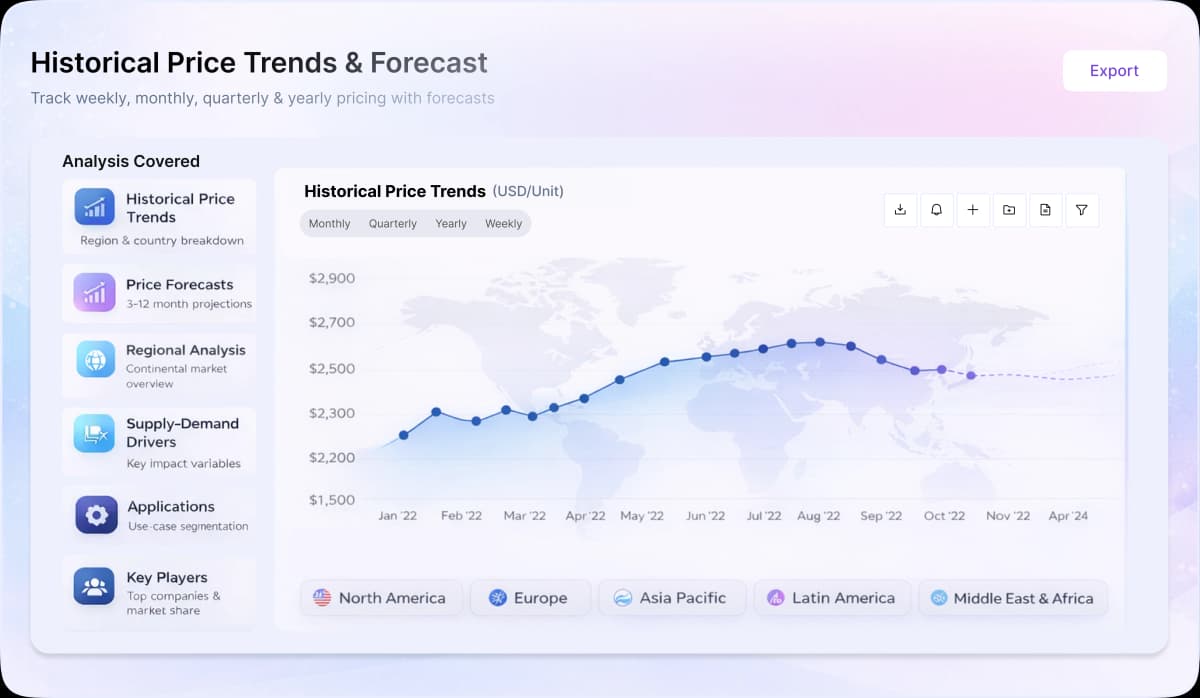
Turn price intelligence into action with the Procurement Resource Database. Log in or subscribe to unlock live price trends, historical charts, supplier databases, cost curves, and analyst-backed insights across chemicals, agriculture, energy, packaging, and more. Use these tools to benchmark your contracts, plan budgets with confidence, and stay ahead of market moves on every product you buy.

0

+

Products

0

+

Regions

0

+

Subscriptions

Asia

The Asian Anisole market followed a consistent downward trajectory in the fourth quarter. China's strict export restrictions remained a dominant factor, leading to significant domestic oversupply. Despite high production rates at manufacturing facilities, demand stayed weak, causing substantial inventory accumulation.

The government's continued export limitations created a notable supply-demand mismatch in the local market. Indian markets echoed this bearish trend, marked by post-festive season slowdown and weak agrochemical sector demand. Plant shutdowns for maintenance were implemented by several firms to address the supply-demand imbalance, yet prices continued to decline.

Europe

European Anisole markets saw price depreciation throughout Q4. The trend was influenced by falling feedstock costs and subdued downstream demand. Market participants maintained cautious buying patterns, keeping their inventory levels minimal. The overall chemical sector weakness in the region, combined with sufficient availability and competition from Asian markets, contributed to the downward price movement.

North America

The North American market exhibited similar bearish trends during Q4. Prices decreased due to weak demand fundamentals and comfortable inventory positions. The ongoing construction sector slowdown continued to impact the broader chemical industry, affecting Anisole consumption. Manufacturers adjusted their operating rates to manage the oversupply situation, but this did little to support prices.


About Anisole

Anisole is an aromatic organic compound with chemical formula C7H8O that has a nice and pleasant odor. It is frequently employed as a solvent in numerous industrial processes, as a flavoring and aroma component in cosmetics and culinary items, and as a chemical synthesis intermediate. Additionally, it can operate as a monomer in polymerization processes. Agrochemicals and pharmaceuticals also use anisole as a raw material.

Anisole Product Detail

HS Code
29093090
Chemical Formula

C7H8O

CAS Number
100-66-3
Molecular Weight
108.14 g/mol
Industrial Uses

Solvent, Laboratory reagent, Organic synthesis, Pesticide and insecticide, Polymers

Supplier Database

Solvay SA, Westman Chemicals Pvt Ltd, Benzo Chem Industries Pvt Ltd, Huaian Depon Chemical Co Ltd, Clean Science and Technology Private Limited

Synonyms

Methoxybenzene, Methyl phenyl ether

Regional Coverage

Asia Pacific

China, India, Indonesia, Pakistan, Bangladesh, Japan, Philippines, Vietnam, Iran, Thailand, South Korea, Iraq, Saudi Arabia, Malaysia, Nepal, Taiwan, Sri Lanka, UAE, Israel, Hongkong, Singapore, Oman, Kuwait, Qatar, Australia, and New Zealand

Europe

Germany, France, United Kingdom, Italy,Spain, Russia, Turkey, Netherlands, Poland, Sweden, Belgium, Austria, Ireland Switzerland, Norway, Denmark, Romania, Finland, Czech Republic, Portugal and Greece

North America

United States and Canada

Latin America

Brazil, Mexico, Argentina, Columbia, Chile, Ecuador, and Peru

Africa

South Africa, Nigeria, Egypt, Algeria, Morocco

CurrencyUS$ (Data can also be provided in local currency)

Supplier Database AvailabilityYes

Customization ScopeThe report can be customized as per the requirements of the customer

Post-Sale Analyst Support360-degree analyst support after report delivery

Note: Our supplier search experts can assist your procurement teams in compiling and validating a list of suppliers indicating they have products, services, and capabilities that meet your company's needs.

Anisole Production Processes

Methanol and phenol are subjected to methylation via vapor phase technique. This process is carried out in alumina activated catalyst in fixed bed reactors.

Frequently Asked Questions

The anisole market outlook remains positive, supported by growing demand from pharmaceutical, fragrance, cosmetics, and agrochemical applications. Asia-Pacific continues to represent an important growth region, while increasing use of anisole as an intermediate in pharmaceutical and specialty chemical manufacturing is supporting consumption. Expanding chemical production and demand for fragrance ingredients are expected to sustain market growth through 2026, although regulatory requirements and supply-chain conditions will continue to influence procurement decisions across major markets.
Anisole prices are driven primarily by phenol and methanol feedstock costs, the two key inputs for the vapor-phase methylation production route. Regional supply-demand balances, freight and logistics costs, and currency movements shape the price gap between major consuming markets, particularly between Asian production hubs and the United States and Europe. Domestic availability and import competition influence how much of any feedstock cost change passes through to buyers. Downstream demand from flavours and fragrances, pharmaceutical intermediate, and agrochemical producers sets the pace of offtake against available supply.
The anisole market is concentrated among a small set of suppliers. Solvay SA operates as a European multinational, while Huaian Depon Chemical is based in China, and Westman Chemicals, Benzo Chem Industries, and Clean Science and Technology are all India-based. China and India together dominate production and export supply, with the United States representing a major consuming market alongside Europe.
Anisole is produced primarily via vapor-phase methylation of phenol and methanol, the two key feedstocks. In a fixed-bed reactor, phenol and methanol react over a γ-Al2O3-supported activated alumina catalyst to yield anisole. An alternative route uses dimethyl sulfate with phenol in an alkaline aqueous solution. Naturally, anisole occurs in tarragon oil. The finished product then serves as a fragrance and aroma component, a pharmaceutical intermediate (e.g., for guaiacol, dextromethorphan), an agrochemical feedstock, and a solvent or dye intermediate.
Anisole demand is driven primarily by the paints and coatings, textiles, and printing industries, where it serves as an intermediate in dyes, coatings, and pigments production. The agrochemical sector is another major consumer, using anisole in pesticide and herbicide synthesis. Pharmaceutical and fragrance industries also contribute through drug intermediates and aromatic chemical production. These end markets collectively shape procurement patterns, with regional demand imbalances between major consuming markets showing up in persistent price spreads between regions.
Anisole is available in two principal grades. Technical grade, at approximately 99.0-99.5% purity, accounts for the majority of market volume and serves fragrance manufacturing, solvent use, and general chemical intermediate applications. High-purity grade, above 99.5% purity, is required for pharmaceutical API synthesis, electronic-grade applications, and analytical reference standards. It requires additional distillation passes and gas chromatography characterization, carrying a price premium due to stricter end-user specifications and regulatory standards.
Procurement Resource assesses anisole prices through a structured, data-driven methodology combining direct engagement with producers, suppliers and traders, secondary market data, continuous monitoring of feedstock and input costs, trade-flow and inventory tracking, and exchange or spot benchmarks. All inputs are validated and translated into a transparent price assessment and outlook. The detailed methodology is available on the Procurement Resource website.

Our Price Analysis Methodology

About the Author

Prakhar Panchbhaiya profile photo

Prakhar Panchbhaiya

Assistant Manager: Business Insights and Content

Supporting procurement teams with category intelligence, market research, price trends, supply-demand analysis, and strategic sourcing insights across key industries.

Schedule Demo

Schedule A Demo

Experience how Procurement Resource transforms raw material price data into clear, decision ready intelligence. Optimise your performance with reliable, expert market data and analysis. Schedule your demo today to experience a live walk-through where our experts will showcase interactive price charts, forecasted prices, and insights driving the prices for your key commodities, tailored to your workflows. Contact us now!

Our Team will be happy to assist you

We are just a text away

+1

Still Need Help?

Europe & Africa

+44 7573 171117

[email protected]

USA & Canada

+1 307 363 1045

[email protected]

APAC

+91 8850629517

[email protected]

Unlock full access to Procurement Resource's price databases, interactive charts, and short-term forecasts for thousands of commodities. Elevate your sourcing decisions by comparing prices across regions, downloading historical data, and layering in analyst-backed insights, all with our flexible plans that scale as your portfolio grows.

Still have any Questions

Contact Us
Mastercard
Wire
VISA
Stripe

Why Procurement Database

Commodity Market Intelligence

Commodity Market Intelligence

Track prices, market movements, supply-demand dynamics, and industry developments across hundreds of commodities through a centralized intelligence platform built for informed procurement decisions.

Price Forecasts & Market Outlooks

Price Forecasts & Market Outlooks

Understand market fluctuations using analyst-backed forecasts, historical pricing patterns, and evolving industry trends to strengthen sourcing strategies and budget planning.

Cost & Procurement Optimization

Cost & Procurement Optimization

Leverage cost models, pricing benchmarks, and procurement insights to evaluate purchasing opportunities, improve negotiations, and enhance operational efficiency.

Global & Regional Market Insights

Global & Regional Market Insights

Access region-specific price trends, trade activities, capacity changes, and supply chain developments influencing commodity markets worldwide.

1/4