Udeesha Tomar
AVP - Strategy and Solutions
Leading procurement research solutions across chemicals, materials, and food & beverages, with expertise in price forecasting and market analytics.
| Product | Region | Incoterm Basis | Price | Last Updated Month |
|---|---|---|---|---|
| Butyl Rubber | China | FOB | USD 4,974.00/MT | April 2026 |
| Butyl Rubber | USA | CIF | USD 5,061.00/MT | April 2026 |
| Butyl Rubber | Germany | FOB | USD 5,100.00/MT | April 2026 |
| Butyl Rubber | India | CIF | USD 5,024.00/MT | April 2026 |
| Butyl Rubber | Japan | CIF | USD 5,016.00/MT | April 2026 |
| Butyl Rubber | China | FOB | USD 3,565.00/MT | March 2026 |
| Butyl Rubber | USA | CIF | USD 3,652.00/MT | March 2026 |
| Butyl Rubber | Germany | FOB | USD 3,647.00/MT | March 2026 |
| Butyl Rubber | India | CIF | USD 3,620.00/MT | March 2026 |
| Butyl Rubber | Japan | CIF | USD 3,601.00/MT | March 2026 |
Stay updated with the latest butyl rubber prices, historical data, and tailored regional analysis
Asia
In Asia, the butyl rubber market remained pressured by oversupply despite rising production costs in the first quarter of 2026. Iran war–related disruptions in the Strait of Hormuz tightened petrochemical supply chains, increasing costs across ethylene-linked derivatives, including isobutylene. However, supply-side pressure dominated, as China’s rubber imports increased significantly, leading to inventory accumulation and downward pressure on prices. Additionally, China imposed anti-dumping duties on halogenated butyl rubber imports from India, Japan, and Canada, restricting inflows and partially supporting domestic prices. Downstream demand remained mixed, with tire exports improving but domestic demand weak and finished goods inventories elevated, limiting price gains.
Europe
In the European region, the butyl rubber price graph displayed a firmer path driven by higher costs of raw materials and reduced imports in Q1’26. Tight supply conditions in the global market and high upstream pricing further drove up production costs. Moreover, distorted supply conditions amid lower imports from Asia, driven by anti-dumping measures, also impacted supply conditions. Consumption from the tire and automotive industries maintained stability while being cautious with their purchases and margins under pressure, which limited further price growth.
North America
In Q1’26, butyl rubber prices in North America were driven by cost-push factors, including higher values of feedstocks and tight global supply conditions. However, prices faced headwinds from the consumption side as the automotive and tire industries maintained cautious behaviour. Broader weakness in the non-ferrous and industrial complex, together with high inventory levels, did not allow suppliers to raise prices to cover higher production costs.
Analyst Insight
According to Procurement Resource, butyl rubber prices are expected to remain volatile, with feedstock-driven support persisting while high inventories and uneven downstream demand may cap further upside.
Related Report
Get real-time price assessments, periodic trends, forecasts and price driver insights across key global markets.

Unlock Price Insights NowOur Clients

Turn price intelligence into action with the Procurement Resource Database. Log in or subscribe to unlock live price trends, historical charts, supplier databases, cost curves, and analyst-backed insights across chemicals, agriculture, energy, packaging, and more. Use these tools to benchmark your contracts, plan budgets with confidence, and stay ahead of market moves on every product you buy.

0
+Products
0
+Regions
0
+Subscriptions
Asia
The Asian butyl rubber market experienced a declining trajectory during the fourth quarter, influenced primarily by weakening feedstock ethylene costs and subdued downstream consumption patterns. Early-period pricing witnessed downward pressure as feedstock cost support diminished amid oversupply conditions and inventory accumulation. Demand from tire manufacturing for inner liner applications remained cautious, with producers maintaining need-based purchasing strategies rather than building forward positions. Pharmaceutical stopper manufacturers demonstrated measured procurement activity, while the adhesives and sealants sectors showed limited growth momentum. Automotive hose and vibration dampening applications generated steady but uninspiring consumption levels as broader industrial activity stayed constrained. The remainder of the quarter brought stabilization as prices consolidated at lower levels, with limited volatility observed through the final weeks. Supply-demand dynamics remained balanced, though cautious, with tire manufacturers adjusting production schedules to align with moderate replacement tire demand and original equipment manufacturer requirements showing seasonal weakness.


Europe
European butyl rubber markets mirrored Asian trends throughout the quarter, experiencing an early-period decline followed by extended stability at lower levels. Feedstock ethylene cost pressures contributed to the initial weakening, while downstream consumption from tire manufacturing and pharmaceutical packaging applications stayed muted. Market sentiment remained cautious as economic uncertainties and soft automotive production limited buyer activity across inner liner and specialty rubber applications. Pharmaceutical stopper demand showed measured patterns, while adhesives and sealants manufacturers maintained conservative inventory positions. Production levels stayed consistent as supply aligned with subdued downstream requirements from the tire and industrial rubber sectors.
North America
North American butyl rubber markets displayed initial weakness during the opening period before recovering mid-quarter as feedstock ethylene costs increased and supply conditions tightened. Demand strengthened from tire manufacturing for replacement and original equipment applications, particularly during the final weeks, as seasonal factors supported consumption. Pharmaceutical stopper manufacturers demonstrated improved procurement activity, while adhesives, sealants, and protective coating applications showed increased order flows. Automotive hose and vibration dampening sectors benefited from steady industrial demand, enabling producers to maintain firmer pricing through year-end despite earlier quarter softness.
The copolymerization reaction of isobutylene and isoprene results in the production of butyl rubber, that belongs to the category of synthetic elastomers. This rubber has high gas permeability, excellent weather resistance, flexibility, and enhanced resistance to chemicals. Due to its these properties, it is widely used in the production of airtight seals, applications employing chemical and gas protection and moisture resistance.
Tire inner lines, Adhesives and sealants, Medical applications, Sports equipment, Electrical insulation, Liners for tanks and ponds
Isobutylene-isoprene rubber
Fine organics, Timco Rubber, The Goodyear tire and rubber products Inc, JSR Corporation, Exxon Mobil Chemical, Reliance Industries Ltd, LANXESS AG, Eastman Chemical Company
CurrencyUS$ (Data can also be provided in local currency)
Supplier Database AvailabilityYes
Customization ScopeThe report can be customized as per the requirements of the customer
Post-Sale Analyst Support360-degree analyst support after report delivery
Note: Our supplier search experts can assist your procurement teams in compiling and validating a list of suppliers indicating they have products, services, and capabilities that meet your company's needs.
The reaction of methyl chloride and ethylene in liquid state produces butyl rubber. The excess methyl chloride is removed from the solution by adding hot water. It is then stabilized by calcium stearate and with subsequent purification step, the final product is obtained.

AVP - Strategy and Solutions
Leading procurement research solutions across chemicals, materials, and food & beverages, with expertise in price forecasting and market analytics.
Our Price Analysis Methodology

Experience how Procurement Resource transforms raw material price data into clear, decision ready intelligence. Optimise your performance with reliable, expert market data and analysis. Schedule your demo today to experience a live walk-through where our experts will showcase interactive price charts, forecasted prices, and insights driving the prices for your key commodities, tailored to your workflows. Contact us now!
Our Team will be happy to assist you
We are just a text away
Still Need Help?
Unlock full access to Procurement Resource's price databases, interactive charts, and short-term forecasts for thousands of commodities. Elevate your sourcing decisions by comparing prices across regions, downloading historical data, and layering in analyst-backed insights, all with our flexible plans that scale as your portfolio grows.
Still have any Questions
Contact Us


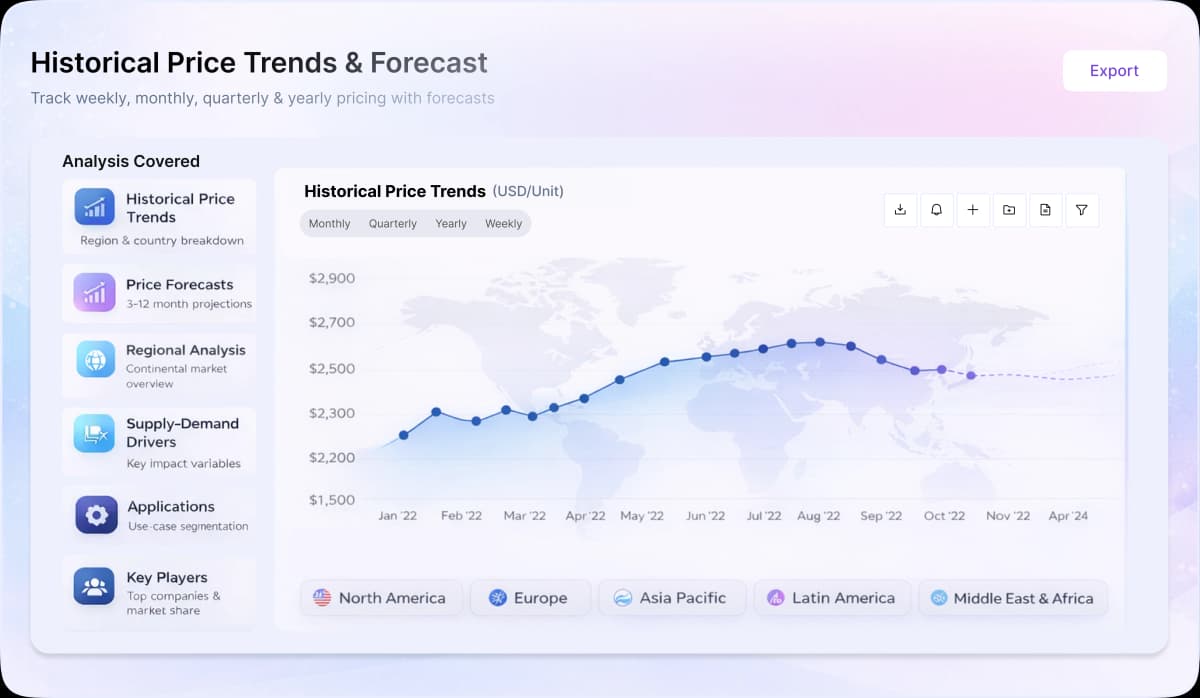
Price Trend Dashboard - What's Included
Price trends across a diverse portfolio of categories and products, spanning board to niche chemicals
Coverage extendable to grade-specific chemicals based on procurement requirements
Regular price tracking supported by robust historical datasets
News, policy updates, and key market drivers impacting price movements
Short-term and long-term price outlooks and forecasts
Supply-demand dynamics and capacity-driven market analysis