Udeesha Tomar
AVP - Strategy and Solutions
Leading procurement research solutions across chemicals, materials, and food & beverages, with expertise in price forecasting and market analytics.
Asia
In Asia, chloroform prices gained support during Q1’26 despite softer feedstock conditions. In India, chlorine, a primary feedstock, declined by ~0.90% from January to March and ~2.00% from the previous quarter, reflecting weak demand from PVC and construction-linked sectors. However, chloroform market sentiment improved due to stronger methanol costs, lower import availability, and constrained regional production. China’s chloroform trade flows showed imports falling sharply, while exports improved year on year during January-February, indicating tighter domestic availability and better overseas movement. Downstream demand from refrigerant production, pharmaceutical solvents, and fluorochemical intermediates supported regional consumption.
Europe
In Europe, chloroform prices remained firm during Q1’26 as energy-intensive chemical production faced higher operating costs. Chlorine, a primary feedstock, stayed supported by elevated energy costs, supply issues, and reduced competitiveness against Asian cargoes affected by trade disruptions. The Iran war and Strait of Hormuz closure increased freight, insurance, and delivery risks, raising landed-cost pressure for chemical imports. Demand from refrigerants, specialty solvents, and pharmaceutical applications remained steady, allowing producers to maintain firm offers despite weaker construction-linked chemical consumption.
North America
In North America, chloroform prices followed a firm trend in Q1’26, supported by tighter global chemical availability and higher logistics costs. The upstream market was supported by reduced global production, lower imports, and stronger overseas demand for US chlor-alkali products. Supply disruptions in Asia and Europe increased reliance on North American material, strengthening regional export interest. Chloroform demand from refrigerants, agrochemical intermediates, fluorochemicals, and pharmaceuticals remained stable, supporting market firmness.
Analyst Insight
According to Procurement Resource, chloroform prices are expected to remain firm if freight disruptions, energy costs, and feedstock pressure persist. Stable demand from refrigerants and pharmaceutical applications may continue to support the market.
Related Report
Get real-time price assessments, periodic trends, forecasts and price driver insights across key global markets.
Unlock Price Insights NowOur Clients

Turn price intelligence into action with the Procurement Resource Database. Log in or subscribe to unlock live price trends, historical charts, supplier databases, cost curves, and analyst-backed insights across chemicals, agriculture, energy, packaging, and more. Use these tools to benchmark your contracts, plan budgets with confidence, and stay ahead of market moves on every product you buy.

0
+Products
0
+Regions
0
+Subscriptions
Asia
In Q4 2025, chloroform prices in Asia showed mixed movement. In the Chinese market, the prices of chloroform went down during October, as the demand from major downstream industries remained low. Similarly, the pharmaceutical industry was buying cautiously, and the demand for R22 refrigerant went down after the summer season came to a close. At the same time, the level of local production remained high, hence reducing the need to import the chemical, thereby keeping the supply levels comfortable. Therefore, the prices went down in the Chinese market.
On the other hand, in the South Korean market, the prices of chloroform remained stable in Q4’25. The level of production remained steady, and the inventory level, as well as trading activities, were normal in the market. Therefore, the overall sentiment in the South Korean market was said to be neutral, hence keeping the prices stable in the Asian market.
Europe
In the European region, the prices of chloroform were steady in Q4’25. There was enough supply in the market, and producers were running at a steady pace. Demand from the pharmaceutical industry and other uses of refrigerants was steady, though not robust enough to drive prices up. Buying activities were normal, and there was no indication of stockpiling. Everything was normal in the European chloroform market, including opportunities for arbitrageurs to make money. The prices were steady, indicating a balance between supply and demand, and there was little fluctuation in the prices of the chemical in the European region, compared to other months of the year, in which there was a lot of fluctuation in the prices of the chemical.
North America
In North America, especially in the United States, chloroform prices stayed flat in Q4’25 after several weeks of earlier declines. Production remained disciplined, and stock levels were comfortable. Demand from refrigerant and chemical sectors was stable, although not particularly strong. Market participants focused on maintaining steady contract flows rather than expanding spot activity. Limited trading opportunities and balanced fundamentals supported price stability. Overall, the region experienced a quiet and controlled market environment.
Chloroform is basically a colourless, volatile, liquid derivative of trichloromethane with an ether-like odour. Earlier it was utilised as an inhaled anaesthetic during surgery, but the primary use of chloroform today is in industries, where it is widely utilised as a solvent. It is majorly produced as a precursor to PTFE (polytetrafluoroethylene). It is one of the four chloromethanes and a trihalomethane. It is a powerful anaesthetic and sedative when inhaled or ingested.

CHCl3
Solvents, Reagent, Functional fluids, Fluorinated refrigerants and fluorinated resins, Intermediates, Extraction and purification of antibiotics, Laboratory chemicals
Trichloromethane, Methane Trichloride, TCM, Freon 20, Refrigerant-20
PJSC Khimprom, Merck KGaA, Shin-Etsu Chemical Co., Ltd, Alfa Aesar, Thermo Fisher Scientific Inc.
CurrencyUS$ (Data can also be provided in local currency)
Supplier Database AvailabilityYes
Customization ScopeThe report can be customized as per the requirements of the customer
Post-Sale Analyst Support360-degree analyst support after report delivery
Note: Our supplier search experts can assist your procurement teams in compiling and validating a list of suppliers indicating they have products, services, and capabilities that meet your company's needs.
In order to produce Chloroform, a mixture of chlorine and either chloromethane or methane is heated, which produces a free radical halogenation at 400–500 °C, transforming the precursors to more chlorinated compounds.
Further, as Chloroform undergoes chlorination to produce carbon tetrachloride, this process finally produces a mixture of four chloromethanes (chloromethane, dichloromethane, chloroform, and carbon tetrachloride), and thus, Chloroform is finally separated via distillation.
Udeesha Tomar
AVP - Strategy and Solutions
Leading procurement research solutions across chemicals, materials, and food & beverages, with expertise in price forecasting and market analytics.
Our Price Analysis Methodology

Experience how Procurement Resource transforms raw material price data into clear, decision ready intelligence. Optimise your performance with reliable, expert market data and analysis. Schedule your demo today to experience a live walk-through where our experts will showcase interactive price charts, forecasted prices, and insights driving the prices for your key commodities, tailored to your workflows. Contact us now!
Our Team will be happy to assist you
We are just a text away
Still Need Help?
The report involves the cost analysis of the production of Glycerin from plant and animal sources where it occurs in triglycerides, esters of glycerol with long-chain carboxylic acids.
This process for the production of oxygen is basically cryogenic distillation of air. It employs distillation column with the appropriate conditions.
Unlock full access to Procurement Resource's price databases, interactive charts, and short-term forecasts for thousands of commodities. Elevate your sourcing decisions by comparing prices across regions, downloading historical data, and layering in analyst-backed insights, all with our flexible plans that scale as your portfolio grows.
Still have any Questions
Contact Us


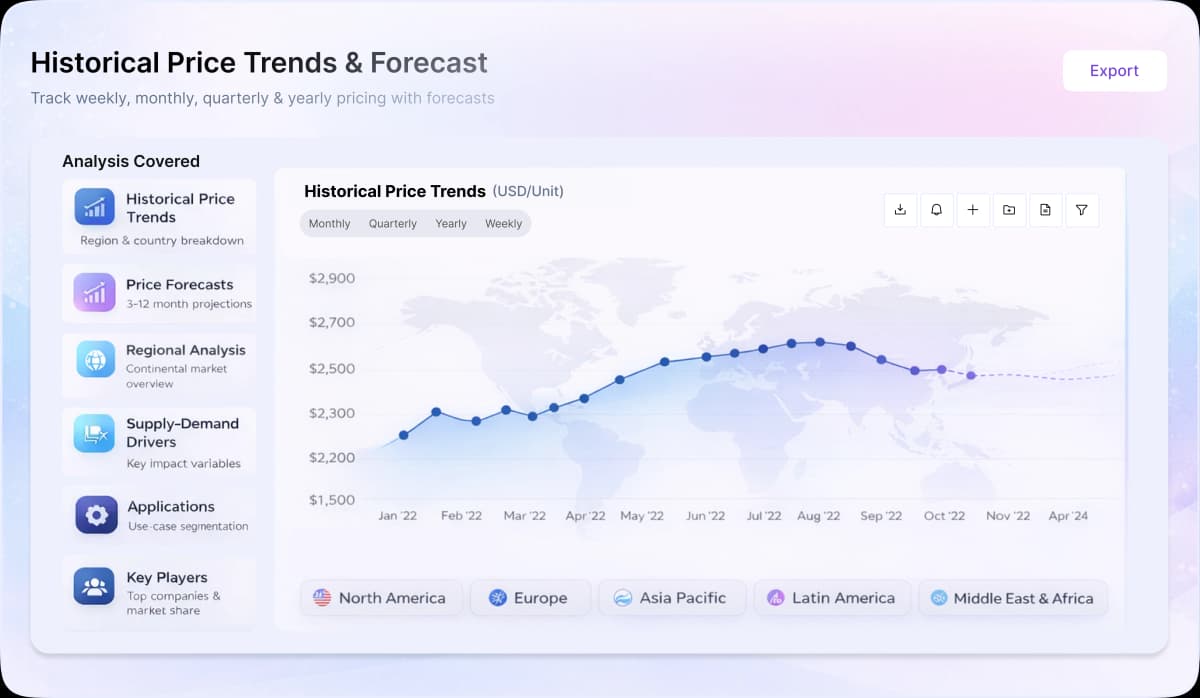
Price Trend Dashboard - What's Included
Price trends across a diverse portfolio of categories and products, spanning board to niche chemicals
Coverage extendable to grade-specific chemicals based on procurement requirements
Regular price tracking supported by robust historical datasets
News, policy updates, and key market drivers impacting price movements
Short-term and long-term price outlooks and forecasts
Supply-demand dynamics and capacity-driven market analysis