Eucalyptol Price Trend Analysis 2026: Historical Prices, Latest News, Market Insights, Supply Demand Analysis & Price Drivers

Pragati Agarwal profile photo
Written ByPragati Agarwal

Procurement Resource Database

Laptop screen

Turn price intelligence into action with the Procurement Resource Database. Log in or subscribe to unlock live price trends, historical charts, supplier databases, cost curves, and analyst-backed insights across chemicals, agriculture, energy, packaging, and more. Use these tools to benchmark your contracts, plan budgets with confidence, and stay ahead of market moves on every product you buy.

0

+

Products

0

+

Regions

0

+

Subscriptions

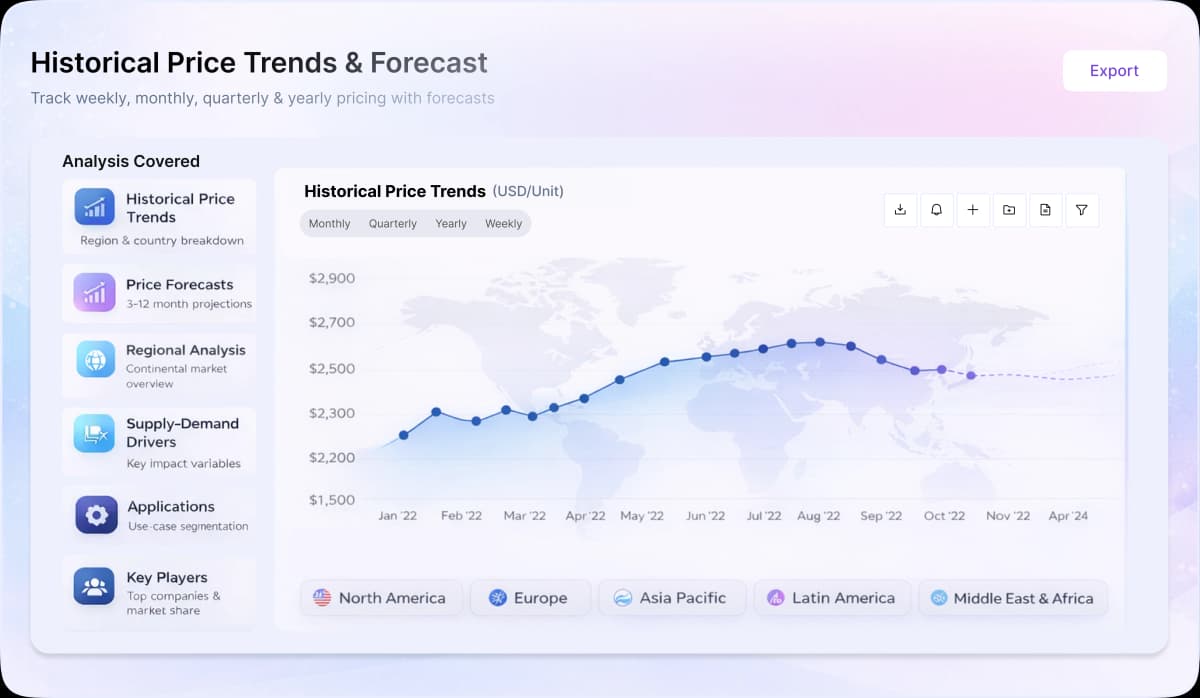
Eucalyptol prices in the second half of 2025 moved under mixed pressures. Overall agricultural and raw material markets had already shown a downward trend earlier in the year, and this created a softer tone for plant-based extracts as well.

Weak global growth and slowing activity in major emerging economies reduced buying interest for many natural ingredients, and this also weighed on demand for Eucalyptol. Trade uncertainty and rising tariffs added caution among importers, so orders were placed more selectively and shipments were timed more carefully.

At the same time, some cost pressures remained. Fertilizer prices rose during 2025 and energy markets stayed sensitive to geopolitical tensions, especially in the Middle East. Because eucalyptus cultivation depended on stable input costs, these uncertainties created occasional upward cost signals.

Heat waves and weather stress in key producing regions also raised concerns about leaf yields, which led to short-lived bouts of supply tightness. But these spikes were mostly contained because global demand stayed moderate.

As a result, Eucalyptol trends in H2’25 showed gentle fluctuations rather than strong swings softened by weak demand but occasionally supported by production and shipping risks.


About Eucalyptol

Eucalyptol, a cyclic ether and a monoterpenoid, is a natural constituent of several aromatic plants, including Salvia and Eucalyptus leaves, and their essential oil fractions. In appearance, it is a colourless liquid with fresh mint-like smell and a spicy, cooling taste. It is used in flavourings, fragrances, and cosmetics. It is widely used as an ingredient in mouthwashes and as a cough suppressant.

Eucalyptol Product Detail

Chemical Formula

C10H18O

CAS Number
470-82-6
Molecular Weight
154.249 g/mol
Industrial Uses

Air care products, Cosmetics, Flavouring and fragrance, Insecticide and repellent, Mouthwashes, Traditional medicine , Food products, Paramedical applications

Synonyms

1,3,3-Trimethyl-2-oxabicyclo [2.2.2] octane , 1,8-Cineole, Cineole, 1,8-Epoxy-p-menthane 

Supplier Database

Berjé Inc., Symerise AG, Robertet Groupe, Fleurchem, Inc., Privi Organics Pvt. Ltd.

Regional Coverage

Asia Pacific

China, India, Indonesia, Pakistan, Bangladesh, Japan, Philippines, Vietnam, Iran, Thailand, South Korea, Iraq, Saudi Arabia, Malaysia, Nepal, Taiwan, Sri Lanka, UAE, Israel, Hongkong, Singapore, Oman, Kuwait, Qatar, Australia, and New Zealand

Europe

Germany, France, United Kingdom, Italy,Spain, Russia, Turkey, Netherlands, Poland, Sweden, Belgium, Austria, Ireland Switzerland, Norway, Denmark, Romania, Finland, Czech Republic, Portugal and Greece

North America

United States and Canada

Latin America

Brazil, Mexico, Argentina, Columbia, Chile, Ecuador, and Peru

Africa

South Africa, Nigeria, Egypt, Algeria, Morocco

CurrencyUS$ (Data can also be provided in local currency)

Supplier Database AvailabilityYes

Customization ScopeThe report can be customized as per the requirements of the customer

Post-Sale Analyst Support360-degree analyst support after report delivery

Note: Our supplier search experts can assist your procurement teams in compiling and validating a list of suppliers indicating they have products, services, and capabilities that meet your company's needs.

Eucalyptol Production Process

  • Production of Eucalyptol via Fractional Distillation

Eucalyptol is obtained via fractional distillation of essential oils containing high levels of eucalyptol, often Eucalyptus globulus. In this process, Eucalyptus globulus undergoes fractional distillation and Eucalyptol is obtained after its separation by congealing the distillate.

Frequently Asked Questions

The eucalyptol outlook for 2026 points to moderate, range-bound prices. Steady downstream demand from personal care and pharmaceutical segments will be offset by cautious, hand-to-mouth buying amid subdued industrial activity and trade-policy uncertainty in major importing economies. Weather disruption to eucalyptus yields poses the main upside risk. Feedstock availability will stay uneven as the structural shift away from monoculture plantations in South and Southeast Asia sustains raw material tightness, though expanded plantation capacity in Latin America and East Asia provides a partial offset. Logistics costs will temper downward price movement.
Eucalyptol prices reflect competing supply and demand forces. A structural shift away from monoculture plantations toward native species in South and Southeast Asian eucalyptus-growing regions can constrain raw material availability, sustaining feedstock tightness and price support. Expanded plantation capacity in Latin America and East Asia can moderate supply, though elevated logistics costs tend to temper downward movement. Steady consumption from personal care and pharmaceutical buyers provides a firm baseline, while subdued industrial activity and trade-policy uncertainty can keep broader buying cautious. Weather disruption to eucalyptus yields remains a key upside risk.
The eucalyptol market is shaped by a split supply picture. South and Southeast Asian producers face constrained eucalyptus cultivation as plantations shift away from monoculture, tightening feedstock availability. Latin America and East Asia have expanded plantation capacity, helping moderate overall supply. Key companies active in the market include Berjé Inc., Symerise AG, Robertet Groupe, Fleurchem Inc., and Privi Organics Pvt. Ltd., who serve as the primary trading and distribution links across the value chain. Asia's structural feedstock tightness is the main concentration risk for supply security.
Eucalyptol is sourced from Eucalyptus globulus leaves, whose essential oil naturally contains 70-90% eucalyptol. The production route begins with treating eucalyptus oil with phenol, followed by reduced-pressure rectification to obtain kettle bottom liquid. Normal-pressure rectification of the diluted kettle bottom liquid yields a eucalyptol-water azeotrope, from which water is removed and the residue dried to produce pure eucalyptol. The finished product supplies downstream markets including pharmaceuticals, cosmetics, oral care, food and beverage flavoring, and aromatherapy.
Eucalyptol demand is driven by several downstream industries. Pharmaceuticals and OTC respiratory medications consume the largest share, as rising cases of asthma, COPD, and rhinosinusitis sustain steady offtake. Cosmetics and personal care products leverage its antimicrobial and anti-inflammatory properties, with growing consumer preference for natural ingredients adding momentum. The food and beverage sector uses eucalyptol as a clean-label flavoring agent, while the aroma chemicals and fragrance industry absorbs it into air care and perfumery. Insect repellent manufacturers also contribute, as eucalyptol serves as a natural active ingredient.
Eucalyptol is supplied as a colourless liquid with a fresh mint-like smell and spicy, cooling taste, with the molecular formula C10H18O and molecular weight 154.25 g/mol. It is classified as GRAS by the USFDA for food use. The compound is also known commercially as 1,8-cineole, cineole, 1,8-epoxy-p-menthane, and cajeputol. It constitutes 70 to 90% of Eucalyptus globulus essential oil. These specifications underpin its suitability across pharmaceutical, food, cosmetic, and fragrance applications, where purity and natural origin drive procurement decisions.
Procurement Resource assesses eucalyptol prices through a structured, data-driven methodology combining primary engagement with producers, suppliers and traders, secondary market data, monitoring of feedstock and input costs, trade-flow and inventory tracking, and exchange or spot benchmarks. Each assessment is validated and translated into a transparent price outlook. The detailed methodology is available on the Procurement Resource website.

Our Price Analysis Methodology

About the Author

Pragati Agarwal profile photo

Pragati Agarwal

Senior Business Insights Analyst

Delivering price trend analysis and procurement market insights at Procurement Resource, with expertise in identifying commodity patterns, supporting purchasing strategies, and improving cost efficiency through actionable market intelligence.

Schedule Demo

Schedule A Demo

Experience how Procurement Resource transforms raw material price data into clear, decision ready intelligence. Optimise your performance with reliable, expert market data and analysis. Schedule your demo today to experience a live walk-through where our experts will showcase interactive price charts, forecasted prices, and insights driving the prices for your key commodities, tailored to your workflows. Contact us now!


Our Team will be happy to assist you

We are just a text away

+1

Still Need Help?

Europe & Africa

+44 7573 171117

[email protected]

USA & Canada

+1 307 363 1045

[email protected]

APAC

+91 8850629517

[email protected]

Other Related Reports

Syngas Production from Fuel Oil (heavy hydrocarbons)

This report presents a cost analysis of syngas production from heavy fuel (heavy hydrocarbons)

LPG Production from Crude Oil

This report provides the cost structure of LPG production by the petroleum refining process. In this process, the crude oil recovered is separated into oil and wet gas via a gas trap.

Orange Oil Production by Cold Pressing

This report provides the cost structure of production of Orange oil by cold pressing method. After the extraction of juice from orange, the peels of the fruit are cold pressed for extraction of oil.

Ammonia Production from Heavy Oils

This report provides the economy of producing ammonia by partial oxidation method.

Unlock full access to Procurement Resource's price databases, interactive charts, and short-term forecasts for thousands of commodities. Elevate your sourcing decisions by comparing prices across regions, downloading historical data, and layering in analyst-backed insights, all with our flexible plans that scale as your portfolio grows.

Still have any Questions

Contact Us
Mastercard
Wire
VISA
Stripe

Related News

View All

Why Procurement Database

Commodity Market Intelligence

Commodity Market Intelligence

Track prices, market movements, supply-demand dynamics, and industry developments across hundreds of commodities through a centralized intelligence platform built for informed procurement decisions.

Price Forecasts & Market Outlooks

Price Forecasts & Market Outlooks

Understand market fluctuations using analyst-backed forecasts, historical pricing patterns, and evolving industry trends to strengthen sourcing strategies and budget planning.

Cost & Procurement Optimization

Cost & Procurement Optimization

Leverage cost models, pricing benchmarks, and procurement insights to evaluate purchasing opportunities, improve negotiations, and enhance operational efficiency.

Global & Regional Market Insights

Global & Regional Market Insights

Access region-specific price trends, trade activities, capacity changes, and supply chain developments influencing commodity markets worldwide.

1/4