Need latest Heptanoic Acid prices?
Get real-time price assessments, periodic trends, forecasts and price driver insights across key global markets.
Unlock Price Insights NowOur Clients
Asia
In Asia, Heptanoic Acid prices remained mostly stable during Q4’25. Demand from cosmetics, personal care, and chemical industries was steady, with buyers purchasing mainly for operational needs rather than speculative stockpiling. Indian castor oil, a key raw material, maintained predictable pricing, which helped producers control costs and avoid sudden price changes. Seasonal production patterns and cautious purchasing behaviour kept market activity calm. Overall, the region saw only minor fluctuations in prices, reflecting a balanced market with adequate availability of Heptanoic Acid.
Europe
In Europe, the Heptanoic Acid market showed slight firmness through Q4’25. Demand from fragrance and specialty chemical sectors remained consistent, and buyers placed regular orders for planned production cycles. European manufacturers focused on maintaining steady supplies and inventories, which limited abrupt price movements. The influence of global castor oil prices was reflected indirectly, as any major changes upstream could have affected local costs, but during this quarter, stability prevailed. Prices moved in a narrow range, supported by controlled purchasing and predictable market conditions.
North America
In North America, Heptanoic Acid prices saw moderate upward pressure in Q4’25. Cosmetic and personal care producers maintained steady demand, especially for products aimed at year-end and holiday markets. Buyers managed inventories carefully, which prevented large spikes in pricing. Producers were able to operate smoothly without major interruptions, and price increases were gradual. Overall, market sentiment remained positive, with prices reflecting steady demand rather than supply shortages or speculative buying.
Analyst Insight
According to Procurement Resource, Heptanoic Acid prices are expected to remain stable to slightly firm, supported by continued steady demand from cosmetic, fragrance, and chemical industries, with no major issues in feedstock availability.
Related Report
Get real-time price assessments, periodic trends, forecasts and price driver insights across key global markets.
Unlock Price Insights NowOur Clients

Turn price intelligence into action with the Procurement Resource Database. Log in or subscribe to unlock live price trends, historical charts, supplier databases, cost curves, and analyst-backed insights across chemicals, agriculture, energy, packaging, and more. Use these tools to benchmark your contracts, plan budgets with confidence, and stay ahead of market moves on every product you buy.

0
+Products
0
+Regions
0
+Subscriptions
Asia
In Asia, the Heptanoic Acid market remained mostly subdued throughout the first half of 2025. The year started with low industrial activity, and the usual slowdown around the Lunar New Year further dampened trade. Demand from downstream sectors such as lubricants and specialty esters was limited, while supply remained sufficient.
Exporters faced stiff competition within the region, leading to cautious pricing strategies. Many buyers avoided large purchases, anticipating more supply in the near future due to new production developments overseas. Despite brief periods of stable inquiries, overall market sentiment stayed weak.
Europe
Europe experienced more fluctuation in Heptanoic Acid pricing. In early 2025, prices were supported by steady demand from performance materials, aviation, and cosmetics sectors. Temporary supply concerns and inventory restocking added to the upward pressure. However, by March, improved availability and easing logistics reduced urgency among buyers.
A key shift occurred when OQ Chemicals announced it would begin local production in Germany by June. This news caused many buyers to hold off on bulk orders, expecting better availability and potentially more competitive pricing. Once the Oberhausen facility became operational in June, confidence in local supply grew, helping to stabilize prices.
North America
In North America, Heptanoic Acid prices were mostly stable through H1’25. The year began with steady demand and manageable supply levels. However, as the quarter progressed, buyers became more conservative due to softer demand from energy and consumer sectors.
In April, OQ Chemicals introduced moderate price increases, which were gradually implemented depending on contract terms. While some resistance was noted, the market adjusted slowly. By June, attention shifted to global developments, with importers and formulators preparing for the impact of expanded European production on future pricing.
Heptanoic Acid, an aliphatic carboxylic acid, is a colourless liquid with a pungent odour. It is poorly miscible in water and is found to float on it as it is less dense than water. The product is a conjugate acid of a heptanoate. It has a flash point of about 200°F. It is a straight-chain saturated fatty acid that contributes to the preparation of esters in the fragrance industry.

C7H14O2
Synthesis of esters, Flavour and fragrance agents, Additive in cigarettes, Drugs and nutritional supplements, Intermediates, Corrosion inhibition, Lubricants, Floor coverings, Paints and coatings
Enanthic acid, n-Heptanoic acid, Oenanthic acid
Ernesto Ventós, S.A, Arkema S.A, OXEA GmbH, Kalpsutra Chemicals Pvt. Ltd., Toronto Research Chemicals Inc, IOI Oleo GmbH
CurrencyUS$ (Data can also be provided in local currency)
Supplier Database AvailabilityYes
Customization ScopeThe report can be customized as per the requirements of the customer
Post-Sale Analyst Support360-degree analyst support after report delivery
Note: Our supplier search experts can assist your procurement teams in compiling and validating a list of suppliers indicating they have products, services, and capabilities that meet your company's needs.
In order to produce Heptanoic Acid from castor oil, the decomposition of esters obtained from castor oil takes place. In this process, the castor oil acid methyl ester decomposition is carried out in the presence of water vapour at 500-600°C to form oenanthal (heptanal) along with undecanoic acid methyl ester. After this, oenanthal is oxidised to produce Heptanoic Acid as the final product.
Our Price Analysis Methodology

Experience how Procurement Resource transforms raw material price data into clear, decision ready intelligence. Optimise your performance with reliable, expert market data and analysis. Schedule your demo today to experience a live walk-through where our experts will showcase interactive price charts, forecasted prices, and insights driving the prices for your key commodities, tailored to your workflows. Contact us now!
Our Team will be happy to assist you
We are just a text away
Still Need Help ?
Milk is acidified using acids like dilute hydrochloric acid or sulfuric acid, until the isoelectric point of casein is achieved.
The report is a detailed study of economics of production of oxalic acid by the reaction of nitric acid with glucose/ sugar.
This report revolves around the production of acetic acid using butane. Butane is oxidized using air as an oxygen source in the presence of metal catalysts such as cobalt acetate, at a temperature of 110–120 °C and a pressure of 60 atm.
Unlock full access to Procurement Resource's price databases, interactive charts, and short-term forecasts for thousands of commodities. Elevate your sourcing decisions by comparing prices across regions, downloading historical data, and layering in analyst-backed insights, all with our flexible plans that scale as your portfolio grows.
Still have any Questions
Contact Us


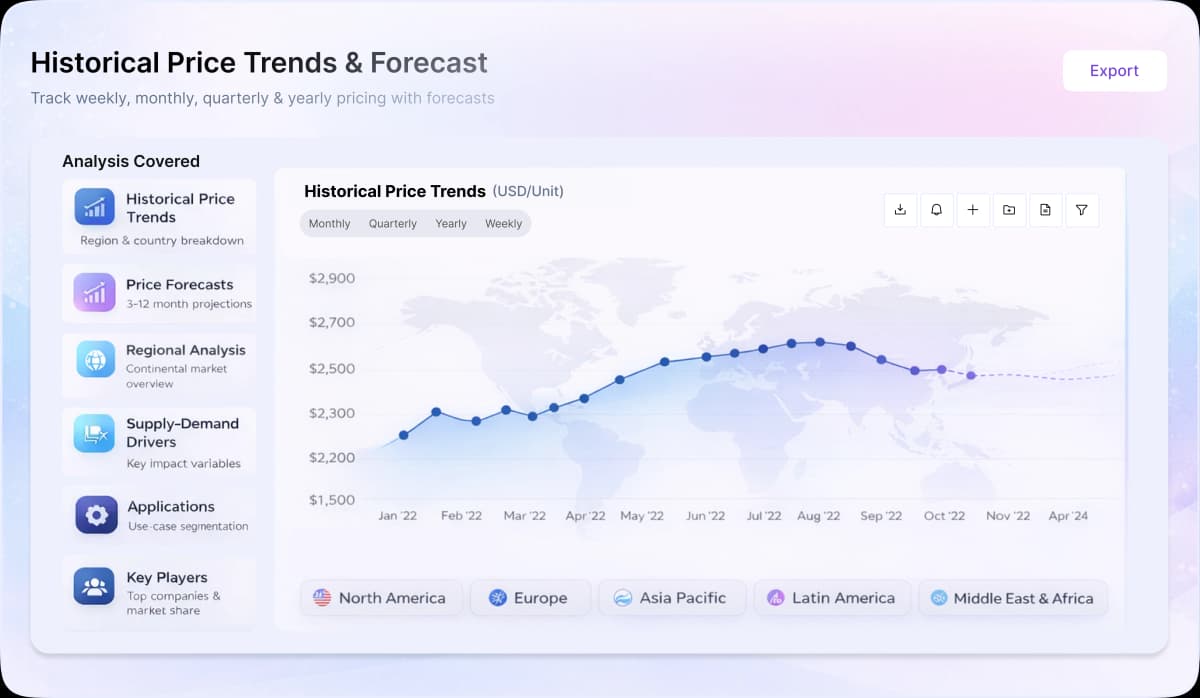
Price Trend Dashboard - What's Included
Price trends across a diverse portfolio of categories and products, spanning board to niche chemicals
Coverage extendable to grade-specific chemicals based on procurement requirements
Regular price tracking supported by robust historical datasets
News, policy updates, and key market drivers impacting price movements
Short-term and long-term price outlooks and forecasts
Supply–demand dynamics and capacity-driven market analysis