Hexyl Salicylate Price Trend Analysis 2026: Historical Prices, Market Insights, Latest News, Price Drivers & Supply Demand Analysis

Pragati Agarwal profile photo
Written ByPragati Agarwal

Procurement Resource Database

Laptop screen

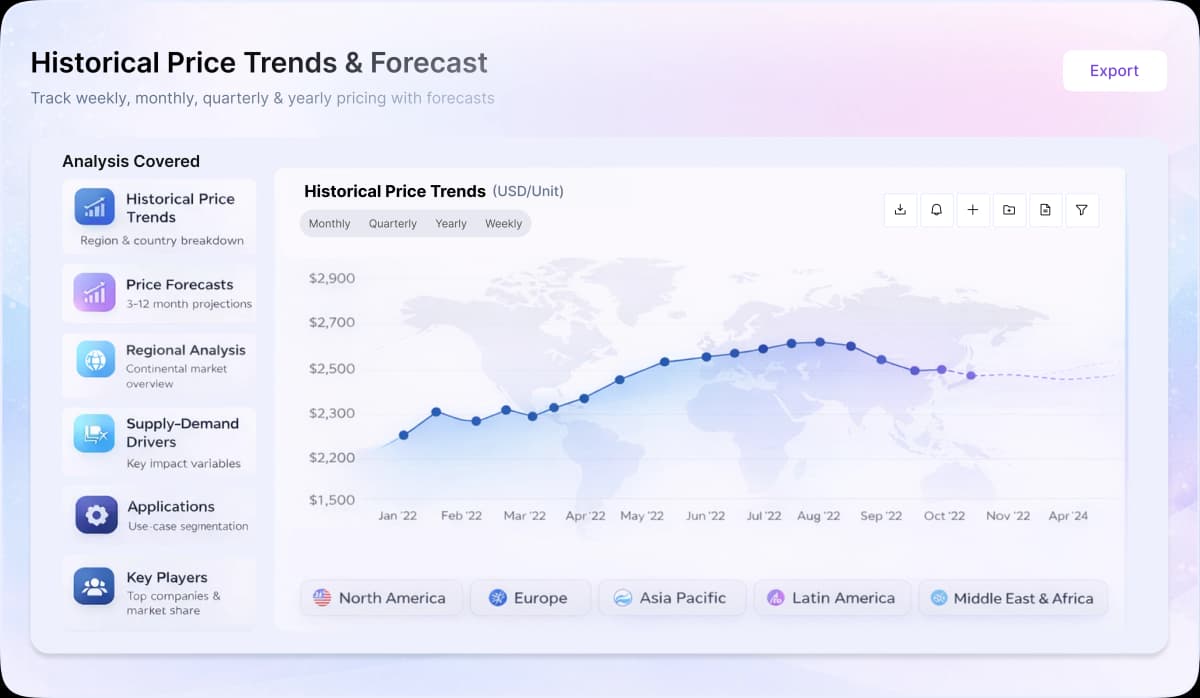
Turn price intelligence into action with the Procurement Resource Database. Log in or subscribe to unlock live price trends, historical charts, supplier databases, cost curves, and analyst-backed insights across chemicals, agriculture, energy, packaging, and more. Use these tools to benchmark your contracts, plan budgets with confidence, and stay ahead of market moves on every product you buy.

0

+

Products

0

+

Regions

0

+

Subscriptions

Asia

In Asia, Hexyl Salicylate prices showed a mostly stable to slightly firm trend during Q4’25. Demand from the personal care and fragrance sectors remained steady, supported by ongoing production of cosmetics, soaps, and skin care products. However, buying activity stayed cautious, as many manufacturers preferred small purchases due to slow overall economic growth. On the supply side, feedstocks such as hexene remained widely available, which helped keep production running smoothly. Weak downstream momentum in some industrial sectors limited sharp price gains, resulting in balanced market conditions for most of the quarter.

Europe

In Europe, Hexyl Salicylate prices remained largely stable in Q4’25 with mild upward pressure. Demand was supported by consistent output from the fragrance, beauty, and home care industries, especially toward the year-end festive season. The presence of well-managed inventories and reliable feedstock availability kept supply conditions comfortable. However, higher operating and compliance costs led producers to maintain firm pricing positions. Buyers continued to place planned orders rather than aggressive restocking, which kept price movements controlled rather than volatile.

North America

In North America, Hexyl Salicylate prices followed a firm trend through Q4’25. Strong demand from the personal care and cosmetics segment supported consumption, driven by steady sales of premium beauty and hygiene products. Feedstock markets such as hexene remained firm but stable, allowing producers to maintain consistent operating rates. The absence of major production disruptions and well-integrated supply chains helped prevent supply shortages. As a result, prices strengthened gradually rather than sharply, reflecting confidence in demand rather than tight supply.


About Hexyl Salicylate

Hexyl Salicylate belongs to the class of organic compounds called as benzoic acid esters. These can be referred to as ester derivatives of benzoic acid. It has mild, herbal, floral fragrance, possessing typical salicylate characteristic. It is widely used as a blending agent owing to its excellent blending properties. It serves as a useful modifier of floral fragrances particularly with amyl salicylate.

Hexyl Salicylate Product Detail

Chemical Formula

C13H18O3

CAS Number
6259-76-3
Molecular Weight
222.28 g/mol
Industrial Uses

Odour Agent, Air Care Products, Cleaning and Furnishing Care Products, Laundry and Dishwashing Products, Personal Care Products

Synonyms

Hexyl 2-hydroxybenzoate, Hexyl salicylic acid  , n-hexyl salicylate, Benzoic acid, 2-hydroxy-, Hexyl Ester

Supplier Database

Berjé Inc, Azelis Deutschland GmbH, Zhejiang Xinhua Chemical Co, Ltd., Ernesto Ventós, S.A, Vigon International, Inc.

Regional Coverage

Asia Pacific

China, India, Indonesia, Pakistan, Bangladesh, Japan, Philippines, Vietnam, Iran, Thailand, South Korea, Iraq, Saudi Arabia, Malaysia, Nepal, Taiwan, Sri Lanka, UAE, Israel, Hongkong, Singapore, Oman, Kuwait, Qatar, Australia, and New Zealand

Europe

Germany, France, United Kingdom, Italy,Spain, Russia, Turkey, Netherlands, Poland, Sweden, Belgium, Austria, Ireland Switzerland, Norway, Denmark, Romania, Finland, Czech Republic, Portugal and Greece

North America

United States and Canada

Latin America

Brazil, Mexico, Argentina, Columbia, Chile, Ecuador, and Peru

Africa

South Africa, Nigeria, Egypt, Algeria, Morocco

CurrencyUS$ (Data can also be provided in local currency)

Supplier Database AvailabilityYes

Customization ScopeThe report can be customized as per the requirements of the customer

Post-Sale Analyst Support360-degree analyst support after report delivery

Note: Our supplier search experts can assist your procurement teams in compiling and validating a list of suppliers indicating they have products, services, and capabilities that meet your company's needs.

Hexyl Salicylate Production Processes

  • Production of Hexyl Salicylate from Hexanol and Salicylic Acid

In this process, hexanol reacts with salicylic acid in the presence of solvent and PTSA at reflux temperature to separate and remove water azeotropically, where total hexanol gets converted into Hexyl salicylate (solution).

The obtained solution is cooled up to room temperature and washed with alkaline water up to neutral pH, thus separating organic layer (Hexyl salicylate) and aqueous water layer (effluent water). Finally, pure Hexyl salicylate is obtained by distilleting crude hexyl salicylate under vacuum.

Frequently Asked Questions

The hexyl salicylate outlook for 2026 points to broadly stable prices, with any upside expected to be gradual and demand-driven. Downstream demand from cosmetics, fine perfumes, soaps, and sunscreen lotions will be the primary price catalyst, while feedstock costs for hexanol and salicylic acid and their availability will shape the supply side. A sustained pickup in fragrance and personal care orders could push prices higher, but restrained buying from downstream producers amid macro uncertainty or adequate feedstock supply would keep a lid on gains.

Hexyl salicylate prices are shaped by seasonal buying patterns and downstream demand momentum. In Asia, seasonal restocking ahead of the Lunar New Year by Chinese and Indian manufacturers typically provides early support, though momentum can fade if downstream cosmetics and fragrance producers curtail new orders amid macro uncertainty. In North America, demand growth tends to reflect the broader consumer backdrop alongside gradual inventory normalization. Feedstock availability generally stays adequate, limiting cost-driven upside.

China and India are the principal manufacturing bases for hexyl salicylate, with Zhejiang Xinhua Chemical Co., Ltd. identified as a key producer. On the trading side, Berjé Inc and Vigon International, Inc. serve North America, while Azelis Deutschland GmbH and Ernesto Ventós, S.A. are active in Europe. Production is concentrated in Asia, but distribution is spread across multiple regions, meaning any supply disruption at a small number of Asian manufacturing sites could have outsized effects on global availability.

Hexyl salicylate is naturally present in Vanilla planifolia. Commercially, it is produced via esterification of salicylic acid with n-hexanol, catalysed by a strong acid such as sulfuric acid or PTSA at reflux, with water removed azeotropically. The crude solution is cooled, washed with alkaline water to neutral pH, and the organic layer is separated to yield the final ester. An alternative route uses methyl salicylate via transesterification. The finished product is used as a fragrance modifier in perfumes, cosmetics, shampoos, soaps, lotions, deodorants, and household detergents.

Hexyl Salicylate demand is driven primarily by the fragrance and personal care industries for its sweet, floral-fruity scent. Cosmetics manufacturers use it across decorative cosmetics, shampoos, fine fragrances and toilet soaps, while personal care producers incorporate it in moisturizers, body washes, antiperspirants and hair serums. Household cleaning and laundry makers add it to detergents, air care and dishwashing formulations. Sunscreen and skincare producers use it as a fragrance note and for UV-related applications.

Hexyl salicylate is sold as a clear, colorless to pale yellow liquid at approximately 98% purity or higher. The two main commercial grades are perfumery grade and functional fragrance grade. Perfumery grade demands tight control over trace color, acid value, and heavy ends through careful reaction management and reduced-pressure finishing, serving fine fragrance, cosmetics, and toiletries. Functional fragrance grade is formulated for household products such as detergents, soaps, and cleaners, where cost, color consistency, and lot repeatability matter more than premium odor profile.

Procurement Resource assesses hexyl salicylate prices through a structured, data-driven methodology combining primary engagement with producers, suppliers and traders, secondary market data, continuous monitoring of feedstock and input costs, trade-flow and inventory tracking, and exchange or spot benchmarks. These inputs are validated and translated into a transparent price assessment and outlook. The detailed methodology is available on the Procurement Resource website.

Our Price Analysis Methodology

About the Author

Pragati Agarwal profile photo

Pragati Agarwal

Senior Business Insights Analyst

Delivering price trend analysis and procurement market insights at Procurement Resource, with expertise in identifying commodity patterns, supporting purchasing strategies, and improving cost efficiency through actionable market intelligence.

Schedule Demo

Schedule A Demo

Experience how Procurement Resource transforms raw material price data into clear, decision ready intelligence. Optimise your performance with reliable, expert market data and analysis. Schedule your demo today to experience a live walk-through where our experts will showcase interactive price charts, forecasted prices, and insights driving the prices for your key commodities, tailored to your workflows. Contact us now!

Our Team will be happy to assist you

We are just a text away

+1

Still Need Help?

Europe & Africa

+44 7573 171117

[email protected]

USA & Canada

+1 254 254 1750

[email protected]

APAC

+91 8850629517

[email protected]

Other Related Reports

2-Ethylhexyl Acrlylate Production from Acrylic Acid and 2-Ethylhexanol via Esterification

This report presents a detailed cost analysis of 2-Ethylhexyl Acrylate preparation from acrylic acid and 2-ethylhexanol through the process of esterification.

Unlock full access to Procurement Resource's price databases, interactive charts, and short-term forecasts for thousands of commodities. Elevate your sourcing decisions by comparing prices across regions, downloading historical data, and layering in analyst-backed insights, all with our flexible plans that scale as your portfolio grows.

Still have any Questions

Contact Us
Mastercard
Wire
VISA
Stripe

Related News

View All

Why Procurement Database

Commodity Market Intelligence

Commodity Market Intelligence

Track prices, market movements, supply-demand dynamics, and industry developments across hundreds of commodities through a centralized intelligence platform built for informed procurement decisions.

Price Forecasts & Market Outlooks

Price Forecasts & Market Outlooks

Understand market fluctuations using analyst-backed forecasts, historical pricing patterns, and evolving industry trends to strengthen sourcing strategies and budget planning.

Cost & Procurement Optimization

Cost & Procurement Optimization

Leverage cost models, pricing benchmarks, and procurement insights to evaluate purchasing opportunities, improve negotiations, and enhance operational efficiency.

Global & Regional Market Insights

Global & Regional Market Insights

Access region-specific price trends, trade activities, capacity changes, and supply chain developments influencing commodity markets worldwide.

1/4