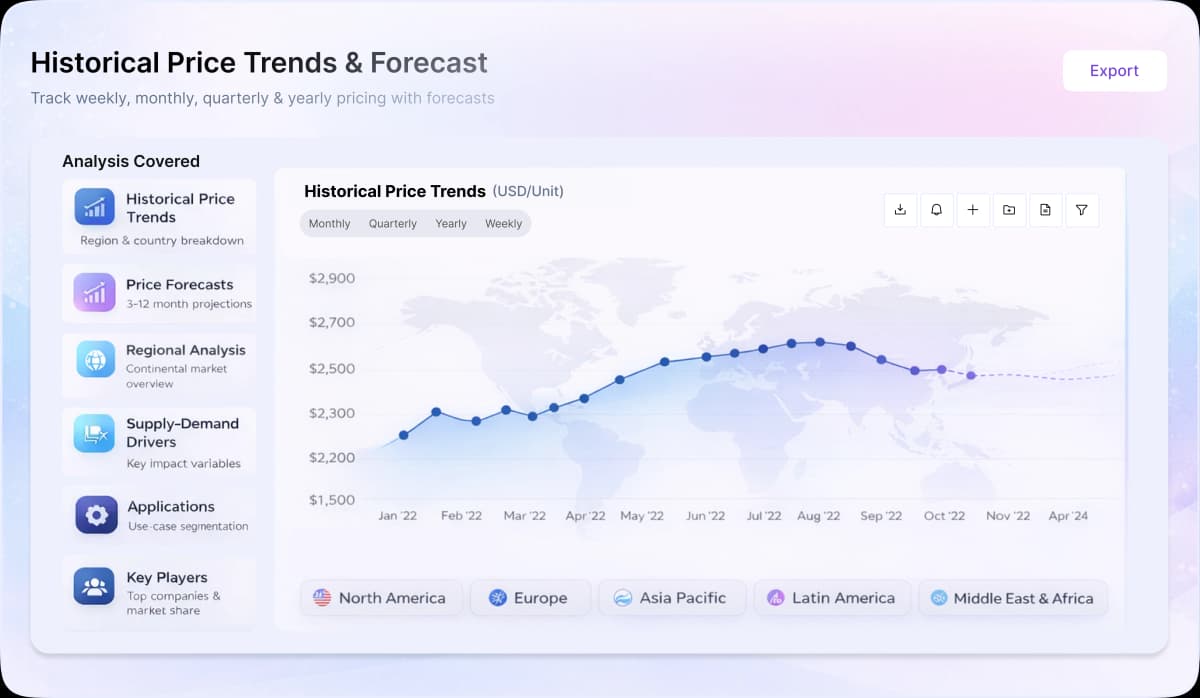
High Tech Factory Construction Cost Price Trend Analysis 2026: Historical Prices, Market Insights, Price Drivers, Latest News & Supply Demand Analysis

Shriya Singh profile photo
Written ByShriya Singh

Procurement Resource Database

Laptop screen

Turn price intelligence into action with the Procurement Resource Database. Log in or subscribe to unlock live price trends, historical charts, supplier databases, cost curves, and analyst-backed insights across chemicals, agriculture, energy, packaging, and more. Use these tools to benchmark your contracts, plan budgets with confidence, and stay ahead of market moves on every product you buy.

0

+

Products

0

+

Regions

0

+

Subscriptions

The fourth quarter of 2025 brought sustained cost pressure to high-tech factory construction projects as multiple challenges converged simultaneously. Material expenses remained elevated throughout the period, with steel and aluminium tariffs reaching historic highs that significantly impacted project budgets. These tariffs, combined with ongoing supply chain disruptions, forced developers to reconsider timelines and financial projections. Many planned factory constructions start were abandoned or postponed as economic viability weakened under rising input costs. 

Labor shortages intensified during the quarter, driving wages upward and creating scheduling bottlenecks for specialized trades essential to advanced manufacturing facilities. This talent squeeze pushed overall labor costs higher while extending project timelines considerably. 

The surge in interest rates throughout 2025 added financing challenges that compounded construction cost pressures. Developers faced difficult decisions about whether to proceed with fixed-price contracts that exposed them to material cost volatility, or negotiate escalation clauses that transferred risk to project owners. The combination of expensive materials, scarce labor, and cautious financing conditions made high-tech factory construction notably more expensive and complex than in previous years. 

About High Tech Factory Construction Cost

High-Tech Factory (Laboratory) construction cost can be 5 times the cost of building and operating any other factory unit. The premium for such a new laboratory construction can be significantly high. These Laboratories also have very high annual energy cost. These high operating costs are the result of high energy requirement for ventilation purpose in laboratories.

Regional Coverage

Asia Pacific

China, India, Indonesia, Pakistan, Bangladesh, Japan, Philippines, Vietnam, Iran, Thailand, South Korea, Iraq, Saudi Arabia, Malaysia, Nepal, Taiwan, Sri Lanka, UAE, Israel, Hongkong, Singapore, Oman, Kuwait, Qatar, Australia, and New Zealand

Europe

Germany, France, United Kingdom, Italy,Spain, Russia, Turkey, Netherlands, Poland, Sweden, Belgium, Austria, Ireland Switzerland, Norway, Denmark, Romania, Finland, Czech Republic, Portugal and Greece

North America

United States and Canada

Latin America

Brazil, Mexico, Argentina, Columbia, Chile, Ecuador, and Peru

Africa

South Africa, Nigeria, Egypt, Algeria, Morocco

CurrencyUS$ (Data can also be provided in local currency)

Supplier Database AvailabilityYes

Customization ScopeThe report can be customized as per the requirements of the customer

Post-Sale Analyst Support360-degree analyst support after report delivery


Note: Our supplier search experts can assist your procurement teams in compiling and validating a list of suppliers indicating they have products, services, and capabilities that meet your company's needs.

Frequently Asked Questions

Costs stay elevated through H1 2026 as tariff-driven spikes in structural steel and aluminium from late 2025 persist, while supply chain disruptions for precision mechanical equipment, cleanroom systems, and HVAC components hamper scheduling. Reshoring and domestic manufacturing expansion keep demand for specialist construction services ahead of supply, sustaining labor cost pressure in tight skilled-trades markets. Modestly easier financing conditions offer only limited relief. Costs are likely to stay firm on tech-sector demand and tight skilled labor, easing only if tariffs stabilize.
High-tech factory construction costs are shaped primarily by tariff regimes on structural steel and aluminium, which push materials above pre-tariff baselines. Supply chain disruptions for precision mechanical equipment, cleanroom systems, and HVAC components can delay projects across North America, Southeast Asia, and parts of Europe, while reshoring and domestic manufacturing expansion keep demand for specialist construction services ahead of supply, intensifying labor cost pressures in already tight skilled-trades markets.
Costs are benchmarked using the Producer Price Index for New Nonresidential Building Construction (186.203 as of July 2026, base June 2009=100) and the Construction Materials PPI (374.039, base 1982=100), with specialized yearbooks covering cleanrooms, semiconductor fabs, and data centers providing granular reference. Costs are assessed per square foot or, for data centers, per megawatt of IT capacity. The structure is dominated by structural commodities, including steel, aluminium, and copper, combined with precision mechanical equipment, cleanroom-grade HVAC, specialist labor, and financing costs.
High tech factory construction costs are driven primarily by tariff regimes, supply chain disruptions, and tight skilled labor. Tariffs on structural steel and aluminium push materials expenditure above pre-tariff baselines, inflating structural commodity budgets. Supply chain disruptions for precision mechanical equipment, cleanroom systems, and HVAC components add cost premiums across North America, Southeast Asia, and Europe. Reshoring and domestic manufacturing expansion keep demand for specialist services ahead of supply, intensifying labor cost pressures. Financing conditions can ease when interest rate environments moderate, providing partial offset.
Semiconductor, electronics, pharmaceutical, biotechnology, and advanced-materials manufacturers are most exposed, as their facilities demand cleanroom-grade ventilation, precision mechanical systems, and tightly controlled environments. Active capacity expansion under reshoring initiatives is pulling specialist construction services ahead of available supply, amplifying labor cost pressures already strained by years of skilled-trades shortages. Elevated tariffs on structural steel and aluminium keep materials expenditure above pre-tariff baselines, compounding the pressure on capital budgets across these sectors.

Tariff regimes imposed in late 2025 that pushed structural steel and aluminium costs to historic highs persisted through H1 2026, keeping materials expenditure firmly above pre-tariff baselines. Because steel and aluminium are foundational inputs for high-tech factory structural systems, these elevated import taxes directly inflated construction budgets. The effect was compounded by ongoing supply chain disruptions for precision equipment and cleanroom components, which strained project scheduling alongside the tariff-driven material cost pressure.


Regional differences in high-tech factory construction costs reflect how each market balances tariff exposure, labor availability, and supply chain access. North America faces steepest cost pressure, as tariffs on structural steel and aluminium keep materials above pre-tariff baselines, while reshoring-driven demand for specialist construction services outpaces supply. Southeast Asia and parts of Europe see elevated but lower costs, as supply chain disruptions for precision mechanical, cleanroom, and HVAC components hamper scheduling. The regional gap is approximately 15-25%, driven by freight on imported equipment, local skilled-trades wage differentials, and varying tariff structures.
Crude oil prices reach factory construction costs indirectly through energy and feedstock channels. Elevated crude drives up fuel and bunker costs for transporting steel, aluminium, and copper, while also pushing naphtha prices higher, as seen when supply disruptions push naphtha sharply above typical levels. As the primary petrochemical feedstock in Asia and Europe, a naphtha price spike raises costs for plastics, packaging, and construction materials derived from ethylene, propylene, and aromatics.
Procurement Resource assesses high tech factory construction cost trends through a structured, data-driven methodology combining primary engagement with producers, suppliers and traders alongside secondary market data. Feedstock and input costs are continuously monitored with trade-flow and inventory movements to capture shifts in equipment, materials and labor pricing. Exchange and spot benchmarks are validated into transparent, region-specific price assessments reflecting real-time market sentiment and structural cost drivers across the value chain. The detailed methodology is available on the Procurement Resource website.

Our Price Analysis Methodology

About the Author

Shriya Singh profile photo

Shriya Singh

Business Insights Analyst

Helping procurement and sourcing teams navigate complex markets through data-driven research, category intelligence, and actionable insights - with a focus on identifying market trends, analyzing supply-side developments, and delivering clear intelligence that supports informed business decisions.

Schedule Demo

Schedule A Demo

Experience how Procurement Resource transforms raw material price data into clear, decision ready intelligence. Optimise your performance with reliable, expert market data and analysis. Schedule your demo today to experience a live walk-through where our experts will showcase interactive price charts, forecasted prices, and insights driving the prices for your key commodities, tailored to your workflows. Contact us now!

Our Team will be happy to assist you

We are just a text away

+1

Still Need Help?

Europe & Africa

+44 7573 171117

[email protected]

USA & Canada

+1 307 363 1045

[email protected]

APAC

+91 8850629517

[email protected]

Unlock full access to Procurement Resource's price databases, interactive charts, and short-term forecasts for thousands of commodities. Elevate your sourcing decisions by comparing prices across regions, downloading historical data, and layering in analyst-backed insights, all with our flexible plans that scale as your portfolio grows.

Still have any Questions

Contact Us
Mastercard
Wire
VISA
Stripe

Related News

View All

Why Procurement Database

Commodity Market Intelligence

Commodity Market Intelligence

Track prices, market movements, supply-demand dynamics, and industry developments across hundreds of commodities through a centralized intelligence platform built for informed procurement decisions.

Price Forecasts & Market Outlooks

Price Forecasts & Market Outlooks

Understand market fluctuations using analyst-backed forecasts, historical pricing patterns, and evolving industry trends to strengthen sourcing strategies and budget planning.

Cost & Procurement Optimization

Cost & Procurement Optimization

Leverage cost models, pricing benchmarks, and procurement insights to evaluate purchasing opportunities, improve negotiations, and enhance operational efficiency.

Global & Regional Market Insights

Global & Regional Market Insights

Access region-specific price trends, trade activities, capacity changes, and supply chain developments influencing commodity markets worldwide.

1/4