Morpholine Price Trend Analysis 2026: Market Insights, Price Drivers, Historical Prices, Latest News & Supply Demand Analysis

Udeesha Tomar profile photo
Written ByUdeesha Tomar

Procurement Resource Database

Laptop screen

Turn price intelligence into action with the Procurement Resource Database. Log in or subscribe to unlock live price trends, historical charts, supplier databases, cost curves, and analyst-backed insights across chemicals, agriculture, energy, packaging, and more. Use these tools to benchmark your contracts, plan budgets with confidence, and stay ahead of market moves on every product you buy.

0

+

Products

0

+

Regions

0

+

Subscriptions

Asia

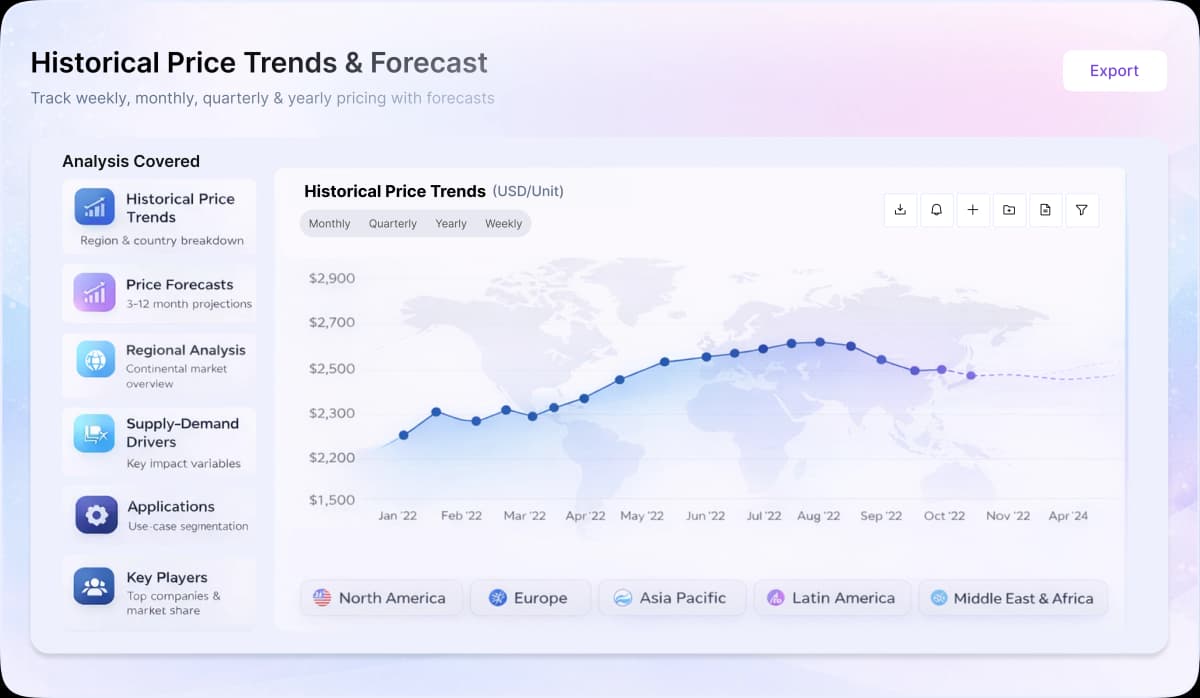
In Asia, Morpholine prices moved unevenly through 2024 as the market reacted to changing costs of feedstocks and unstable downstream demand. Early in the year, sufficient inventories and slow buying from the agrochemical and rubber sectors kept the market quiet. As energy rates climbed mid-year, production costs rose, but this support was partly offset by weak offtake from end users. China experienced periodic supply reductions due to plant turnarounds and export restrictions on several chemical intermediates, which added short bursts of firmness. However, by the last quarter, buying remained cautious because several downstream industries operated below capacity. Overall, the Asian market showed mild ups and downs, with supply constraints often countered by muted consumption.

Europe

In Europe, Morpholine prices showed mixed movement in 2024. The region faced supply disruptions at different points of the year due to maintenance shutdowns, limited import availability, and logistical issues linked to weather and geopolitical tensions. Although rising manufacturing costs occasionally pushed prices higher, this impact did not last long because industrial sentiment stayed weak particularly within coatings, textiles, and oil-field applications. Stock levels remained comfortable, and end users mostly avoided aggressive procurement. Toward the end of the year, market momentum softened further as economic uncertainty and fluctuating energy costs limited overall activity.

North America

In North America, the Morpholine market remained relatively steady with intermittent fluctuations. Fertilizer related consumption and solvents demand stayed average for most of the year, while stable natural gas prices helped keep production costs predictable. Sudden disruptions owing to hurricanes and short-term outages at upstream plants caused brief tightness, but higher local inventories and reduced export movement balanced the market again. Demand from industrial buyers remained cautious, keeping price swings contained.


About Morpholine

Morpholine, an organic chemical compound, serves as an important building block for rubber chemicals and finds a wide range of applications in other industries. This heterocycle has amine as well as ether functional groups. Morpholine is a common additive, in ppm concentrations, for pH adjustment in both fossil fuel and nuclear power plant steam systems. It is known to be a permitted (FDA) in edible coatings for fruit and vegetables.

Morpholine Product Detail

Chemical Formula

C4H9NO or O(CH2CH2)2NH

CAS Number
110-91-8
Molecular Weight
87.12g/mol
Industrial Uses

Intermediate for water treatment, Pharmaceutical, Agrocultural products, Optical brightners, Adhesives and sealant chemicals, Corrosion inhibitors and anti-scaling agents, Intermediates

Synonyms

Diethylenimide oxide, 1,4-Oxazinane, Tetrahydro-1,4-oxazine, Diethylene imidoxide, Diethylene oximide, Tetrahydro-p-oxazine

Supplier Database

BASF SE, Acros Organics, Merck KGaA, Innova Corporate (India), Acuro Organics Limited

Regional Coverage

Asia Pacific

China, India, Indonesia, Pakistan, Bangladesh, Japan, Philippines, Vietnam, Iran, Thailand, South Korea, Iraq, Saudi Arabia, Malaysia, Nepal, Taiwan, Sri Lanka, UAE, Israel, Hongkong, Singapore, Oman, Kuwait, Qatar, Australia, and New Zealand

Europe

Germany, France, United Kingdom, Italy,Spain, Russia, Turkey, Netherlands, Poland, Sweden, Belgium, Austria, Ireland Switzerland, Norway, Denmark, Romania, Finland, Czech Republic, Portugal and Greece

North America

United States and Canada

Latin America

Brazil, Mexico, Argentina, Columbia, Chile, Ecuador, and Peru

Africa

South Africa, Nigeria, Egypt, Algeria, Morocco

CurrencyUS$ (Data can also be provided in local currency)

Supplier Database AvailabilityYes

Customization ScopeThe report can be customized as per the requirements of the customer

Post-Sale Analyst Support360-degree analyst support after report delivery


Note: Our supplier search experts can assist your procurement teams in compiling and validating a list of suppliers indicating they have products, services, and capabilities that meet your company's needs.

Morpholine Production Processes

  • Production of Morpholine via Condensation

Morpholine is prepared by condensation of ethylene oxide with ammonia. It undergoes the industrial process before its commercial use.

Frequently Asked Questions

The morpholine current outlook remains subdued across regions. In Asia, prices are likely to stay range-bound as moderate demand from rubber chemicals, corrosion inhibitors, and agrochemical sectors offers limited support, with periodic supply tightness from maintenance and weather disruptions short-lived. Europe will continue under pressure from weak downstream consumption in coatings, automotive, and construction, with adequate imports and stable energy costs keeping market balanced. North America should see prices hold steady with occasional softness, as manageable natural-gas-linked feedstock costs and high inventories offset brief production outages and hurricane-season disruptions.



Morpholine prices are shaped by interacting regional drivers. In Asia, oversupply in upstream ethylene and amine markets keeps feedstock costs soft, while periodic plant maintenance and weather-related slowdowns in China create brief supply tightness quickly reversed by rebuilt inventories. In Europe, weak downstream consumption from coatings, automotive, and construction sectors reduces demand, with abundant feedstock supply keeping prices subdued despite maintenance shutdowns and port congestion.

Morpholine production is concentrated among integrated manufacturers including BASF, Huntsman Corporation, Nippon Nyukazai, and Balaji Amines, alongside Anhui Haoyuan in China. Asia Pacific and Europe are primary production hubs, while North America and Latin America rely on imports. Major consuming segments include rubber chemicals, corrosion inhibitors, and agrochemicals. This concentration, particularly BASF and Huntsman, makes supply security sensitive to plant outages, feedstock disruptions, or logistics bottlenecks.

Morpholine is produced from diethylene glycol and ammonia, combined with hydrogen using a copper, nickel, or cobalt catalyst. The mixture is heated to approximately 150 to 400 °C under pressure, and morpholine is extracted as a vapor and collected. Diethylene glycol is derived from ethylene oxide, whose cost and availability influence upstream pricing. Ammonia is sourced from nitrogen and hydrogen. The finished product is used as a corrosion inhibitor in boiler water treatment, a solvent in pharmaceutical synthesis, a vulcanization accelerator in rubber, and an additive in agrochemicals, adhesives, optical brighteners, and cleaning products.

Pharmaceutical production is a primary demand driver, as morpholine serves as a solvent in synthesizing antibiotics and anticancer agents; rising drug output tightens supply and supports pricing. Water treatment in power generation and oil and gas relies on morpholine as a corrosion inhibitor, with steady industrial activity sustaining baseline demand. Agricultural fungicide and emulsifier manufacturing creates seasonal demand spikes. Rubber and polymer industries use morpholine as a vulcanization accelerator, linking its demand to construction and automotive output.

Procurement Resource assesses morpholine price trends through a structured, data-driven methodology combining primary engagement with producers, suppliers and traders, secondary market data, monitoring of feedstock and input costs, trade-flow and inventory tracking, and exchange or spot benchmarks. The approach is validated and translated into a transparent price assessment and outlook. The detailed methodology is available on the Procurement Resource website.

Our Price Analysis Methodology

About the Author

Udeesha Tomar profile photo

Udeesha Tomar

AVP - Strategy and Solutions

Leading procurement research solutions across chemicals, materials, and food & beverages, with expertise in price forecasting and market analytics.

Schedule Demo

Schedule A Demo

Experience how Procurement Resource transforms raw material price data into clear, decision ready intelligence. Optimise your performance with reliable, expert market data and analysis. Schedule your demo today to experience a live walk-through where our experts will showcase interactive price charts, forecasted prices, and insights driving the prices for your key commodities, tailored to your workflows. Contact us now!

Our Team will be happy to assist you

We are just a text away

+1

Still Need Help?

Europe & Africa

+44 7573 171117

[email protected]

USA & Canada

+1 254 254 1750

[email protected]

APAC

+91 8850629517

[email protected]

Unlock full access to Procurement Resource's price databases, interactive charts, and short-term forecasts for thousands of commodities. Elevate your sourcing decisions by comparing prices across regions, downloading historical data, and layering in analyst-backed insights, all with our flexible plans that scale as your portfolio grows.

Still have any Questions

Contact Us
Mastercard
Wire
VISA
Stripe

Related News

View All

Why Procurement Database

Commodity Market Intelligence

Commodity Market Intelligence

Track prices, market movements, supply-demand dynamics, and industry developments across hundreds of commodities through a centralized intelligence platform built for informed procurement decisions.

Price Forecasts & Market Outlooks

Price Forecasts & Market Outlooks

Understand market fluctuations using analyst-backed forecasts, historical pricing patterns, and evolving industry trends to strengthen sourcing strategies and budget planning.

Cost & Procurement Optimization

Cost & Procurement Optimization

Leverage cost models, pricing benchmarks, and procurement insights to evaluate purchasing opportunities, improve negotiations, and enhance operational efficiency.

Global & Regional Market Insights

Global & Regional Market Insights

Access region-specific price trends, trade activities, capacity changes, and supply chain developments influencing commodity markets worldwide.

1/4