Need latest PA6 (Nylon 6) prices?
Get real-time price assessments, periodic trends, forecasts and price driver insights across key global markets.
Unlock Price Insights NowAsia
In Asia, PA6 prices kept moving downward through the second half of 2025. China showed the clearest drop, as benchmark indicators reported steady month-to-month declines. Supply stayed more than enough, and demand from key sectors like textiles, packaging, and engineering equipment remained soft.

Competition from imports and local producers continued, and buyers focused only on essential purchases. Even ongoing anti-dumping discussions in other regions did not lift sentiment in Asia. Overall, the Asian PA6 market stayed weak and heavily driven by oversupply during H2.

Europe
In Europe, PA6 stayed under pressure during H2’25. Industrial activity remained mixed, and demand from automotive and consumer goods did not fully recover. European converters also faced rising uncertainty from global shifts such as new resin capacity growth in Asia and changing energy-market conditions.
Imports remained an important factor and made it difficult for European suppliers to hold margins. As a result, PA6 in Europe mostly followed the global softening trend, with limited support from downstream markets.
North America
In North America, PA6 prices continued to ease through the second half of the year. Demand related to construction stayed limited because high interest rates slowed building activity. Although automotive output improved, it was not strong enough to create real upward momentum for PA6.
Trade policy changes and tariff discussions between the U.S., Mexico, and China created some short-term uncertainty, but they did not tighten supply enough to stop the downward movement. Overall, the North American market saw steady but moderate price declines.
Get real-time price assessments, periodic trends, forecasts and price driver insights across key global markets.
Unlock Price Insights Now
Turn price intelligence into action with the Procurement Resource Database. Log in or subscribe to unlock live price trends, historical charts, supplier databases, cost curves, and analyst-backed insights across chemicals, agriculture, energy, packaging, and more. Use these tools to benchmark your contracts, plan budgets with confidence, and stay ahead of market moves on every product you buy.

0
+Products
0
+Regions
0
+Subscriptions
| Product | Category | Region | Price | Last Updated Month |
| PA6 (Nylon 6) | Chemicals | China | USD 1704/MT | January 2025 |
| PA6 (Nylon 6) | Chemicals | China | USD 1610/MT | April 2025 |
Stay updated with the latest PA6 (Nylon 6) prices, historical data, and tailored regional analysis
Asia
In Asia, particularly China, the PA6 market exhibited a fluctuating yet overall declining trend during the first half of 2025. Prices hovered around USD 1704/MT in January and fell to approximately USD 1610/MT by April. The initial decline was driven by weak Caprolactam values and subdued demand from textile and automotive sectors, which led to lower production costs and cautious purchasing behavior. A brief rebound followed, supported by restocking activities and rising feedstock prices, influenced by global crude oil movements. However, this recovery was short-lived.
Prices resumed their decline due to oversupply, falling feedstock costs, and continued weak export demand. Downstream sectors such as textiles and engineering plastics showed limited buying interest, contributing to a consistent downward movement mid-period. Although there was a slight upward revision toward the end—likely due to cost-push effects or short-term restocking—the overall trend remained negative, with the market characterized by high inventories, overcapacity, and weak downstream pull.
Europe
In Europe, the PA6 market saw a modest price increase early in the year as suppliers attempted to restore margins amid rising energy and feedstock costs. This was partially supported by a moderate rise in Caprolactam values. However, demand remained tepid, particularly from the automotive and consumer durables sectors, with many buyers relying on existing inventories, resulting in low spot trading.
As feedstock prices eased and imports from Asia intensified competition, sellers reduced prices to retain market share. Although there were announcements of Caprolactam capacity closures, immediate supply impacts were minimal. By the latter part of the period, pricing stabilized with limited buying interest, as industrial customers remained cautious amid broader economic uncertainty.
North America
In North America, the PA6 market experienced steady demand but faced rising supply pressure. Early-year support came from the resolution of logistical disruptions and restocking efforts. However, the reactivation of previously offline capacities and flat demand in sectors like construction and automotive led to oversupply. Softer feedstock prices, inflation concerns, and trade policy uncertainties further dampened market sentiment. Buyers focused on short-term procurement, avoiding long-term commitments, which led to a gradual but sustained price decline by the end of the period.
PA6 (Nylon 6) is a polymer that was developed to reproduce the properties of nylon 6,6 without violating its production patent. PA6 (Nylon 6), a semicrystalline polyamide, is not a condensation polymer unlike most other nylons. It is widely used in plastic and textile industry. It is produced using ring-opening polymerization. Owing to its unique properties like high tensile strength, excellent resistance to abrasion and high elasticity and lustre, demand for Nylon 6 has been growing in packaging and engineering plastics sector.
(C6H11NO)n
Carpets, Tire cords, Apparel, Hosiery and upholstery, Seat belts, Parachutes, Ropes and industrial cords, Extrusion, injection and blow moulding, Engineering materials, Moulded parts
Polyamide 6 (PA6), Poly(azepan-2-one); poly(hexano-6-lactam), Poly[azanediyl(1-oxohexane-1,6-diyl)], Polycaprolactam
BASF SE, Koninklijke DSM N.V., Ter Hell Plastic GmbH, Formosa Group , Radici Partecipazioni SpA , Rabigh Refining and Petrochemical Co SJSC or Petro Rabigh, Lanxess AG, Evonik Industries AG
CurrencyUS$ (Data can also be provided in local currency)
Supplier Database AvailabilityYes
Customization ScopeThe report can be customized as per the requirements of the customer
Post-Sale Analyst Support360-degree analyst support after report delivery
Note: Our supplier search experts can assist your procurement teams in compiling and validating a list of suppliers indicating they have products, services, and capabilities that meet your company's needs.
In order to produce PA6 (Nylon 6), the ring opening polymerisation process is utilised. In this process, caprolactam is used as a monomer, which undergoes hydrolytic mechanism to finally give PA6 (Nylon 6).
Our Price Analysis Methodology

Experience how Procurement Resource transforms raw material price data into clear, decision ready intelligence. Optimise your performance with reliable, expert market data and analysis. Schedule your demo today to experience a live walk-through where our experts will showcase interactive price charts, forecasted prices, and insights driving the prices for your key commodities, tailored to your workflows. Contact us now!
Our Team will be happy to assist you
We are just a text away
Still Need Help ?
This report comprises thorough cost economics of Nylon-6,6 production via mass polymerization process.
Unlock full access to Procurement Resource's price databases, interactive charts, and short-term forecasts for thousands of commodities. Elevate your sourcing decisions by comparing prices across regions, downloading historical data, and layering in analyst-backed insights, all with our flexible plans that scale as your portfolio grows.
Still have any Questions
Contact Us


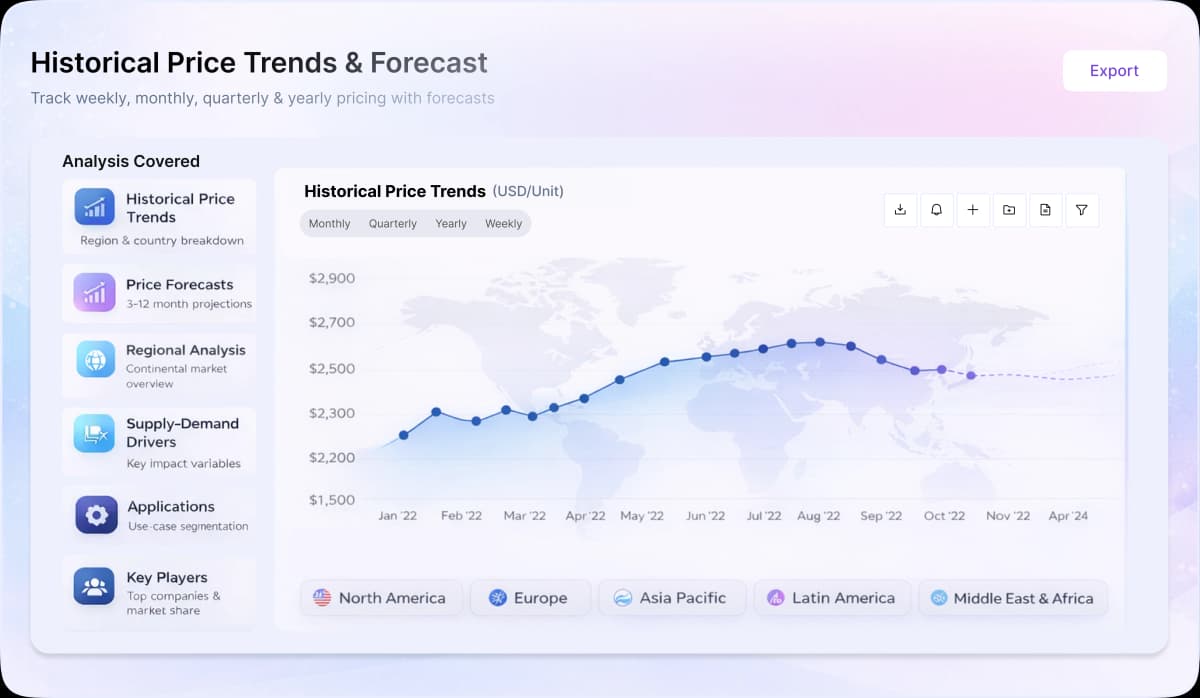
Price Trend Dashboard - What's Included
Price trends across a diverse portfolio of categories and products, spanning board to niche chemicals
Coverage extendable to grade-specific chemicals based on procurement requirements
Regular price tracking supported by robust historical datasets
News, policy updates, and key market drivers impacting price movements
Short-term and long-term price outlooks and forecasts
Supply–demand dynamics and capacity-driven market analysis