Need latest PA66 (Nylon 66) prices?
Get real-time price assessments, periodic trends, forecasts and price driver insights across key global markets.
Unlock Price Insights NowOur Clients
Asia
In Asia, PA66 prices moved lower through the second half of 2025. Market activity stayed calm, and buying interest remained limited as downstream sectors such as textiles, engineering parts, and packaging continued to operate at slow speeds.
Suppliers in the region faced steady competition from both local producers and imports, which kept the market well supplied. Even as discussions about trade actions took place in other regions, they did not improve sentiment in Asia. Overall, the market stayed weak, and prices slipped gradually as oversupply outweighed demand.
Europe
In Europe, PA66 also experienced downward pressure during H2’25. Manufacturers in automotive and consumer goods did not see the rebound they had hoped for, which reduced their raw material needs. At the same time, European buyers faced uncertainty caused by changing global production patterns and shifts in energy markets.
Imports continued to play an important role and made it difficult for local producers to protect their margins. As a result, PA66 in Europe largely followed the global softening trend and showed steady declines throughout the period.
North America
In North America, PA66 prices trended downward as the overall global outlook. Construction activity remained slow because borrowing costs stayed high, and this prevented stronger demand from building-related applications. Although automotive output improved somewhat, it was not enough to create real upward support for PA66.
Trade discussions among the U.S., Mexico, and China added some temporary uncertainty, but they did not limit supply enough to change the overall direction. The market therefore saw consistent but moderate easing through the second half of the year.
Analyst Insight
According to Procurement Resource, PA66 prices are expected to stay soft unless demand improved or supply tightened, with no clear signs of a quick recovery toward the end of 2025.
Related Report
Get real-time price assessments, periodic trends, forecasts and price driver insights across key global markets.

Unlock Price Insights NowOur Clients

Turn price intelligence into action with the Procurement Resource Database. Log in or subscribe to unlock live price trends, historical charts, supplier databases, cost curves, and analyst-backed insights across chemicals, agriculture, energy, packaging, and more. Use these tools to benchmark your contracts, plan budgets with confidence, and stay ahead of market moves on every product you buy.

0
+Products
0
+Regions
0
+Subscriptions
| Product | Category | Region | Price | Last Updated Month |
| PA66 (Nylon 66) | Chemicals | Asia | USD 2566/MT | January 2025 |
| PA66 (Nylon 66) | Chemicals | Asia | USD 2383/MT | May 2025 |
Stay updated with the latest PA66 (Nylon 66) prices, historical data, and tailored regional analysis
Asia
Nylon 66 prices in Asia softened over the first half of 2025, declining from approximately USD 2566/MT in January to around USD 2383/MT in May. The quarter began with a notable drop, driven by months of sluggish domestic demand. Chinese producers adopted a cautious stance, limiting supply as downstream procurement remained weak. Inventories were slightly lower than the previous quarter, yet limited buying interest from key sectors kept demand stagnant.
After a brief period of stabilization, prices resumed their downward trend, influenced by ongoing export uncertainties and the absence of strong market drivers. Toward the end of the quarter, prices declined more sharply, reflecting weakening sentiment and lack of support from both domestic and international fundamentals. Production curbs and thin order books restricted any upward momentum, resulting in an overall subdued pricing environment.
Europe
In Europe, Nylon 66 prices remained relatively firm throughout the quarter. The period began with stable prices, supported by higher production costs and efforts by sellers to pass on these increases. Upward price movement continued briefly, fueled by steady domestic demand and rising upstream costs. Midway through the quarter, prices entered a consolidation phase as sellers sought to maintain gains amid moderate demand.
In the latter half, although prices remained elevated compared to earlier levels, the pace of increase slowed, indicating buyer resistance and emerging competition from imported alternatives. By the end of the period, the market showed signs of leveling off, shaped by stock build-up and shifting trade dynamics.
North America
North American Nylon 66 prices declined gradually throughout the quarter. Initially, pricing was stable as market participants remained cautious due to macroeconomic uncertainty. As the period progressed, prices trended downward incrementally. Despite steady supply, demand from key industries such as automotive and industrial manufacturing remained insufficient.
Attempts by producers to maintain pricing gave way to broader discounting, especially as restocking failed to materialize. A sharper drop near the quarter's close reflected persistent oversupply and ongoing buyer hesitation. The overall market tone was weak, with limited prospects for near-term recovery.
PA66 (Nylon 66) is a member of polyamide or nylon family. It is one of the most common types of nylons that is utilised in textile and plastic industries. Nylon 66 is called so because it is produced from two monomers, namely, hexamethylenediamine and adipic acid, and each contains 6 carbon atoms. It has a lower moisture absorption frequency than PA6. Nylon 66 is known for its high mechanical strength, rigidity, good stability under heat and/or chemical resistance.
(C12H22N2O2)n
Textile, Carpets, Moulded parts, Automotive applications , 3D structural objects, Fire safe polymers, Electro-insulating elements and pipes , Conveyor belts and hoses, Polymer-framed weapons, Outer layer of turnout blankets , Guitar nut materialElectronic and electrical parts
Poly[imino(1,6-dioxohexamethylene) iminohexamethylene], Poly(azanediyladipoylazanediylhexane-1,6-diyl), Poly(hexamethylene adipamide), Poly(N,N'-hexamethyleneadipinediamide)
BASF SE, Koninklijke DSM N.V., Radici Partecipazioni SpA , TER HELL Plastic GmbH , Li Peng Enterprise Co. ltd, Lanxess AG, Evonik Industries AG
CurrencyUS$ (Data can also be provided in local currency)
Supplier Database AvailabilityYes
Customization ScopeThe report can be customized as per the requirements of the customer
Post-Sale Analyst Support360-degree analyst support after report delivery
Note: Our supplier search experts can assist your procurement teams in compiling and validating a list of suppliers indicating they have products, services, and capabilities that meet your company's needs.
In order to produce PA66 (Nylon 66), polycondensation of hexamethylenediamine and adipic acid is carried out to form nylon salt. The obtained nylon salt is polymerised either in batches or continuously to finally produce PA66 (Nylon 66).
Our Price Analysis Methodology

Experience how Procurement Resource transforms raw material price data into clear, decision ready intelligence. Optimise your performance with reliable, expert market data and analysis. Schedule your demo today to experience a live walk-through where our experts will showcase interactive price charts, forecasted prices, and insights driving the prices for your key commodities, tailored to your workflows. Contact us now!
Our Team will be happy to assist you
We are just a text away
Still Need Help ?
This report comprises thorough cost economics of Nylon-6,6 production via mass polymerization process.
Unlock full access to Procurement Resource's price databases, interactive charts, and short-term forecasts for thousands of commodities. Elevate your sourcing decisions by comparing prices across regions, downloading historical data, and layering in analyst-backed insights, all with our flexible plans that scale as your portfolio grows.
Still have any Questions
Contact Us


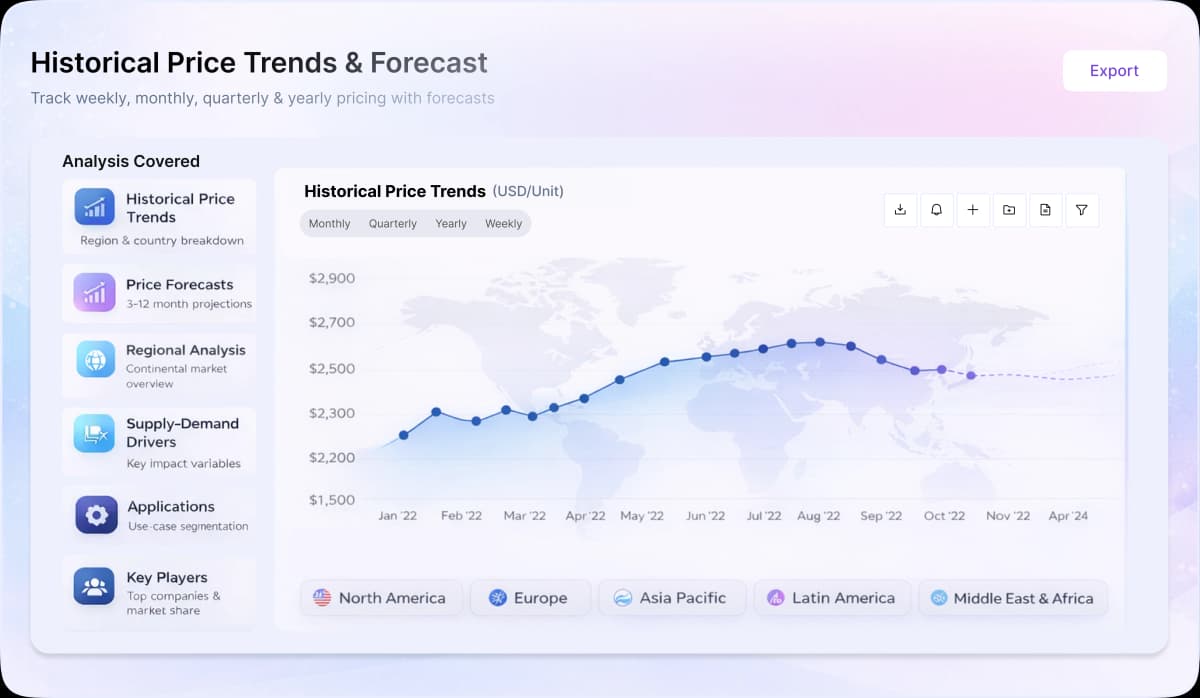
Price Trend Dashboard - What's Included
Price trends across a diverse portfolio of categories and products, spanning board to niche chemicals
Coverage extendable to grade-specific chemicals based on procurement requirements
Regular price tracking supported by robust historical datasets
News, policy updates, and key market drivers impacting price movements
Short-term and long-term price outlooks and forecasts
Supply–demand dynamics and capacity-driven market analysis