Udeesha Tomar
AVP - Strategy and Solutions
Leading procurement research solutions across chemicals, materials, and food & beverages, with expertise in price forecasting and market analytics.
Asia
In Asia, paraffin prices remained firm during Q1’26 due to elevated refinery-linked production costs and higher regional freight expenses. Market sentiment strengthened after Reuters reported that Brent crude forecasts for 2026 increased by nearly 30% from pre-war estimates, while global energy supply concerns intensified due to the Iran conflict. Tightened export availability and higher marine insurance costs following the Strait of Hormuz disruption supported replacement values across China and India. Stable downstream demand from candles, packaging waxes, rubber products, textiles, and adhesives continued to support regional procurement despite cautious buying activity.
Europe
In Europe, paraffin prices strengthened as import-dependent buyers faced elevated freight, utility, and replacement costs during Q1’26. Shipping disruptions and rerouting of tanker cargoes increased logistics expenses across the region, while concerns regarding declining OPEC+ output by up to 11 million barrels/day in Q2’26 further tightened energy-linked sentiment. Demand from cosmetics, board coating, industrial wax applications, and candle manufacturing remained comparatively stable, although weaker industrial activity limited sharper gains.
North America
In North America, paraffin prices remained stable-to-firm due to higher export replacement costs and tightening global refinery economics. Reuters also noted that WTI forecasts increased substantially from pre-conflict projections, while the International Energy Agency’s 400-million-barrel strategic release covered only around 20 days of normal Hormuz flows, sustaining supply-risk sentiment globally. Demand from packaging, adhesives, candles, rubber processing, and industrial wax applications remained balanced, supporting steady procurement activity despite cautious inventory management.
Analyst Insight
According to Procurement Resource, in the near term, paraffin prices are expected to remain firm as elevated refinery-linked production costs, freight inflation, and geopolitical supply risks continue supporting global market sentiment, although moderate downstream demand may limit sharper volatility.

Related Report
Get real-time price assessments, periodic trends, forecasts and price driver insights across key global markets.
Unlock Price Insights NowOur Clients

Turn price intelligence into action with the Procurement Resource Database. Log in or subscribe to unlock live price trends, historical charts, supplier databases, cost curves, and analyst-backed insights across chemicals, agriculture, energy, packaging, and more. Use these tools to benchmark your contracts, plan budgets with confidence, and stay ahead of market moves on every product you buy.

0
+Products
0
+Regions
0
+Subscriptions
| Product | Category | Region | Price | Last Updated Month |
| Paraffin | Chemicals | China | 919 USD/MT | September 2025 |
Stay updated with the latest Paraffin prices, historical data, and tailored regional analysis
Asia
In 2025, paraffin prices in Asia moved in fluctuating manner as supply conditions, freight rates, and seasonal demand shifted across the year. Early on, prices softened because shipping costs eased and inventories remained comfortable, while demand from candles, packaging, and personal care stayed steady but not strong. As the second quarter continued, port congestion and tighter global supply pushed prices upward again.
Mid-year festive orders and stronger candle exports kept the market firm for a short period. Later, improved vessel movement and more stable refinery output reduced cost pressure, allowing prices to settle. Further, better logistics and steady stock levels kept the market balanced, preventing sharp price swings.
Europe
Paraffin prices in Europe generally leaned towards the softer side through 2025 as supply gradually improved. Early in the year, more Chinese volumes arrived in Europe when sellers redirected shipments away from the U.S., increasing competition and holding prices down.
Although refinery maintenance in parts of eastern Europe initially limited local availability, completed maintenance and steadier imports later in the year restored balance. Even though freight and tariff-related costs continued to influence the market, inventories stayed manageable. Cautious buying and stable supply conditions kept prices from rising sharply. By the end of 2025, Europe saw a mostly steady market with only mild pressure from shifting import flows.
North America
North America experienced the most noticeable volatility. Early in 2025, paraffin prices climbed due to tight imports, high freight costs, and port congestion. Limited Chinese supply in the first months added to the upward pressure. This changed mid-year when temporary tariff relief encouraged Chinese exporters to send more material to the U.S., easing shortages and leading to price declines.
Even with lingering logistical issues, the return of these volumes and soft downstream demand prevented a strong rebound. By late 2025, increased availability of Chinese products and cautious buying kept the market mostly stable with minor fluctuations.
Paraffin, composed of a mixture of hydrocarbon molecules, is a soft colorless solid, obtained from petroleum, coal or shale oil. At room temperature, the substance is solid, but begins to melt above approximately 37 °C (99 °F). Its boiling point is over 370 °C (698 °F).
Lubrication and hot melt adhesives, Agriculture, Electrical insulation, Food, Candles, Rubber and plastic processing aids
Paraffin wax, Petroleum wax
Paraffinwaxco, Inc., Sinopec, PetroChina Company Limited, Chennai Petroleum Corporation Limited, Numaligarh Refinery Limited, UNICORN PETROLEUM INDUSTRIES PVT. LTD.
CurrencyUS$ (Data can also be provided in local currency)
Supplier Database AvailabilityYes
Customization ScopeThe report can be customized as per the requirements of the customer
Post-Sale Analyst Support360-degree analyst support after report delivery
Note: Our supplier search experts can assist your procurement teams in compiling and validating a list of suppliers indicating they have products, services, and capabilities that meet your company's needs.
Slack wax, a mixture of oil and wax, is a byproduct from the refining of lubricating oil. While preparing Paraffin from slack wax, the oil is removed (de-oiling or de-waxing) from the slack wax and it is further crystallised and then filtered to produce Paraffin.

AVP - Strategy and Solutions
Leading procurement research solutions across chemicals, materials, and food & beverages, with expertise in price forecasting and market analytics.
Our Price Analysis Methodology

Experience how Procurement Resource transforms raw material price data into clear, decision ready intelligence. Optimise your performance with reliable, expert market data and analysis. Schedule your demo today to experience a live walk-through where our experts will showcase interactive price charts, forecasted prices, and insights driving the prices for your key commodities, tailored to your workflows. Contact us now!
Our Team will be happy to assist you
We are just a text away
Still Need Help?
This report presents a cost analysis of syngas production from heavy fuel (heavy hydrocarbons)
Unlock full access to Procurement Resource's price databases, interactive charts, and short-term forecasts for thousands of commodities. Elevate your sourcing decisions by comparing prices across regions, downloading historical data, and layering in analyst-backed insights, all with our flexible plans that scale as your portfolio grows.
Still have any Questions
Contact Us


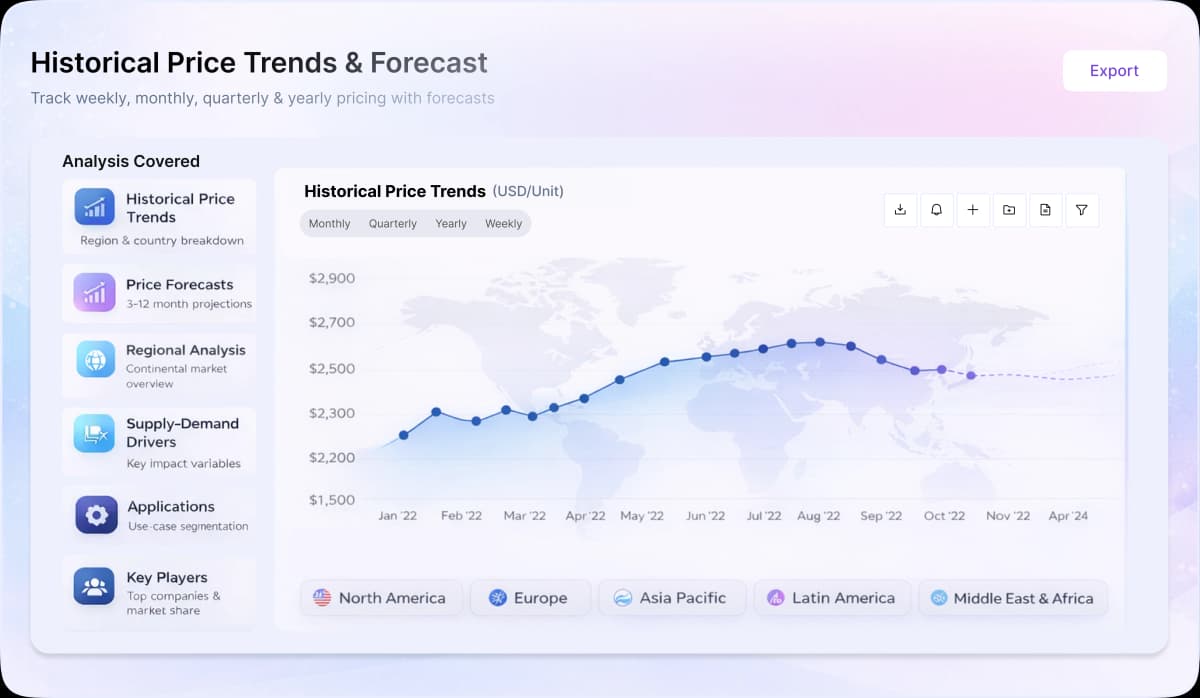
Price Trend Dashboard - What's Included
Price trends across a diverse portfolio of categories and products, spanning board to niche chemicals
Coverage extendable to grade-specific chemicals based on procurement requirements
Regular price tracking supported by robust historical datasets
News, policy updates, and key market drivers impacting price movements
Short-term and long-term price outlooks and forecasts
Supply-demand dynamics and capacity-driven market analysis