
Prakhar Panchbhaiya
Assistant Manager: Business Insights and Content
Supporting procurement teams with category intelligence, market research, price trends, supply-demand analysis, and strategic sourcing insights across key industries.

| Product | Region | Incoterm Basis | Price | Last Updated Month |
|---|---|---|---|---|
| Peppermint Oil | Germany | CFR | USD 54,658.00/MT | August 2026 |
| Peppermint Oil | Germany | CFR | USD 54,190.00/MT | July 2026 |
Stay updated with the latest Peppermint Oil prices, historical data, and tailored regional analysis
| Product | Category | Region | Price | Time Period |
| Peppermint Oil | Flavours and Fragrances | USA | USD 31127/MT | September 2025 |
| Peppermint Oil | Flavours and Fragrances | China | USD 39863/MT | September 2025 |
Stay updated with the latest peppermint oil prices, historical data, and tailored regional analysis
Peppermint oil prices in the second half of 2025 moved upward, driven by a significant shortfall in production output from India, the world's primary source of peppermint oil. According to the Peppermint Oil price database, the season got off to a structurally weak start as unusual weather patterns across key cultivation states, including Uttar Pradesh, Punjab, and Bihar, severely hampered distillation efficiency. Although sowing volumes were broadly in line with the previous year, persistent humidity and frequent rainfall during the critical growing and distillation period prevented producers from achieving optimal oil recovery. Temperatures necessary for effective distillation were reached, yet the accompanying moisture conditions offset the benefits, pushing oil recovery rates well below the levels typically seen in a normal season.
The Peppermint Oil price curve reflected the resulting tightness in available supply, with market participants reporting constrained inventories across the Peppermint Oil market. Trade activity was affected as buyers sought to secure limited volumes, adding further upward momentum to the Peppermint Oil price graph. Demand from the food, pharmaceutical, and personal care sectors remained steady throughout the period, leaving the gap between supply and consumption difficult to bridge in the near term.
Analyst Insight
According to Procurement Resource, the peppermint oil market is likely to remain tight until the next cultivation season brings clearer visibility on supply outlook.
Related Report
Need Latest Peppermint Oil Prices?
Get real-time price assessments, periodic trends, forecasts and price driver insights across key global markets.
Our Clients































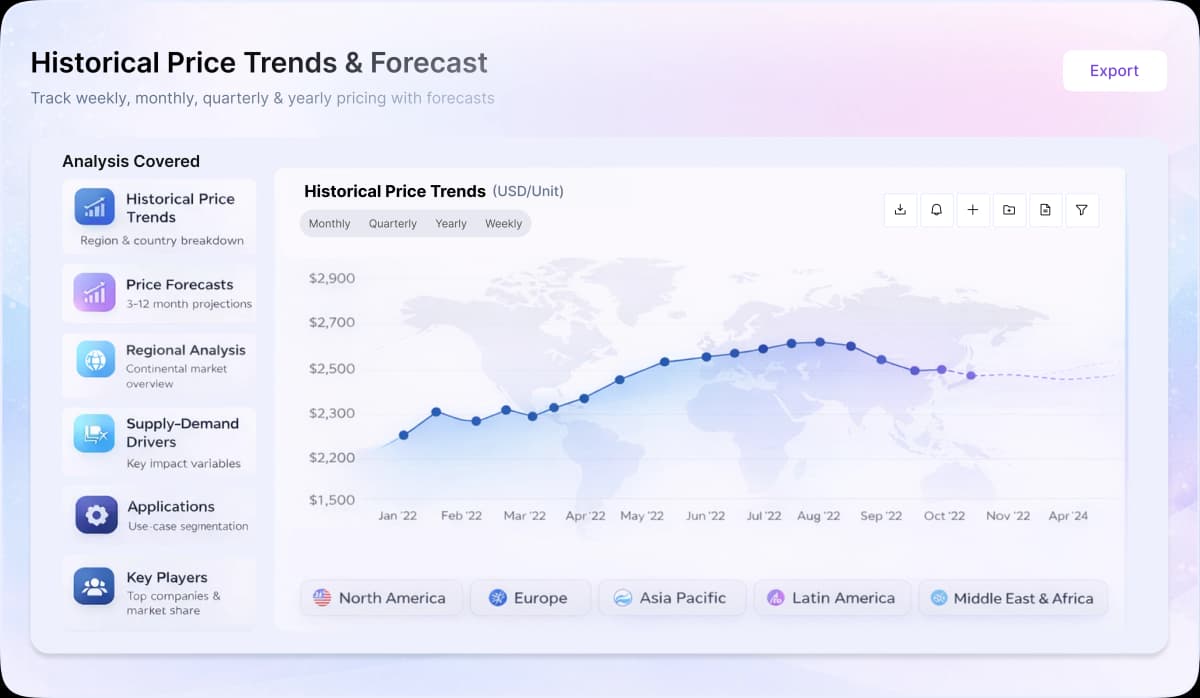
Turn price intelligence into action with the Procurement Resource Database. Log in or subscribe to unlock live price trends, historical charts, supplier databases, cost curves, and analyst-backed insights across chemicals, agriculture, energy, packaging, and more. Use these tools to benchmark your contracts, plan budgets with confidence, and stay ahead of market moves on every product you buy.
0
+Products
0
+Regions
0
+Subscriptions
During the first half of 2025, peppermint oil prices exhibited a steady upward trend across key global regions, influenced by robust downstream demand and evolving supply-side challenges. In North America, consistent consumption from the pharmaceutical and food sectors supported price growth, while occasional logistical bottlenecks and weather inconsistencies added pressure. In Europe, particularly in Germany and the United Kingdom, prices firmed due to persistent demand from healthcare and personal care industries, compounded by currency fluctuations and a strong reliance on imports amid limited domestic production.
In the Asia-Pacific region, China led the price incline, driven by heightened demand from flavoring and medicinal sectors, tightening local supplies, and elevated freight and production costs. Similarly, Brazil witnessed moderate price increases, shaped by rising input expenses and seasonal volatility, despite a relatively balanced domestic demand. Across all major markets, global peppermint oil prices were shaped by a confluence of factors such as climate-dependent crop yields, rising production and logistics costs, and shifting currency valuations, resulting in an overall firming but regionally nuanced pricing landscape.
Peppermint oil, derived from the leaves of the Mentha piperita plant, is a popular essential oil known for its strong, refreshing aroma and wide-ranging therapeutic benefits. It contains menthol, a compound responsible for its cooling sensation and soothing effects. Peppermint oil is widely used in aromatherapy to relieve headaches, reduce stress, and promote mental clarity. It is also used in personal care products such as toothpaste, shampoos, soaps, and lotions due to its antimicrobial and soothing properties. In the food and beverage industry, peppermint oil is valued for its intense flavor and is commonly used in candy, gum, and teas.
Mentha Piperita Oil, Oil of Peppermint, Peppermint Terpenes
Flavour and Fragrance, Personal Care Products and Cosmetics, Medicines and Pharmaceuticals, Culinary Applications
Greenleaf Extractions Pvt Ltd, Young Living Essential Oils, Aksu Vital Natural products and Cosmetics, Plant Therapy Essential Oils
CurrencyUS$ (Data can also be provided in local currency)
Supplier Database AvailabilityYes
Customization ScopeThe report can be customized as per the requirements of the customer
Post-Sale Analyst Support360-degree analyst support after report delivery
Note: Our supplier search experts can assist your procurement teams in compiling and validating a list of suppliers indicating they have products, services, and capabilities that meet your company's needs.
Peppermint oil has a wide range of industrial applications due to its refreshing aroma and therapeutic properties. In the food and beverage industry, it is used as a flavoring agent in products like candies, gum, teas, and baked goods. In the cosmetic and skincare sectors, peppermint oil is valued for its cooling, soothing, and antimicrobial properties, often included in lotions, shampoos, soaps, and toothpaste. Additionally, it is used in the pharmaceutical industry for its potential to relieve headaches, muscle pain, and digestive issues. Peppermint oil is also incorporated into cleaning products and air fresheners for its refreshing scent and natural antibacterial qualities.
Our Price Analysis Methodology
Assistant Manager: Business Insights and Content
Supporting procurement teams with category intelligence, market research, price trends, supply-demand analysis, and strategic sourcing insights across key industries.

Experience how Procurement Resource transforms raw material price data into clear, decision ready intelligence. Optimise your performance with reliable, expert market data and analysis. Schedule your demo today to experience a live walk-through where our experts will showcase interactive price charts, forecasted prices, and insights driving the prices for your key commodities, tailored to your workflows. Contact us now!
Our Team will be happy to assist you
We are just a text away
Still Need Help?
This report presents a cost analysis of syngas production from heavy fuel (heavy hydrocarbons)
This report provides the cost structure of LPG production by the petroleum refining process. In this process, the crude oil recovered is separated into oil and wet gas via a gas trap.
This report provides the economy of producing ammonia by partial oxidation method.
Unlock full access to Procurement Resource's price databases, interactive charts, and short-term forecasts for thousands of commodities. Elevate your sourcing decisions by comparing prices across regions, downloading historical data, and layering in analyst-backed insights, all with our flexible plans that scale as your portfolio grows.
Still have any Questions
Contact Us



Price Trend Dashboard - What's Included
Price trends across a diverse portfolio of categories and products, spanning board to niche chemicals
Coverage extendable to grade-specific chemicals based on procurement requirements
Regular price tracking supported by robust historical datasets
News, policy updates, and key market drivers impacting price movements
Short-term and long-term price outlooks and forecasts
Supply–demand dynamics and capacity-driven market analysis

Track prices, market movements, supply-demand dynamics, and industry developments across hundreds of commodities through a centralized intelligence platform built for informed procurement decisions.

Understand market fluctuations using analyst-backed forecasts, historical pricing patterns, and evolving industry trends to strengthen sourcing strategies and budget planning.

Leverage cost models, pricing benchmarks, and procurement insights to evaluate purchasing opportunities, improve negotiations, and enhance operational efficiency.
Access region-specific price trends, trade activities, capacity changes, and supply chain developments influencing commodity markets worldwide.