

Udeesha Tomar
AVP - Strategy and Solutions
Leading procurement research solutions across chemicals, materials, and food & beverages, with expertise in price forecasting and market analytics.

Asia
Asian phosphorous acid markets remained closely linked to yellow-phosphorus availability and downstream agrochemical demand. China's yellow-phosphorus market was expected to remain well supplied in 2026, with planned capacity additions exceeding projected demand growth and creating a potential surplus. This limited the scope for sustained feedstock-driven price escalation. Nevertheless, higher production costs and periodic procurement from glyphosate and other phosphorus-chemical manufacturers provided support during parts of H1. Export activity also influenced regional availability, particularly as buyers in India and other Asian markets sought alternative cargoes. Overall, Asian conditions remained more balanced than those in import-dependent Western markets.
Europe
European phosphorous acid procurement underwent the most significant structural change during H1. From March 2026, a definitive ~122% anti-dumping duty was imposed on Chinese imports, substantially altering landed-cost economics and encouraging buyers to reconsider sourcing patterns. The EU market consumes around 9,000 tonnes annually and previously relied heavily on Chinese imports, while domestic production is concentrated in Germany and the Netherlands. Demand from phosphonate production, water treatment, agriculture, and specialty chemicals remained intact. Consequently, European procurement conditions became considerably firmer and more supply-sensitive as buyers adjusted to the changed import environment.
North America
North American markets remained comparatively exposed to imported phosphorus-chemical supply, with feedstock costs, freight, and downstream agrochemical activity influencing procurement. Demand from agriculture, water treatment, and specialty chemical applications provided a stable consumption base. Glyphosate remained an important downstream channel, although changing trade-policy conditions surrounding Chinese agrochemical imports introduced uncertainty for future purchasing patterns. Adequate Asian production prevented a fundamental global shortage, but logistics and replacement-cost movements could still create periodic upward pressure on delivered material.
Analyst Insight
Phosphorous acid prices are likely to retain a regionally divergent outlook. European costs should remain comparatively supported while buyers adjust to restricted Chinese-origin economics.
Related Report
Need Latest Phosphorous Acid Prices?
Get real-time price assessments, periodic trends, forecasts and price driver insights across key global markets.
Our Clients































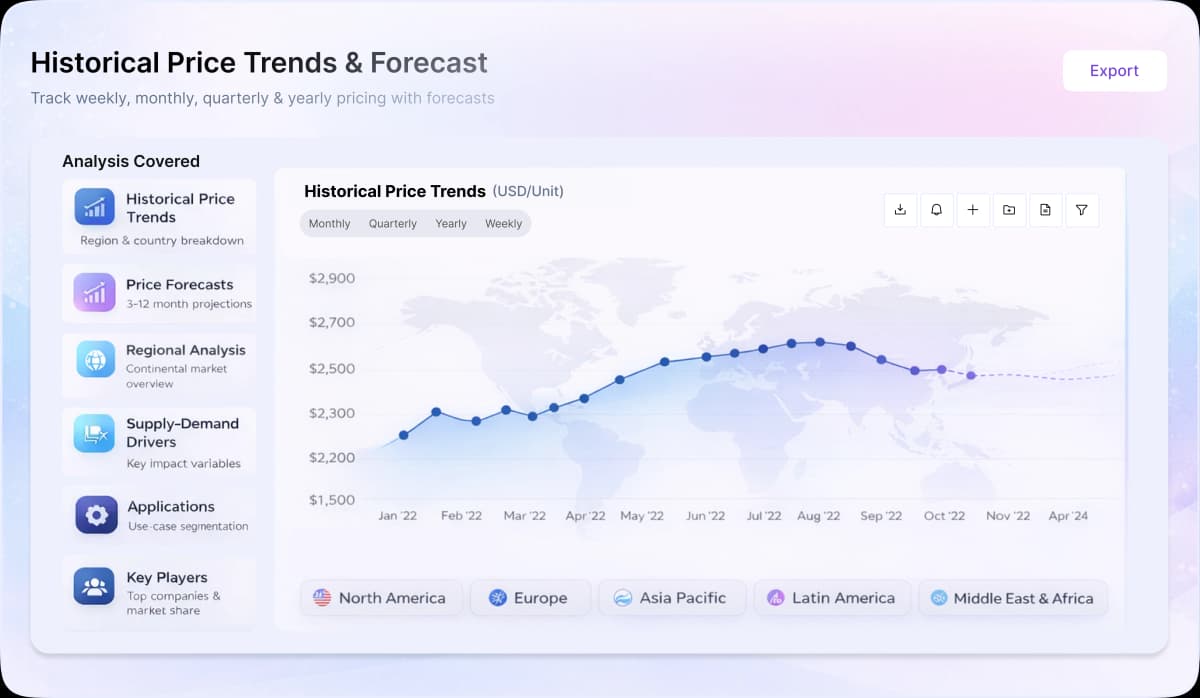
Turn price intelligence into action with the Procurement Resource Database. Log in or subscribe to unlock live price trends, historical charts, supplier databases, cost curves, and analyst-backed insights across chemicals, agriculture, energy, packaging, and more. Use these tools to benchmark your contracts, plan budgets with confidence, and stay ahead of market moves on every product you buy.
0
+Products
0
+Regions
0
+Subscriptions
Asia
The Chinese phosphorous acid market displayed mixed dynamics during the fourth quarter, with pricing movements reflecting shifting cost support and supply-demand conditions. The opening period witnessed modest weakness as prices eased slightly, driven by lower raw material phosphorus yellow costs that reduced production economics support. Market sentiment remained cautious as downstream buyers maintained need-based purchasing strategies with limited speculative activity. Mid-quarter brought appreciation as raw material costs strengthened progressively, providing enhanced cost support. Market optimism increased as trading activity improved and downstream inquiries expanded from fertilizer producers and industrial phosphate manufacturers. The latter portion introduced consolidation as phosphorus yellow markets experienced renewed softening after mid-period strength, weakening cost support. Supply-demand conditions remained balanced, with downstream procurement continuing an as-needed basis without significant inventory building, leading to range-bound fluctuations through year-end.
Europe
European phosphorous acid markets displayed initial weakness before entering sustained appreciation during the latter portion of the quarter. The opening period witnessed a gradual decline as prices softened from their early-quarter levels. Supply conditions remained adequate as import availability from Asian origins supplemented domestic production capacity. Downstream demand from fertilizer and industrial phosphate applications maintained steady consumption patterns, with agricultural sector requirements following typical seasonal cycles. The remainder of the quarter brought progressive strengthening as prices advanced consistently, with the upward trajectory continuing through year-end as market fundamentals improved and cost structures provided increasing support. Raw material availability and energy costs influenced production economics, contributing to the upward pricing momentum. Industrial consumers adjusted procurement timing in response to market movements while maintaining regular offtake levels.
North America
North American markets followed patterns like Chinese trends, experiencing initial modest weakness followed by mid-quarter appreciation and late-quarter consolidation. Raw material cost dynamics influenced pricing movements, with phosphorus-based feedstock availability and pricing creating variable cost support. Demand from fertilizer manufacturing and food-grade phosphorous acid applications remained steady, with buyers maintaining regular procurement schedules throughout the period as supply-demand conditions stayed balanced. Industrial consumption from water treatment and specialty chemical sectors continued at typical levels.
Phosphorous Acid, an intermediate in the production of other phosphorus compounds, is a diprotic acid. A diprotic acid simply means that it readily ionises two protons. It is a weak dibasic acid. Phosphorous Acid is widely utilised in the production of basic lead phosphite, a stabiliser in PVC along with related chlorinated polymers.
H3O3P
Agricultural chemicals (non-pesticidal), Intermediates, Corrosion inhibitors and anti-scaling agents, Lubricants and lubricant additives
Phosphonic acid, Dihydroxyphosphine oxide, Orthophosphorous acid, Oxo-?5-phosphanediol, Oxo-?5-phosphonous acid
Jordan Phosphate Mines Company Plc., Ma’aden Wa’ad Al Shamal Phosphate Company (MWSPC), OCP Group, Yara International ASA, The Mosaic Company
CurrencyUS$ (Data can also be provided in local currency)
Supplier Database AvailabilityYes
Customization ScopeThe report can be customized as per the requirements of the customer
Post-Sale Analyst Support360-degree analyst support after report delivery
Note: Our supplier search experts can assist your procurement teams in compiling and validating a list of suppliers indicating they have products, services, and capabilities that meet your company's needs.
The production of Phosphorous Acid from phosphorus trichloride involves the process of hydrolysis. Thus, phosphorus trichloride is hydrolysed with water or steam to obtain Phosphorous Acid as the final product.
Our Price Analysis Methodology
AVP - Strategy and Solutions
Leading procurement research solutions across chemicals, materials, and food & beverages, with expertise in price forecasting and market analytics.
Experience how Procurement Resource transforms raw material price data into clear, decision ready intelligence. Optimise your performance with reliable, expert market data and analysis. Schedule your demo today to experience a live walk-through where our experts will showcase interactive price charts, forecasted prices, and insights driving the prices for your key commodities, tailored to your workflows. Contact us now!
Our Team will be happy to assist you
We are just a text away
Still Need Help?
Unlock full access to Procurement Resource's price databases, interactive charts, and short-term forecasts for thousands of commodities. Elevate your sourcing decisions by comparing prices across regions, downloading historical data, and layering in analyst-backed insights, all with our flexible plans that scale as your portfolio grows.
Still have any Questions
Contact Us



Price Trend Dashboard - What's Included
Price trends across a diverse portfolio of categories and products, spanning board to niche chemicals
Coverage extendable to grade-specific chemicals based on procurement requirements
Regular price tracking supported by robust historical datasets
News, policy updates, and key market drivers impacting price movements
Short-term and long-term price outlooks and forecasts
Supply–demand dynamics and capacity-driven market analysis

Track prices, market movements, supply-demand dynamics, and industry developments across hundreds of commodities through a centralized intelligence platform built for informed procurement decisions.

Understand market fluctuations using analyst-backed forecasts, historical pricing patterns, and evolving industry trends to strengthen sourcing strategies and budget planning.

Leverage cost models, pricing benchmarks, and procurement insights to evaluate purchasing opportunities, improve negotiations, and enhance operational efficiency.
Access region-specific price trends, trade activities, capacity changes, and supply chain developments influencing commodity markets worldwide.