Goldman Raises Oil Forecast
Goldman Sachs lifted its December and 2027 oil price forecasts amid heightened supply disruption risk from Russia-Ukraine and Middle East conflicts. The bank now expects higher prices, reflecting a stronger risk premium.

Goldman Sachs lifted its December and 2027 oil price forecasts amid heightened supply disruption risk from Russia-Ukraine and Middle East conflicts. The bank now expects higher prices, reflecting a stronger risk premium.
Crude oil prices are rising, adding pressure to domestic inflation. The volatility is expected to continue influencing commodity market trends.
Asia
Asian PTMEG markets remained closely linked to developments across the BDO-spandex chain. Chinese supply remained substantial, but firm BDO (Butanediol) conditions and sustained demand from spandex manufacturers provided cost support during parts of H1. China's spandex trade also remained active, although exports weakened during January–May, indicating some pressure on downstream demand. Meanwhile, continued PTMEG capacity and domestic availability kept competition among producers elevated, limiting the extent of upward price transmission during weaker demand periods.
Europe
European PTMEG markets faced increasing feedstock and sourcing uncertainty toward the end of H1 following the EU's definitive BDO anti-dumping measures. The duties covered Chinese, Saudi Arabian, and US-origin BDO and were introduced after the Commission determined that dumped imports had injured EU BDO producers. Since BDO is an upstream intermediate for THF and several downstream products, the measures increased the importance of alternative sourcing and domestic supply for European buyers.
North America
North American PTMEG conditions remained influenced by domestic BDO availability, downstream spandex and elastomer demand, and international trade flows. The EU's BDO duties added another layer of uncertainty for US exporters and could alter regional trade patterns, although the direct impact on North American PTMEG remained more limited than in Europe. Demand from performance elastomers and textile applications provided a steady consumption base.
Analyst Insight
PTMEG markets are expected to remain sensitive to BDO availability and spandex demand, while European trade measures could increase regional sourcing differentiation.
Related Report
Need Latest Polytetramethylene Ether Glycol (PTMEG) Prices?
Get real-time price assessments, periodic trends, forecasts and price driver insights across key global markets.
Our Clients































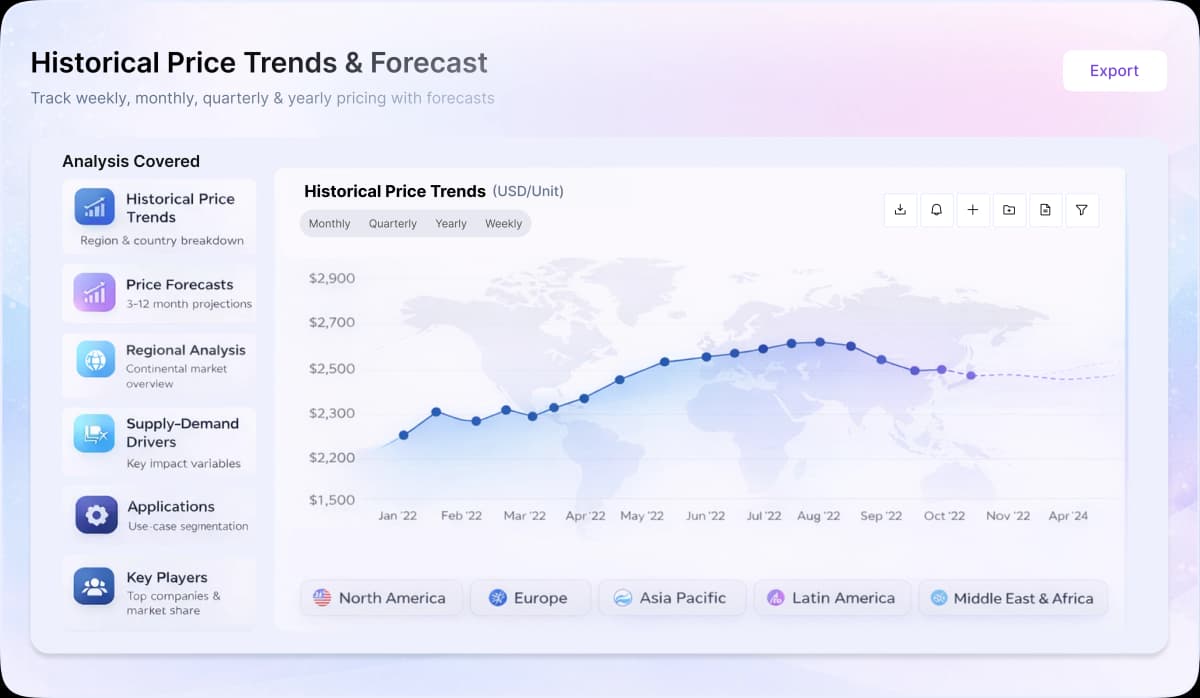
Turn price intelligence into action with the Procurement Resource Database. Log in or subscribe to unlock live price trends, historical charts, supplier databases, cost curves, and analyst-backed insights across chemicals, agriculture, energy, packaging, and more. Use these tools to benchmark your contracts, plan budgets with confidence, and stay ahead of market moves on every product you buy.
0
+Products
0
+Regions
0
+Subscriptions
Asia
During H2 2025, the polytetramethylene ether glycol market in Asia remained closely tied to developments in the 1,4-butanediol and spandex chains. Chinese production capacity continued to expand, keeping supply competition elevated, while slower growth in spandex demand limited the ability of producers to pass through higher feedstock costs. CCFGroup's 2025 industry review subsequently noted that Chinese polytetramethylene ether glycol capacity growth remained substantial, while imports declined and exports increased, reflecting China's increasingly competitive supply position.
Europe
European polytetramethylene ether glycol demand remained more closely connected with non-fibre polyurethane applications, including elastomers, adhesives and coatings, rather than the predominantly spandex-driven Asian market. Procurement remained sensitive to import availability and upstream tetrahydrofuran costs. The European Union's June 2025 initiation of an anti-dumping investigation into 1,4-butanediol from China, Saudi Arabia and the United States also introduced greater uncertainty around future feedstock sourcing, although definitive duties were not imposed until 2026 and therefore should not be treated as an H2 2025 price driver.
North America
In North America, polytetramethylene ether glycol consumption remained comparatively diversified, with polyurethane elastomers and other non-fibre applications representing an important demand base. The region was therefore less directly dependent on spandex than China and other Asian markets. During H2 2025, procurement conditions were influenced by downstream industrial demand, import availability and tetrahydrofuran-linked production economics, while the European Union's investigation into 1,4-butanediol trade added a developing trade consideration for international suppliers without yet creating the direct tariff impact seen later in 2026.
Polytetramethylene Ether Glycol (PTMEG) is a white waxy solid polyol which upon melting turns into a clear, colourless, viscous liquid. It is mainly used in the production of polyurethane fibers, elastomers and copolyester-ether.
C6H16O3
Production of polyurethanes, polyesters & polyamides
Production of polyurethanes, polyesters & polyamides
BASF SE, Mitsui Chemicals, Inc., BASF SE, Genomatica, Asahi Kasei Corp., DuPont, The Dow Chemical Company
CurrencyUS$ (Data can also be provided in local currency)
Supplier Database AvailabilityYes
Customization ScopeThe report can be customized as per the requirements of the customer
Post-Sale Analyst Support360-degree analyst support after report delivery
Note: Our supplier search experts can assist your procurement teams in compiling and validating a list of suppliers indicating they have products, services, and capabilities that meet your company's needs.
In this process, tetrahydrofuran is mixed with the catalyst fluorosulfonic acid. As a result of this, polymerization products are formed, namely, polytetramethylene ether chains with sulfur ester groups. Sulfates are then hydrolyzed with water and the acid is removed.
Our Price Analysis Methodology

AVP - Strategy and Solutions
Leading procurement research solutions across chemicals, materials, and food & beverages, with expertise in price forecasting and market analytics.
Experience how Procurement Resource transforms raw material price data into clear, decision ready intelligence. Optimise your performance with reliable, expert market data and analysis. Schedule your demo today to experience a live walk-through where our experts will showcase interactive price charts, forecasted prices, and insights driving the prices for your key commodities, tailored to your workflows. Contact us now!
Our Team will be happy to assist you
We are just a text away
Still Need Help?
This report shows the cost structure of ethylene glycol production from the hydrolysis of ethylene oxide.
This report provides the cost structure of ethyl tert-butyl ether production using C4 raffinate stream or raffinate-1 or butane or isobutylene along with ethanol.
Unlock full access to Procurement Resource's price databases, interactive charts, and short-term forecasts for thousands of commodities. Elevate your sourcing decisions by comparing prices across regions, downloading historical data, and layering in analyst-backed insights, all with our flexible plans that scale as your portfolio grows.
Still have any Questions
Contact Us



Price Trend Dashboard - What's Included
Price trends across a diverse portfolio of categories and products, spanning board to niche chemicals
Coverage extendable to grade-specific chemicals based on procurement requirements
Regular price tracking supported by robust historical datasets
News, policy updates, and key market drivers impacting price movements
Short-term and long-term price outlooks and forecasts
Supply–demand dynamics and capacity-driven market analysis

Track prices, market movements, supply-demand dynamics, and industry developments across hundreds of commodities through a centralized intelligence platform built for informed procurement decisions.

Understand market fluctuations using analyst-backed forecasts, historical pricing patterns, and evolving industry trends to strengthen sourcing strategies and budget planning.

Leverage cost models, pricing benchmarks, and procurement insights to evaluate purchasing opportunities, improve negotiations, and enhance operational efficiency.
Access region-specific price trends, trade activities, capacity changes, and supply chain developments influencing commodity markets worldwide.