Crude Futures Firm on Spot Demand
Crude oil futures firmed amid firm spot demand, with both major global benchmarks edging higher in trade. Increased positioning by market participants reflected continued underlying demand support.
Strait of Hormuz closure continues to constrain global oil supply, with observed output remaining significantly below year-ago levels. IEA revised its demand forecast downward as inventories fell to multi-decade lows, reinforcing upward price pressure and market volatility.
In the first half of 2025, the Polytrimethylene Terephthalate (PTT) market showed mixed movements across regions, largely influenced by trends in related polyester markets like PET. In Asia, particularly China, PTT prices followed a bumpy path. Prices initially rose slightly due to restocking efforts and some recovery in downstream demand after the Lunar New Year.
However, this improvement did not last long. High stock levels, economic concerns, and slow activity in key end-use sectors like textiles led to weaker pricing mid-period. Towards the end of the half, a small recovery was observed, supported by modest seasonal demand, but the overall price movement remained cautious and relatively flat.
In Southeast Asia, the situation was more bearish. Oversupply and weak consumption across local industries put pressure on PTT prices, which faced continued downward pressure. Falling input costs added to this softness, as manufacturers had limited incentive to build inventory.
Europe saw a more structured recovery in PTT prices during the second quarter. Initially, weak demand and high inventories held the market down. But as the need for packaging and textile applications grew, alongside regulatory support for sustainable materials, prices began to pick up. Restocking and improved sentiment, especially in markets like Germany, gave the region a stronger footing by the end of H1.
In North America, the market was more balanced. Early restocking in Q1 supported prices briefly, but the momentum faded by March. In Q2, seasonal demand helped steady the market, though competition from alternative materials capped further gains.
Analyst Insight
According to Procurement Resource, PTT prices are expected to recover gradually in H2’25, helped by seasonal demand and sustainability-driven policies, though cost pressures may limit sharp increases.
Related Report
Need latest Polytrimethylene Terephthalate price?
Get real-time price assessments, periodic trends, forecasts and price driver insights across key global markets.
Unlock Price Insights NowOur Clients

Turn price intelligence into action with the Procurement Resource Database. Log in or subscribe to unlock live price trends, historical charts, supplier databases, cost curves, and analyst-backed insights across chemicals, agriculture, energy, packaging, and more. Use these tools to benchmark your contracts, plan budgets with confidence, and stay ahead of market moves on every product you buy.
0
+Products
0
+Regions
0
+Subscriptions
The price trend of Polytrimethylene Terephthalate (PTT) in 2024 experienced fluctuations, tied to shifts in the European automotive market. PTT is used in seat covers and door panels, so its demand is linked to new vehicle production. The European car market faced significant challenges, with registrations at their lowest in over two years. A decline in battery-electric vehicle (BEV) sales contributed to the slowdown, reducing demand for PTT-based materials. The European Automobile Manufacturers Association reported an 18.3% drop in car registrations in August, affecting raw material procurement.
Germany and France were particularly affected, with registration declines of 27.8% and 24.3%, respectively. Italy and Spain also saw declines. Rising production costs in the auto industry, including higher financing rates and inflation, further pressured PTT demand. Some European markets, like Poland and Denmark, saw slight growth, but it was insufficient to counteract the broader slowdown. By the end of 2024, PTT prices remained under strain due to weak demand from the auto sector, compounded by lower vehicle production and financial headwinds in the European car market.
PTT is a semi-aromatic thermoplastic polyester which can be easily thermoformed and spun in high-quality fibres. It is obtained by polymerizing or transesterifying 1,3-propanediol and terephthalic acid or dimethyl terephthalate. Its mechanical properties resemble PET, whereas its flexibility and moulding capabilities resemble PBT. PTT is widely used in making fibres for carpets due to its high tensile strength, durability, and excellent abrasion resistance.
(C11H10O4)n
Automotives, Textiles, Electronics, Packaging and Films
PTT, Poly-1,3-propylene terephthalate
DuPont, RTP, Sinopec, Eastman Chemical Co., Royal Dutch/Shell Group of Companies
CurrencyUS$ (Data can also be provided in local currency)
Supplier Database AvailabilityYes
Customization ScopeThe report can be customized as per the requirements of the customer

Post-Sale Analyst Support360-degree analyst support after report delivery

Note: Our supplier search experts can assist your procurement teams in compiling and validating a list of suppliers indicating they have products, services, and capabilities that meet your company's needs.
PTT is produced by the polymerization of 1,3-propanediol and terephthalic acid or dimethyl terephthalate. The feedstocks are initially fed into the system, which turns them into a feed slurry. From there, it is transported to the reactors, where the esterification occurs in the presence of suitable catalysts. Then, vacuum and heat are applied to remove water for polymerization to occur, giving the desired PTT.
Our Price Analysis Methodology

Lead - Social & Development Research
Delivering procurement intelligence and supply chain analytics across healthcare, FMCG, and chemicals sectors, with expertise in cost modeling, vendor mapping, and spend optimization to support data-driven sourcing decisions and procurement outcomes.


Experience how Procurement Resource transforms raw material price data into clear, decision ready intelligence. Optimise your performance with reliable, expert market data and analysis. Schedule your demo today to experience a live walk-through where our experts will showcase interactive price charts, forecasted prices, and insights driving the prices for your key commodities, tailored to your workflows. Contact us now!
Our Team will be happy to assist you
We are just a text away
Still Need Help?
This report provides the cost structure of PET production through esterification of ethylene glycol and terephthalic acid.
The report contains the cost analysis of PET production using DMT process.
Unlock full access to Procurement Resource's price databases, interactive charts, and short-term forecasts for thousands of commodities. Elevate your sourcing decisions by comparing prices across regions, downloading historical data, and layering in analyst-backed insights, all with our flexible plans that scale as your portfolio grows.
Still have any Questions
Contact Us


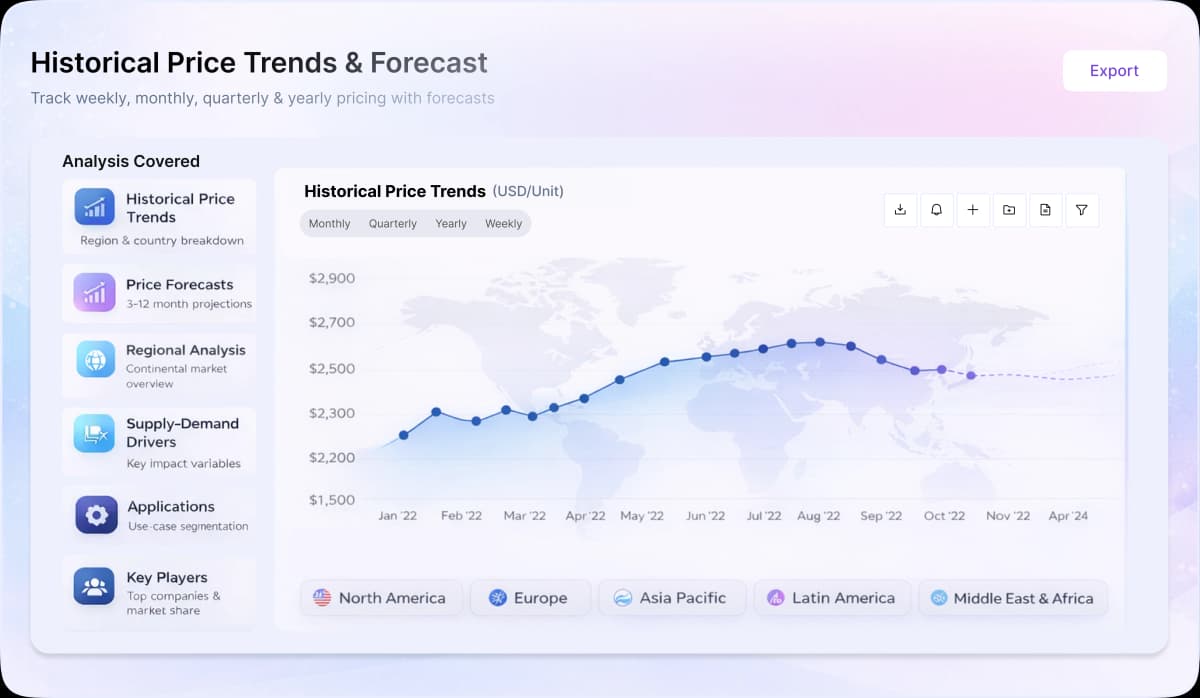
Price Trend Dashboard - What's Included
Price trends across a diverse portfolio of categories and products, spanning board to niche chemicals
Coverage extendable to grade-specific chemicals based on procurement requirements
Regular price tracking supported by robust historical datasets
News, policy updates, and key market drivers impacting price movements
Short-term and long-term price outlooks and forecasts
Supply-demand dynamics and capacity-driven market analysis