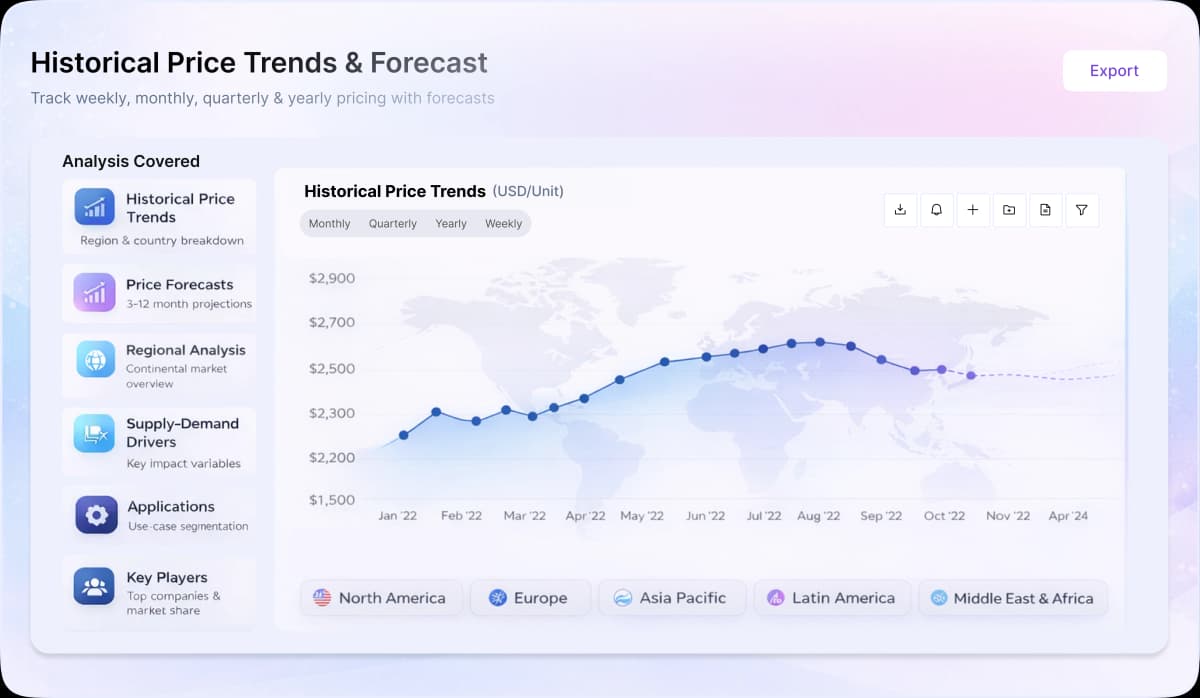
Propanol Price Trend Analysis 2026: Latest News, Historical Prices, Market Insights, Price Drivers & Supply Demand Analysis

Shriya Singh profile photo
Written ByShriya Singh

Procurement Resource Database

Laptop screen

Turn price intelligence into action with the Procurement Resource Database. Log in or subscribe to unlock live price trends, historical charts, supplier databases, cost curves, and analyst-backed insights across chemicals, agriculture, energy, packaging, and more. Use these tools to benchmark your contracts, plan budgets with confidence, and stay ahead of market moves on every product you buy.

0

+

Products

0

+

Regions

0

+

Subscriptions

Asia

Asian propanol markets during the fourth quarter displayed mixed movements largely influenced by upstream feedstock dynamics. In China, prices declined during the first half as weakening propylene cost support reduced production expenses, and downstream buying interest remained cautious. Key consuming sectors, including solvents, coatings, and chemical intermediates, operated under margin pressure with reduced procurement activity. Operating losses in derivative applications limited restocking, while expectations of additional supply weighed on sentiment. The pharmaceutical and personal care segments maintained conservative purchasing patterns. During the second half, prices recorded a slight recovery, though the rebound proved modest. By quarter-end, prices stabilized within a narrow range as supply-demand conditions balanced. Industrial solvent demand remained tepid, with end-users adopting wait-and-see approaches across automotive coatings, printing inks, and cleaning product formulations.

Europe

European propanol markets broadly resembled Asian trends during the fourth quarter. The period began with softer pricing reflecting limited downstream momentum from industrial solvents, pharmaceuticals, and personal care formulations. Demand from derivative sectors remained measured, with no strong cost push evident from propylene feedstock developments. Coatings and printing ink manufacturers maintained conservative procurement strategies, purchasing primarily for immediate needs. The pharmaceutical sector showed steady consumption, while cosmetics applications demonstrated seasonal moderation. During the latter portion, prices exhibited mild recovery before transitioning into stability. Overall volatility remained contained as the market moved from early weakness to equilibrium. Industrial cleaning formulations and specialty chemical applications maintained baseline demand without expansion.

North America

North American propanol markets followed a comparable trajectory during the fourth quarter. Initial softness stemmed from a balanced-to-ample supply and moderate demand from derivative applications. Propylene feedstock developments provided limited cost support. Key consuming sectors, including coatings, adhesives, and industrial solvents, demonstrated steady purchasing activity without aggressive inventory building. The pharmaceutical and agrochemical segments maintained regular procurement rhythms. Mid-quarter adjustments produced limited upward movement, though gains proved unsustained. By quarter-close, prices stabilized, aligning with global patterns of contained recovery. Printing inks and specialty solvent applications reflected moderate industrial activity without demand acceleration.


About Propanol

Propanol has the same strong musty smell as rubbing alcohol and is a clear, colourless liquid in appearance. 53–77°F flash point At 700 °F, it self-ignites. Vapors are less irritating to the eyes, nose, and throat than air and are heavier than it. Density of about 6.5 lb per gal. used to create antifreezes, rubbing alcohols, soaps, window cleaners, acetone, medicines, perfumes, lacquer formulations, dye solutions, cosmetics, skin and hair preparations, and other chemicals and goods.

Propanol Product Detail

HS Code
29051210
Chemical Formula

C3H8O

CAS Number
71-23-8
Molecular Weight
60.10 g/mol
Industrial Uses

Glass Industry, Production of solvents and alkenes, Flame scarfing, Metallurgical heating and hardening, Welding, Cutting

Synonyms

Propyl alcohol, Propan-1-ol, n-propanol

Supplier Database

Dow Chemical Company, BASF SE, Royal Dutch Shell Plc., Eastman Chemical Company, Mitsui Chemicals Inc.

Regional Coverage

Asia Pacific

China, India, Indonesia, Pakistan, Bangladesh, Japan, Philippines, Vietnam, Iran, Thailand, South Korea, Iraq, Saudi Arabia, Malaysia, Nepal, Taiwan, Sri Lanka, UAE, Israel, Hongkong, Singapore, Oman, Kuwait, Qatar, Australia, and New Zealand

Europe

Germany, France, United Kingdom, Italy,Spain, Russia, Turkey, Netherlands, Poland, Sweden, Belgium, Austria, Ireland Switzerland, Norway, Denmark, Romania, Finland, Czech Republic, Portugal and Greece

North America

United States and Canada

Latin America

Brazil, Mexico, Argentina, Columbia, Chile, Ecuador, and Peru

Africa

South Africa, Nigeria, Egypt, Algeria, Morocco

CurrencyUS$ (Data can also be provided in local currency)

Supplier Database AvailabilityYes

Customization ScopeThe report can be customized as per the requirements of the customer

Post-Sale Analyst Support360-degree analyst support after report delivery

Note: Our supplier search experts can assist your procurement teams in compiling and validating a list of suppliers indicating they have products, services, and capabilities that meet your company's needs.

Propanol Production Processes

  • Production of Propanol from Catalytic Hydrogenation

This process involves first hydroformylating ethylene with hydrogen and carbon monoxide in the presence of a catalyst, such as rhodium complex, to produce propionaldehyde, which is then hydrogenated to yield propanol as the end product.

Our Price Analysis Methodology

About the Author

Shriya Singh profile photo

Shriya Singh

Business Insights Analyst

Helping procurement and sourcing teams navigate complex markets through data-driven research, category intelligence, and actionable insights - with a focus on identifying market trends, analyzing supply-side developments, and delivering clear intelligence that supports informed business decisions.

Schedule Demo

Schedule A Demo

Experience how Procurement Resource transforms raw material price data into clear, decision ready intelligence. Optimise your performance with reliable, expert market data and analysis. Schedule your demo today to experience a live walk-through where our experts will showcase interactive price charts, forecasted prices, and insights driving the prices for your key commodities, tailored to your workflows. Contact us now!

Our Team will be happy to assist you

We are just a text away

+1

Still Need Help?

Europe & Africa

+44 7573 171117

[email protected]

USA & Canada

+1 307 363 1045

[email protected]

APAC

+91 8850629517

[email protected]

Unlock full access to Procurement Resource's price databases, interactive charts, and short-term forecasts for thousands of commodities. Elevate your sourcing decisions by comparing prices across regions, downloading historical data, and layering in analyst-backed insights, all with our flexible plans that scale as your portfolio grows.

Still have any Questions

Contact Us
Mastercard
Wire
VISA
Stripe

Why Procurement Database

Commodity Market Intelligence

Commodity Market Intelligence

Track prices, market movements, supply-demand dynamics, and industry developments across hundreds of commodities through a centralized intelligence platform built for informed procurement decisions.

Price Forecasts & Market Outlooks

Price Forecasts & Market Outlooks

Understand market fluctuations using analyst-backed forecasts, historical pricing patterns, and evolving industry trends to strengthen sourcing strategies and budget planning.

Cost & Procurement Optimization

Cost & Procurement Optimization

Leverage cost models, pricing benchmarks, and procurement insights to evaluate purchasing opportunities, improve negotiations, and enhance operational efficiency.

Global & Regional Market Insights

Global & Regional Market Insights

Access region-specific price trends, trade activities, capacity changes, and supply chain developments influencing commodity markets worldwide.

1/4