Propylene Glycol Price Trend Analysis 2026: Market Insights, Historical Prices, Price Drivers, Latest News & Supply Demand Analysis

Pragati Agarwal profile photo
Written ByPragati Agarwal

Procurement Resource Database

Laptop screen

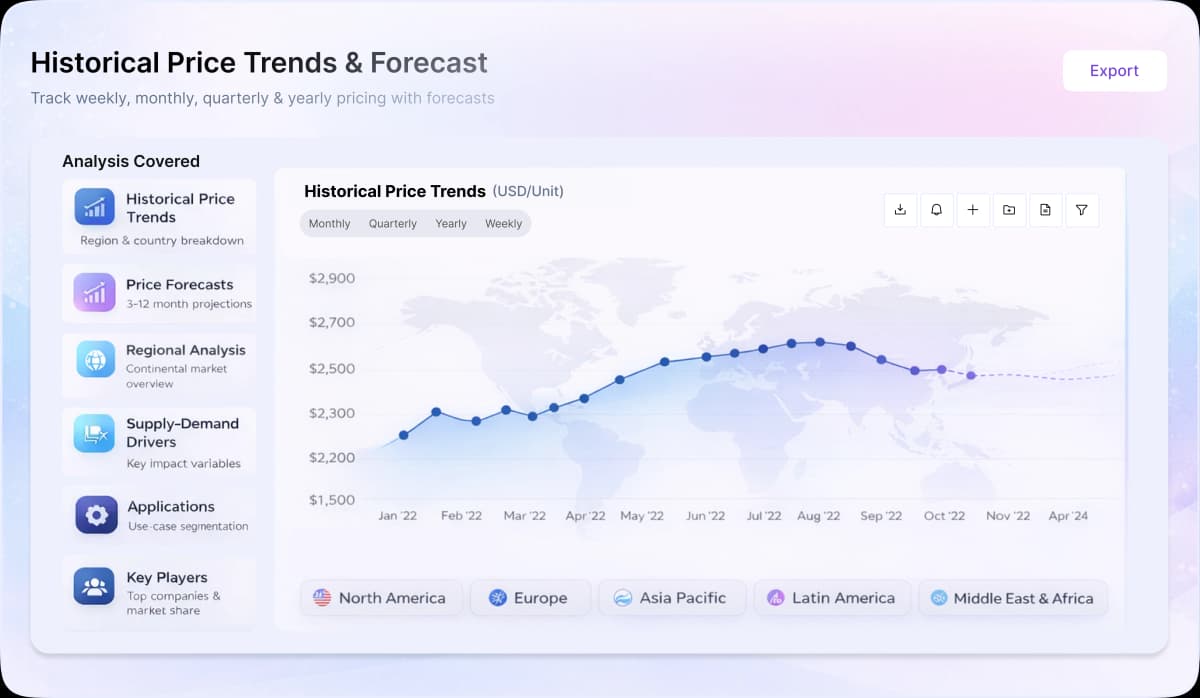
Turn price intelligence into action with the Procurement Resource Database. Log in or subscribe to unlock live price trends, historical charts, supplier databases, cost curves, and analyst-backed insights across chemicals, agriculture, energy, packaging, and more. Use these tools to benchmark your contracts, plan budgets with confidence, and stay ahead of market moves on every product you buy.

Propylene Glycol Dashboard Inclusions

Propylene Glycol Price Dasboard

0

+

Products

0

+

Regions

0

+

Subscriptions

Asia

In Q4 2025, propylene glycol prices in Asia exhibited mixed movement throughout the quarter. The Chinese market experienced a decline during the initial months, continuing the subdued sentiment from the prior period. Downstream sectors, particularly those manufacturing antifreeze formulations, unsaturated polyester resins, and industrial solvents, maintained cautious procurement strategies amid margin constraints and operational challenges. Industrial buyers demonstrated measured restocking behavior, constrained by weak demand signals from end-use segments including automotive coolants, construction materials, and industrial applications. Production rates in derivative facilities remained conservative, limiting spot market activity. Cost pressure from propylene, the primary feedstock, remained muted as international market dynamics and structural oversupply concerns limited upward price transmission. The latter portion of the quarter witnessed a modest recovery as market participants adjusted to earlier price corrections. Nevertheless, the uptick proved moderate, and prices settled into a stable range as the period concluded, with trading activity characterized by limited volatility.

Europe

European propylene glycol markets mirrored the Asian pattern during the fourth quarter. The period commenced with softer pricing levels, reflecting restrained demand from downstream applications including cosmetics, pharmaceuticals, polyester resin manufacturing, and functional fluids. Procurement activity remained measured across derivative sectors, with buyers adopting hand-to-mouth purchasing patterns. No substantial cost-driven support emerged from propylene feedstock channels, as energy costs and production economics provided neutral signals. As the quarter progressed, prices registered a mild recovery before transitioning into a consolidation phase. Market volatility remained contained throughout, with the region moving from early weakness toward relative stability by period end. Trade flows remained balanced, with import-export dynamics showing no significant disruption.

North America

North American propylene glycol pricing followed a trajectory comparable to other global regions in Q4. Initial softness reflected balanced-to-comfortable supply availability alongside moderate demand from antifreeze, food-grade, and industrial chemical segments. Mid-period price adjustments provided limited upward momentum, though gains lacked sustainability as propylene cost support remained neutral. By quarter close, prices had stabilized, consistent with broader international patterns of contained recovery and range-bound trading.

About Propylene Glycol

Propylene glycol is a colorless, odorless, and slightly sweet-tasting organic compound with the chemical formula C3H8O2. It is a type of alcohol and belongs to the class of diols. Propylene glycol is widely used in various industries due to its unique properties. It is a hygroscopic liquid, meaning it absorbs water from the air. This property makes it valuable as a humectant in products like cosmetics, food, and pharmaceuticals, helping to retain moisture and prevent drying.

Additionally, it has low toxicity and is considered safe for human consumption, leading to its usage as a food additive and in medicinal preparations. Propylene glycol also functions as a solvent in numerous applications, making it a versatile and widely employed chemical compound.

Propylene Glycol Product Detail

Hs Code
29053200
Chemical Formula

C3H8O2

Cas Number
57-55-6
Molecular Weight
76.09 g/mol
Industrial Uses

Cosmetics and personal care items, Antifreeze and deicing fluid, Industrial coolant, Food additive and solvent, Chemical processing 

Supplier Database

Lyondell Basell Industries Holdings B.V., INEOS, BASF SE, Repsol, Dow

Regional Coverage

Asia Pacific

China, India, Indonesia, Pakistan, Bangladesh, Japan, Philippines, Vietnam, Iran, Thailand, South Korea, Iraq, Saudi Arabia, Malaysia, Nepal, Taiwan, Sri Lanka, UAE, Israel, Hongkong, Singapore, Oman, Kuwait, Qatar, Australia, and New Zealand

Europe

Germany, France, United Kingdom, Italy,Spain, Russia, Turkey, Netherlands, Poland, Sweden, Belgium, Austria, Ireland Switzerland, Norway, Denmark, Romania, Finland, Czech Republic, Portugal and Greece

North America

United States and Canada

Latin America

Brazil, Mexico, Argentina, Columbia, Chile, Ecuador, and Peru

Africa

South Africa, Nigeria, Egypt, Algeria, Morocco

CurrencyUS$ (Data can also be provided in local currency)

Supplier Database AvailabilityYes

Customization ScopeThe report can be customized as per the requirements of the customer

Post-Sale Analyst Support360-degree analyst support after report delivery

Note: Our supplier search experts can assist your procurement teams in compiling and validating a list of suppliers indicating they have products, services, and capabilities that meet your company's needs.

Propylene Glycol Production Processes

This process involves reacting hydrogen peroxide and propylene monomer to produce propylene oxide. Additionally, propylene glycol is created by hydrating the acquired product, propylene oxide.

In this process, propylene oxide is directly hydrolyzed with water to produce propylene glycol.

In this procedure, hypochlorous acid and propylene monomer react to form propylene chlorohydrin. Additionally, sodium hydroxide reacts with propylene chlorohydrin to produce propylene glycol.

About the Author

Pragati Agarwal profile photo

Pragati Agarwal

Senior Business Insights Analyst

Delivering price trend analysis and procurement market insights at Procurement Resource, with expertise in identifying commodity patterns, supporting purchasing strategies, and improving cost efficiency through actionable market intelligence.

Our Price Analysis Methodology

Schedule Demo

Schedule a demo

Experience how Procurement Resource transforms raw material price data into clear, decision ready intelligence. Optimise your performance with reliable, expert market data and analysis. Schedule your demo today to experience a live walk-through where our experts will showcase interactive price charts, forecasted prices, and insights driving the prices for your key commodities, tailored to your workflows. Contact us now!

Our Team will be happy to assist you

We are just a text away

+1

Still Need Help?

Europe & Africa

+44 7573 171117

[email protected]

USA & Canada

+1 307 363 1045

[email protected]

APAC

+91 8850629517

[email protected]

Unlock full access to Procurement Resource's price databases, interactive charts, and short-term forecasts for thousands of commodities. Elevate your sourcing decisions by comparing prices across regions, downloading historical data, and layering in analyst-backed insights, all with our flexible plans that scale as your portfolio grows.

Still have any Questions

Contact Us
Mastercard
Wire
VISA
Stripe

Why Procurement Database

Commodity Market Intelligence

Commodity Market Intelligence

Track prices, market movements, supply-demand dynamics, and industry developments across hundreds of commodities through a centralized intelligence platform built for informed procurement decisions.

Price Forecasts & Market Outlooks

Price Forecasts & Market Outlooks

Understand market fluctuations using analyst-backed forecasts, historical pricing patterns, and evolving industry trends to strengthen sourcing strategies and budget planning.

Cost & Procurement Optimization

Cost & Procurement Optimization

Leverage cost models, pricing benchmarks, and procurement insights to evaluate purchasing opportunities, improve negotiations, and enhance operational efficiency.

Global & Regional Market Insights

Global & Regional Market Insights

Access region-specific price trends, trade activities, capacity changes, and supply chain developments influencing commodity markets worldwide.

1/4