Quats Price Trend Analysis 2026: Supply Demand Analysis, Latest News, Price Drivers, Historical Prices & Market Insights

Pragati Agarwal profile photo
Written ByPragati Agarwal

Procurement Resource Database

Laptop screen

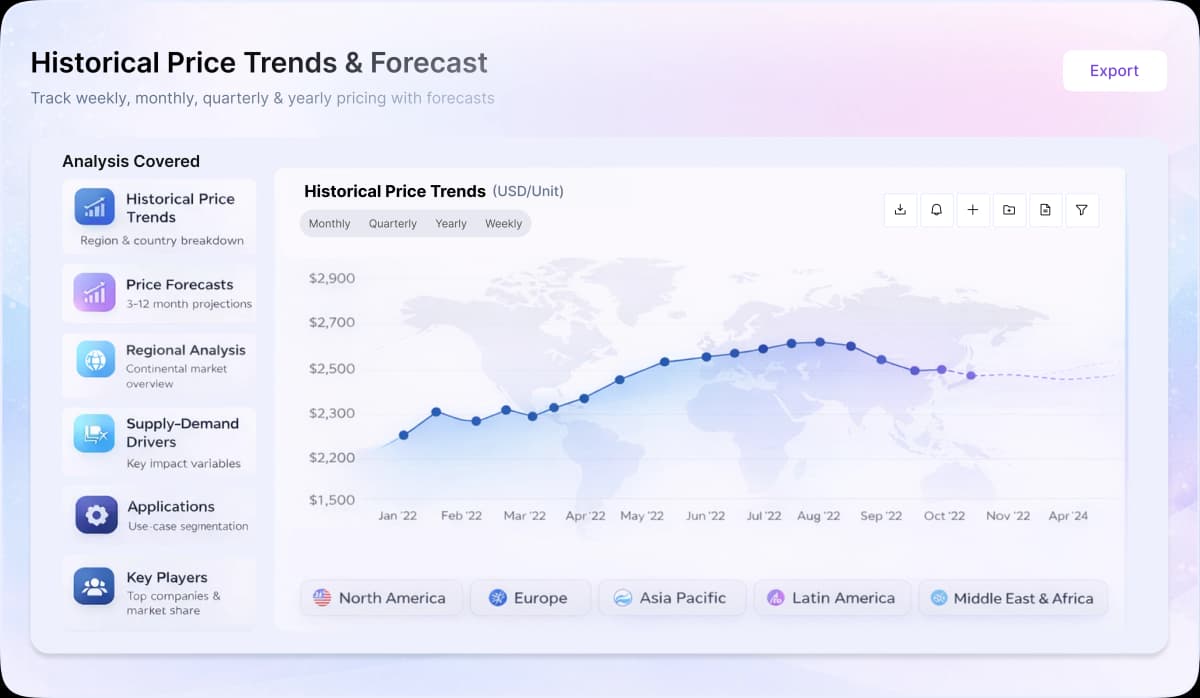
Turn price intelligence into action with the Procurement Resource Database. Log in or subscribe to unlock live price trends, historical charts, supplier databases, cost curves, and analyst-backed insights across chemicals, agriculture, energy, packaging, and more. Use these tools to benchmark your contracts, plan budgets with confidence, and stay ahead of market moves on every product you buy.

0

+

Products

0

+

Regions

0

+

Subscriptions

During the first quarter of 2025, the price trend for quaternary ammonium compounds (quats) remained generally stable, though minor supply issues emerged early in the period. Quats continued to play a crucial role in various industries, including healthcare, personal care, and industrial cleaning. Their use in disinfectants remained particularly significant, as hygiene continued to be a global priority. Additionally, the agriculture and water treatment sectors relied on quats for their antimicrobial properties.

The Chinese Spring Festival led to temporary disruptions in the supply of feedstocks, as several manufacturing plants in China—one of the primary sources of raw materials for quats—either shut down or operated at reduced capacity. This brief production slowdown momentarily affected the supply chain, but the impact was short-lived. Once the holiday period ended, production quickly returned to normal levels. By the end of the quarter, supply conditions had fully stabilized, and the price trend for quats remained steady, with no significant disruptions expected in the near future.


About Quats

Most quaternary ammonium compounds have the general formula R4N+X and are a type of cationic organic nitrogen compound. The nitrogen atom, covalently bonded to four organic groups, bears a positive charge that is balanced by a negative counterion. There are vast numbers of quaternary ammonium compounds.

Many are naturally occurring and have been found to be crucial in biochemical reactions. Many quaternaries are also produced synthetically and are commercially available. Some of the examples of QUATs are benzalkonium chloride, Alkyl dimethyl benzyl ammonium chlorides and methylbenzethonium chloride.

Quats Product Detail

Chemical Formula

NR4+

Industrial Uses

Shampoos, Toilet Cleaners, Hand Soap, Shaving Cream , Sunscreens, Moisturisers , Disinfectant Sprays , Liquid Fabric Softener 

Supplier Database

BASF SE, Clariant AG, KAO Corporation, Croda International Plc., Stepan Company, Evonik Industries AG

Regional Coverage

Asia Pacific

China, India, Indonesia, Pakistan, Bangladesh, Japan, Philippines, Vietnam, Iran, Thailand, South Korea, Iraq, Saudi Arabia, Malaysia, Nepal, Taiwan, Sri Lanka, UAE, Israel, Hongkong, Singapore, Oman, Kuwait, Qatar, Australia, and New Zealand

Europe

Germany, France, United Kingdom, Italy,Spain, Russia, Turkey, Netherlands, Poland, Sweden, Belgium, Austria, Ireland Switzerland, Norway, Denmark, Romania, Finland, Czech Republic, Portugal and Greece

North America

United States and Canada

Latin America

Brazil, Mexico, Argentina, Columbia, Chile, Ecuador, and Peru

Africa

South Africa, Nigeria, Egypt, Algeria, Morocco

CurrencyUS$ (Data can also be provided in local currency)

Supplier Database AvailabilityYes

Customization ScopeThe report can be customized as per the requirements of the customer

Post-Sale Analyst Support360-degree analyst support after report delivery

Note: Our supplier search experts can assist your procurement teams in compiling and validating a list of suppliers indicating they have products, services, and capabilities that meet your company's needs.

Quats Production Processes

  • Production of QUATs via Menshutkin Reaction

In the Menshutkin reaction, the tertiary amines are converted into Quaternary Ammonium Salt by reacting it with alkyl halide and a similar reaction takes place when tertiary phosphines are treated with alkyl halides. For instance, triethyl benzyl ammonium chloride is prepared from triethylamine and benzyl chloride.

Frequently Asked Questions

The quats outlook for 2026 points to stable, well-supplied market conditions through H2 2026, following range-bound pricing in H1 2026 that reflected firm downstream demand balanced against adequate feedstock availability. Healthcare, institutional cleaning, and personal care consumption underpinned steady order cadence, while normalised freight and consistent Chinese tertiary amine and alkyl halide production kept upstream cost pressure contained. The main upside risks to this stable outlook are freight cost increases and any disruption to Chinese amine supply, which could tighten upstream availability and push landed costs higher.

Quats prices tend to stay range bound as opposing forces balance out. On the cost side, steady Chinese production of tertiary amine and alkyl halide feedstocks keeps upstream input costs contained, while improved freight conditions lower landed costs for importers. On the demand side, resilient healthcare and institutional cleaning consumption, stable personal care offtake driven by premiumisation in emerging markets, and agricultural biocidal use all support buying. However, subdued industrial end-use demand prevents sharp upward price pressure.
Major quats companies include BASF SE, Clariant AG, KAO Corporation, Croda International Plc., Stepan Company, and Evonik Industries AG. Chinese manufacturers dominate upstream supply, providing a significant share of the tertiary amine and alkyl halide feedstocks that underpin global quats output. Consumption is spread across key regions, with healthcare, personal care, and institutional cleaning driving steady demand in Asia Pacific, Europe, and North America.

Quats are produced via the Menshutkin reaction, in which tertiary amines are reacted with alkyl halides to form quaternary ammonium salts. The finished quats then serve as active ingredients across disinfectants and sanitizers, personal care products such as shampoos and fabric softeners, pharmaceutical antiseptics and sprays, agricultural fungicides, and water treatment biocides.

Healthcare and pharmaceuticals are the primary demand driver, with quats used in antiseptics, hand sanitizers, disinfectant wipes, medicinal devices, and nasal and ophthalmic sprays. Personal care (shampoos, fabric softeners, creams) holds steady, supported by premiumisation in emerging markets. Agricultural biocides, including fungicides, add further demand. Industrial and institutional cleaning, spanning food processing and hospitality, sustains healthy order volumes. Together, these sectors underpin firm downstream pull, keeping quats prices range bound.

Procurement Resource assesses quats prices through a structured, data-driven methodology. Primary engagement across the value chain gathers validated price points from producers, suppliers, and traders to capture transaction behaviour. This is layered with secondary market data and monitoring of upstream feedstock and input costs, trade flows, and inventory positions, cross-checked against exchange and spot benchmarks. Each data point is validated, normalised, and translated into a price assessment and short-term outlook, ensuring actionable, market-reflective intelligence. Detailed quats methodology, including weighting, frequency, and validation steps, is available on the Procurement Resource website.


Our Price Analysis Methodology

About the Author

Pragati Agarwal profile photo

Pragati Agarwal

Senior Business Insights Analyst

Delivering price trend analysis and procurement market insights at Procurement Resource, with expertise in identifying commodity patterns, supporting purchasing strategies, and improving cost efficiency through actionable market intelligence.

Schedule Demo

Schedule A Demo

Experience how Procurement Resource transforms raw material price data into clear, decision ready intelligence. Optimise your performance with reliable, expert market data and analysis. Schedule your demo today to experience a live walk-through where our experts will showcase interactive price charts, forecasted prices, and insights driving the prices for your key commodities, tailored to your workflows. Contact us now!

Our Team will be happy to assist you

We are just a text away

+1

Still Need Help?

Europe & Africa

+44 7573 171117

[email protected]

USA & Canada

+1 254 254 1750

[email protected]

APAC

+91 8850629517

[email protected]

Other Related Reports

Ammonium Lauryl Sulphate Production via Sulphonation Process

This report presents a detailed cost analysis of ammonium lauryl sulphate production from chlorosulphonic acid, lauryl alcohol, and ammonium hydroxide using the sulphonation process.

Ammonium Lauryl Sulphate Production from Coconut Oil

This report presents a detailed cost analysis of ammonium lauryl sulphate production from coconut oil.

Ammonium Nitrate Production from Metal Nitrates

The report is a detailed cost analysis of production of ammonium nitrate by a typical metathesis reaction.

Ammonium Nitrate Production from Ammonia

The report is a detailed study of economics of ammonium nitrate by the reaction of nitric acid on anhydrous ammonia resulting in an aqueous ammonium nitrate solution.

Ammonium Chloride Production by Solvay Process

The report involves the cost analysis of production of Ammonium Chloride as a product of Solvay Process for production of sodium carbonate.

Unlock full access to Procurement Resource's price databases, interactive charts, and short-term forecasts for thousands of commodities. Elevate your sourcing decisions by comparing prices across regions, downloading historical data, and layering in analyst-backed insights, all with our flexible plans that scale as your portfolio grows.

Still have any Questions

Contact Us
Mastercard
Wire
VISA
Stripe

Related News

View All

Why Procurement Database

Commodity Market Intelligence

Commodity Market Intelligence

Track prices, market movements, supply-demand dynamics, and industry developments across hundreds of commodities through a centralized intelligence platform built for informed procurement decisions.

Price Forecasts & Market Outlooks

Price Forecasts & Market Outlooks

Understand market fluctuations using analyst-backed forecasts, historical pricing patterns, and evolving industry trends to strengthen sourcing strategies and budget planning.

Cost & Procurement Optimization

Cost & Procurement Optimization

Leverage cost models, pricing benchmarks, and procurement insights to evaluate purchasing opportunities, improve negotiations, and enhance operational efficiency.

Global & Regional Market Insights

Global & Regional Market Insights

Access region-specific price trends, trade activities, capacity changes, and supply chain developments influencing commodity markets worldwide.

1/4