Prakhar Panchbhaiya
Assistant Manager: Business Insights and Content
Supporting procurement teams with category intelligence, market research, price trends, supply-demand analysis, and strategic sourcing insights across key industries.
Asia
During the first half of 2025, salicylaldehyde prices in Asia showed mild upward movement, primarily driven by rising feedstock costs. The regional benzene market experienced a price increase in early February, impacting the cost structure of downstream products like salicylaldehyde.
Tighter phenol supply used in its synthesis also added to cost pressures, especially as European producers faced disruptions. Despite this, oversupply and soft downstream demand in broader chemical markets kept the price increase in check. Demand from pharmaceuticals and agrochemicals held relatively stable, particularly in China and India, supporting modest price resilience. However, competitive pressure from lower-cost producers kept margins narrow.
Europe
European salicylaldehyde prices remained largely unstable throughout H1’25. Phenol market volatility, coupled with high energy costs and carbon tax implications, led to production constraints. Plant closures including announcements like Ineos shutting its phenol unit in Gladbeck tightened phenol availability, indirectly raising salicylaldehyde production costs.
Despite some short-lived price rebounds in February due to higher benzene prices, the market was weighed down by weak construction sector demand and chemical overcapacity. The resulting cost-push inflation in the upstream was not always matched by downstream demand, causing inconsistent pricing and margin pressure.
North America
In North America, salicylaldehyde prices showed greater stability. Tariff-related developments created market uncertainty, particularly regarding imports of fragrance and pharmaceutical components, yet domestic production managed to balance supply-demand conditions.
The pharmaceutical sector’s steady demand for intermediates like salicylaldehyde, combined with firm chloroform market conditions and stable methanol supply, helped avoid sharp price swings. However, concerns over broader tariff implications and global market shifts kept sentiment cautious.
Related Report
Get real-time price assessments, periodic trends, forecasts and price driver insights across key global markets.

Unlock Price Insights NowOur Clients

Turn price intelligence into action with the Procurement Resource Database. Log in or subscribe to unlock live price trends, historical charts, supplier databases, cost curves, and analyst-backed insights across chemicals, agriculture, energy, packaging, and more. Use these tools to benchmark your contracts, plan budgets with confidence, and stay ahead of market moves on every product you buy.

0
+Products
0
+Regions
0
+Subscriptions
Asia
In 2024, the Asian Salicylaldehyde market followed a varied trend influenced by fluctuations in upstream Phenol and Chloroform prices, both of which are key feedstocks in its production. In the first half of the year, prices rose steadily due to tight supply conditions and higher production costs, particularly in India and China.
The rise in crude oil and naphtha costs, along with limited feedstock availability, kept the market firm. However, as the year progressed into Q3 and Q4, Salicylaldehyde prices in the region came under pressure. This was due to improved supply from domestic production units, resumption of operations at key plants, and softening feedstock prices, especially Phenol and Chloroform. Buyers across downstream industries like pharmaceuticals and flavors were cautious in their procurement strategies, leading to a subdued demand environment in the latter part of the year.
Europe
The European Salicylaldehyde market experienced a generally downward trend in 2024, reflecting the region's weak economic climate and sluggish demand from end-use sectors. The construction and chemical industries, major consumers of Salicylaldehyde derivatives, continued to struggle throughout the year.
Feedstock Phenol prices showed occasional firmness early on due to energy cost fluctuations, but later declined, mirroring broader global trends. Chloroform prices remained soft due to excess supply and cheaper imports from Asia. All of these factors contributed to lowered production costs, but the lack of strong downstream pull limited any price gains.
North America
In North America, the market showed mixed movement during 2024. Early in the year, prices edged lower due to low demand and logistical challenges impacting trade flows. Feedstock Chloroform and Phenol saw some price recovery in Q3, driven by seasonal demand and stockpiling ahead of the holiday season. However, by Q4, prices began to ease again due to falling crude oil values and weak downstream industries such as polycarbonates and pharmaceuticals. Political uncertainty around the U.S. elections also made market players hesitant to make large-volume commitments.
Salicylaldehyde is known as a hydroxybenzaldehyde that is composed of a hydroxy substituent at position 2. It is an organic compound that appears as a colourless or a pale-yellow liquid. It plays a role as a nematicide and a plant metabolite. Further, it has bitter almond scent with burned flavour. It shows slight solubility in water while it is soluble in ethyl alcohol and diethyl ether.
C7H6O2
Intermediates, Spice, Gasoline additive, Organic synthesis, Production of Coumarin, Analytical chemistry, Dye and perfumery, Flavouring, Saligenin synthesis, Salicylaldoxime synthesis
2-Hydroxybenzaldehyde, o-Hydroxybenzaldehyde
Guannan East Chemical Co., Ltd, Hubei Xiansheng Biotechnology Co., Ltd. , Zhangjiagang Feihang Industry Co., Ltd., Lianyungang Hengshun Chemical Co., Ltd.
CurrencyUS$ (Data can also be provided in local currency)
Supplier Database AvailabilityYes
Customization ScopeThe report can be customized as per the requirements of the customer
Post-Sale Analyst Support360-degree analyst support after report delivery
Note: Our supplier search experts can assist your procurement teams in compiling and validating a list of suppliers indicating they have products, services, and capabilities that meet your company's needs.
In the Reimer–Tiemann reaction, Salicylaldehyde is produced from phenol and chloroform. In this reaction, phenol and chloroform are heated along with sodium hydroxide or potassium hydroxide, which finally produces Salicylaldehyde.

Assistant Manager: Business Insights and Content
Supporting procurement teams with category intelligence, market research, price trends, supply-demand analysis, and strategic sourcing insights across key industries.
Our Price Analysis Methodology

Experience how Procurement Resource transforms raw material price data into clear, decision ready intelligence. Optimise your performance with reliable, expert market data and analysis. Schedule your demo today to experience a live walk-through where our experts will showcase interactive price charts, forecasted prices, and insights driving the prices for your key commodities, tailored to your workflows. Contact us now!
Our Team will be happy to assist you
We are just a text away
Still Need Help?
This report presents a detailed cost analysis of 2-hydroxybenzoic acid production from aspirin or methyl salicylate using hydrolysis.
This report analyses the economics of a typical salicylic acid production process from phenol, sodium hydroxide, carbon dioxide, and sulfuric acid.
Unlock full access to Procurement Resource's price databases, interactive charts, and short-term forecasts for thousands of commodities. Elevate your sourcing decisions by comparing prices across regions, downloading historical data, and layering in analyst-backed insights, all with our flexible plans that scale as your portfolio grows.
Still have any Questions
Contact Us


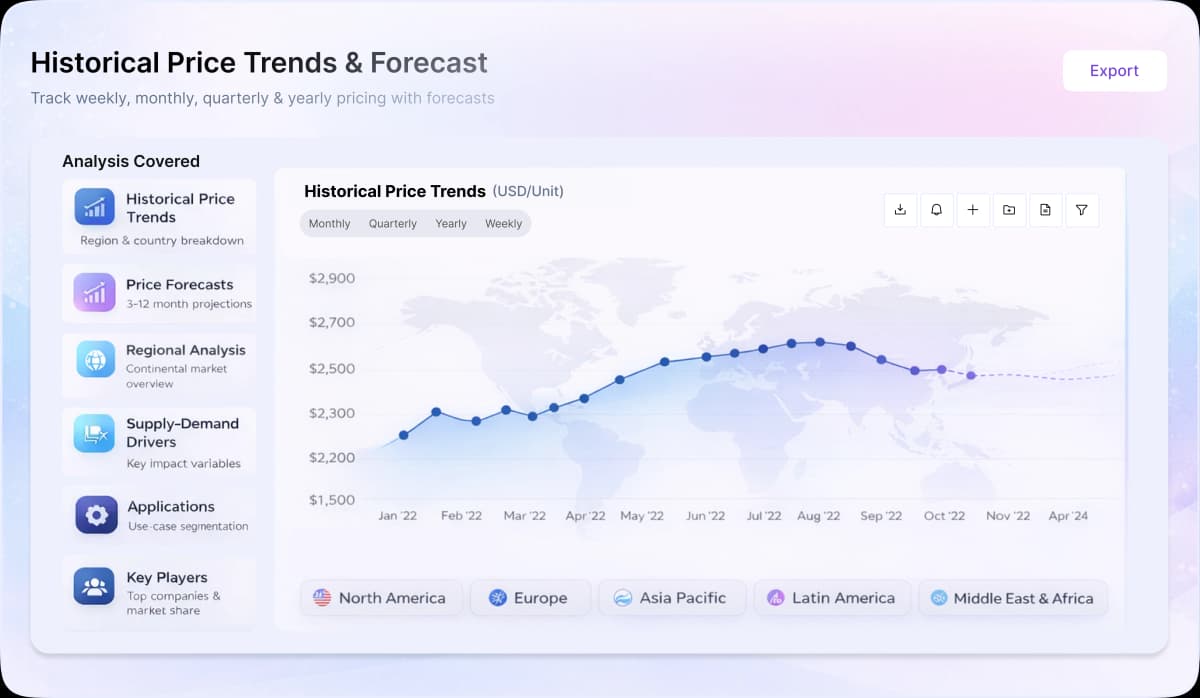
Price Trend Dashboard - What's Included
Price trends across a diverse portfolio of categories and products, spanning board to niche chemicals
Coverage extendable to grade-specific chemicals based on procurement requirements
Regular price tracking supported by robust historical datasets
News, policy updates, and key market drivers impacting price movements
Short-term and long-term price outlooks and forecasts
Supply-demand dynamics and capacity-driven market analysis