

Udeesha Tomar
AVP - Strategy and Solutions
Leading procurement research solutions across chemicals, materials, and food & beverages, with expertise in price forecasting and market analytics.

Asia
During H2 2025, the Asian silicates market followed a mixed trajectory, transitioning from early weakness to a firmer tone by the end of the period. In Q3, prices declined initially due to improved supply conditions and moderate demand from key downstream sectors such as detergents, construction materials, and adhesives, before stabilizing in the mid-quarter and recovering slightly as procurement activity improved. This trend extended into Q4, where prices again softened in the first half amid adequate inventories, lower feedstock support, and cautious buying sentiment. However, the latter half of Q4 saw a sharper recovery, driven by tightening feedstock availability and increased demand from water treatment, refractory materials, and industrial applications. Overall, the region moved from oversupply-driven softness to a more balanced and firmer market environment by the end of H2.
Europe
The European silicates market exhibited a fluctuating yet largely stable trend during H2 2025. In Q3, prices increased steadily, supported by consistent demand from detergent manufacturing, pulp and paper processing, and water treatment sectors, along with firm production costs and relatively tight supply. Toward the end of the quarter, prices softened slightly as supply conditions improved, and buyers became more cautious. In Q4, the market experienced an initial decline driven by softer import values and subdued downstream demand, reaching a mid-quarter low. This was followed by a gradual recovery supported by strengthening feedstock costs and improved procurement activity from industrial and construction sectors. Overall, the market maintained balance, ending the half-year on a relatively stable to firm note.
North America
In North America, the silicates market demonstrated moderate volatility during H2 2025, with trends closely aligning with those observed in Europe. During Q3, prices advanced steadily, supported by firm demand from detergents, water treatment, and industrial applications, along with tight supply conditions and stable production economics. However, prices softened slightly toward the end of the quarter as supply improved. In Q4, the market entered a softer phase initially due to declining feedstock costs and measured demand, reaching a trough mid-quarter. A recovery followed as supply tightened and downstream demand from paper manufacturing and water treatment sectors strengthened. By the end of H2, prices had rebounded, reflecting improved market fundamentals and a more balanced supply-demand scenario.
Analyst Insight
According to Procurement Resource, silicate prices in H2 2025 showed a transition from early softness to firmer conditions toward year-end, supported by tightening supply, improving feedstock cost structures, and gradual recovery in downstream demand across major regions.
Related Report
Need Latest Silicates Prices?
Get real-time price assessments, periodic trends, forecasts and price driver insights across key global markets.
Our Clients




























Turn price intelligence into action with the Procurement Resource Database. Log in or subscribe to unlock live price trends, historical charts, supplier databases, cost curves, and analyst-backed insights across chemicals, agriculture, energy, packaging, and more. Use these tools to benchmark your contracts, plan budgets with confidence, and stay ahead of market moves on every product you buy.
0
+Products
0
+Regions
0
+Subscriptions
Asia
In the first half of 2025, the silicate market in Asia showed stable trends despite facing some seasonal and economic challenges. Production levels stayed steady across the region, with input costs under control, allowing suppliers to maintain consistent output. Demand from construction and manufacturing sectors remained cautious but steady, especially in China, where government initiatives supported construction recovery in key urban areas.
Though the early part of the year was affected by seasonal slowdowns like the Chinese New Year, the market gained some traction by March and April. Restocking activity was moderate, mainly driven by the silicone segment, but overall trading remained subdued. As a result, prices stayed mostly flat throughout the first half, with minimal volatility.
Europe
The European silicate market faced weak demand conditions during H1’25, mainly due to continued sluggishness in the construction and industrial sectors. Germany, in particular, experienced limited activity in both housing and commercial real estate, which kept consumption low. Despite these headwinds, supply remained stable, supported by smooth operations across production facilities.
Inventory levels stayed balanced, thanks to efficient supply chain management. However, overall market sentiment was cautious, with little to no upward pressure on prices. While there were some signs of resilience in certain localized markets, broader economic concerns kept demand growth in check.
North America
In North America, the silicate market also experienced a relatively quiet first half of 2025. Demand was held back by slowdowns in residential construction and a generally cautious economic climate. Despite this, manufacturing sectors such as glass and chemicals provided a base level of support for silicate consumption.
Supply chains functioned well, and inventory remained at manageable levels. As a result, the market maintained a steady price trend, with minimal fluctuations throughout the period. Traders adopted a cautious approach, avoiding aggressive restocking amid uncertain demand outlooks.
A Silicate is a salt or ester extracted from silicic acid. Solid silicates are usually stable and well characterised. Any of numerous insoluble and complex metal salts that hold silicon and oxygen in the anion, constitute the largest class of minerals, and are further utilised in building materials like the cement, bricks, and glass.
Glass, Foundries, Construction, Ceramics, Chemical Industry
Nippon Chemical Industrial CO., LTD, Tokuyama Corporation, BASF SE, PQ Corporation, Evonik Industries AG
CurrencyUS$ (Data can also be provided in local currency)
Supplier Database AvailabilityYes
Customization ScopeThe report can be customized as per the requirements of the customer
Post-Sale Analyst Support360-degree analyst support after report delivery
Note: Our supplier search experts can assist your procurement teams in compiling and validating a list of suppliers indicating they have products, services, and capabilities that meet your company's needs.
In this process, silica sand is fused with soda ash at about 1,100oC to form water glass, that is, glass-like sodium silicate, which is then crushed and dissolved in water and digested under pressure with steam to finally produce neutral silicate.
Our Price Analysis Methodology
AVP - Strategy and Solutions
Leading procurement research solutions across chemicals, materials, and food & beverages, with expertise in price forecasting and market analytics.
Experience how Procurement Resource transforms raw material price data into clear, decision ready intelligence. Optimise your performance with reliable, expert market data and analysis. Schedule your demo today to experience a live walk-through where our experts will showcase interactive price charts, forecasted prices, and insights driving the prices for your key commodities, tailored to your workflows. Contact us now!
Our Team will be happy to assist you
We are just a text away
Still Need Help?
Unlock full access to Procurement Resource's price databases, interactive charts, and short-term forecasts for thousands of commodities. Elevate your sourcing decisions by comparing prices across regions, downloading historical data, and layering in analyst-backed insights, all with our flexible plans that scale as your portfolio grows.
Still have any Questions
Contact Us



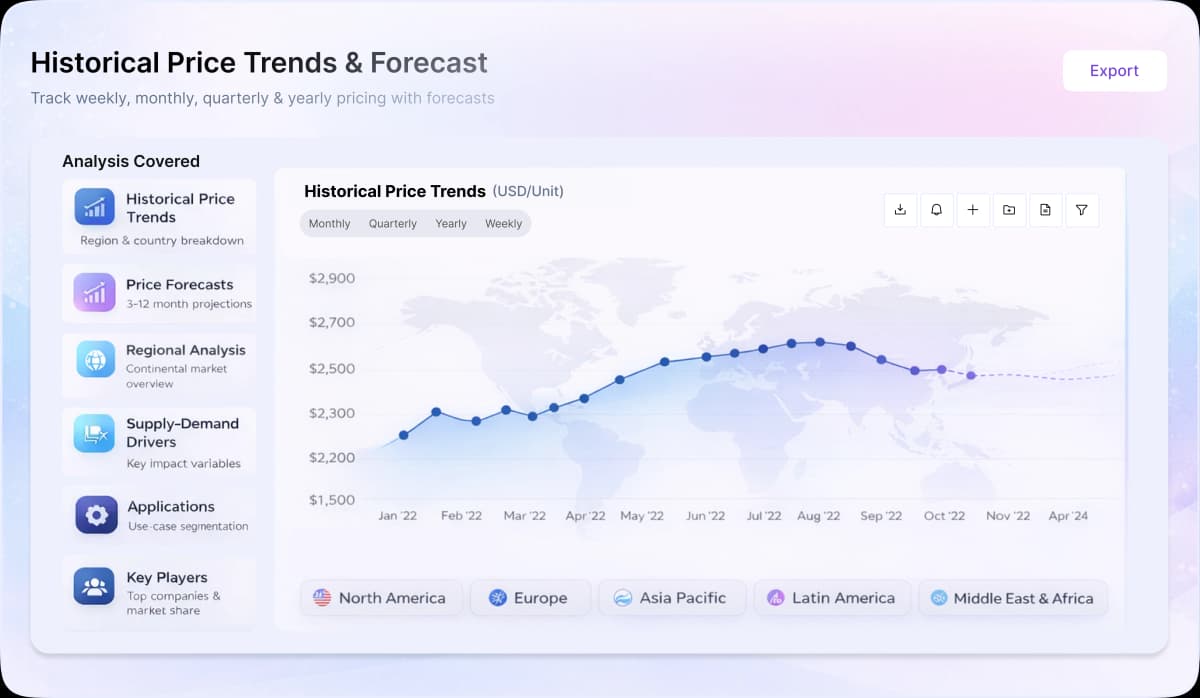
Price Trend Dashboard - What's Included
Price trends across a diverse portfolio of categories and products, spanning board to niche chemicals
Coverage extendable to grade-specific chemicals based on procurement requirements
Regular price tracking supported by robust historical datasets
News, policy updates, and key market drivers impacting price movements
Short-term and long-term price outlooks and forecasts
Supply–demand dynamics and capacity-driven market analysis

Track prices, market movements, supply-demand dynamics, and industry developments across hundreds of commodities through a centralized intelligence platform built for informed procurement decisions.

Understand market fluctuations using analyst-backed forecasts, historical pricing patterns, and evolving industry trends to strengthen sourcing strategies and budget planning.

Leverage cost models, pricing benchmarks, and procurement insights to evaluate purchasing opportunities, improve negotiations, and enhance operational efficiency.
Access region-specific price trends, trade activities, capacity changes, and supply chain developments influencing commodity markets worldwide.