Udeesha Tomar
AVP - Strategy and Solutions
Leading procurement research solutions across chemicals, materials, and food & beverages, with expertise in price forecasting and market analytics.
Asia
In the first half of 2025, the silicone emulsion market in Asia experienced a generally soft trend. During Q1, demand was modest across industries like personal care, construction, and electronics. The Chinese New Year holidays and maintenance shutdowns among raw material suppliers reduced production, but high inventories kept prices in check.
In Q2, operating rates increased as plant turnarounds ended, and feedstock availability improved. However, weak demand especially from the construction sector due to high summer temperatures limited any meaningful price recovery. Despite moderate restocking during the traditional demand season, excess supply and cautious buying behaviour led to an overall subdued market sentiment.
Europe
Silicone emulsion prices in Europe faced consistent downward pressure during H1’25. Demand was tepid from key sectors such as automotive and construction, and oversupply weighed heavily on the market. Although there were brief supply-side disruptions in early Q1, including labor strikes and port delays, these were not enough to support prices long-term.
As raw material costs began to ease and inventories remained high, buyers held back on procurement, anticipating further declines. The slow pace of industrial recovery and broader economic uncertainties added to the bearish tone in the region’s silicone emulsion market.
North America
In North America, the silicone emulsion market showed a mixed performance in H1’25. Q1 saw a slight uptick in demand from sectors such as automotive and personal care, supported by restocking and resilient EV production. However, rising raw material costs and logistical challenges added to production expenses.
By Q2, the market weakened again due to high inventories and softer demand, particularly in construction and industrial applications. Traders adopted a cautious stance, and competitive pricing became more common to encourage sales, contributing to a slow but steady decline in overall market sentiment.
Related Report
Get real-time price assessments, periodic trends, forecasts and price driver insights across key global markets.
Unlock Price Insights NowOur Clients

Turn price intelligence into action with the Procurement Resource Database. Log in or subscribe to unlock live price trends, historical charts, supplier databases, cost curves, and analyst-backed insights across chemicals, agriculture, energy, packaging, and more. Use these tools to benchmark your contracts, plan budgets with confidence, and stay ahead of market moves on every product you buy.

0
+Products
0
+Regions
0
+Subscriptions
Asia
In Asia, Silicone Emulsion prices started 2024 on a weak note. During Q1, demand was subdued across key industries like construction and electronics, while high inventories and global economic uncertainties kept pricing under pressure. The trend continued in Q2, especially in South Korea and China, where overproduction, logistical disruptions, and plant shutdowns further pushed prices downward.
Although Q3 brought a short-lived recovery mainly from rising electric vehicle production and construction activity the momentum faded quickly. Seasonal slowdowns and declining raw material costs in the latter half of Q3 and into Q4 led to a steady fall in prices. By year-end, the market faced continued oversupply and cautious buying behaviour, keeping prices consistently low despite isolated sectoral demand like EV manufacturing.
Europe
Silicone Emulsion prices in Europe began 2024 with moderate strength. Q1 and Q2 were shaped by rising production costs, including high energy prices and expensive raw materials, which pushed prices up, particularly in cosmetics and personal care applications. Disruptions like flooding and plant shutdowns further constrained supply. However, from Q3 onward, the market saw a downward shift.
Weaker economic activity, falling demand from construction and automotive sectors, and inventory corrections among downstream industries led to price reductions. By Q4, even though hybrid vehicle production remained strong, reduced consumer confidence and improved logistics eased price pressures, resulting in a noticeable decline compared to earlier quarters.
North America
In North America, Q1’24 showed a slow recovery in demand, especially from the automotive and electronics sectors, which kept Silicone Emulsion prices relatively firm. However, by Q2, prices began to decline due to oversupply, slowdowns in key markets, and destocking trends.
The downward momentum reversed sharply in Q3, with a strong surge in demand from the automotive and semiconductor industries, coupled with ongoing supply issues such as port congestion and labor strikes. Still, this rebound was short-lived. In Q4, prices dropped again as supply normalized and seasonal factors reduced demand. Despite steady automotive activity, overall consumption was affected by cautious purchasing patterns and economic headwinds.
Silicone emulsions are insoluble silicones that are evenly dispersed in water with the aid of an emulsifying surfactant. They can be divided broadly into 3 groups, depending upon the type of emulsifier system utilised; they can be anionic, cationic and non-ionic.
Cosmetics, Lubricants, Plastic, Car Polish, Textile
BRB International BV, Elkem Silicones, CHT UK Bridgwater Ltd (CHT Group), Om Tex Chem Private Limited
CurrencyUS$ (Data can also be provided in local currency)
Supplier Database AvailabilityYes
Customization ScopeThe report can be customized as per the requirements of the customer
Post-Sale Analyst Support360-degree analyst support after report delivery
Note: Our supplier search experts can assist your procurement teams in compiling and validating a list of suppliers indicating they have products, services, and capabilities that meet your company's needs.

Silicone in water emulsions can be prepared by emulsion polymerisation or by mechanical emulsification of a silicone polymer with one or more surfactants along with water. This emulsion is collected at the outlet of the reactor and inverted by shearing it to an oil-in-water emulsion.

AVP - Strategy and Solutions
Leading procurement research solutions across chemicals, materials, and food & beverages, with expertise in price forecasting and market analytics.

Our Price Analysis Methodology

Experience how Procurement Resource transforms raw material price data into clear, decision ready intelligence. Optimise your performance with reliable, expert market data and analysis. Schedule your demo today to experience a live walk-through where our experts will showcase interactive price charts, forecasted prices, and insights driving the prices for your key commodities, tailored to your workflows. Contact us now!

Our Team will be happy to assist you
We are just a text away
Still Need Help?
This report presents a detailed cost structure of silicone elastomers production. Silicone elastomers are derived from the copolymerization of cyclic siloxane with phenylmethylsiloxane and vinylmethylsiloxane.
This report presents a detailed cost analysis of Silicone Fluid production, more specifically methyl hydrogen polysiloxane.
Unlock full access to Procurement Resource's price databases, interactive charts, and short-term forecasts for thousands of commodities. Elevate your sourcing decisions by comparing prices across regions, downloading historical data, and layering in analyst-backed insights, all with our flexible plans that scale as your portfolio grows.
Still have any Questions
Contact Us


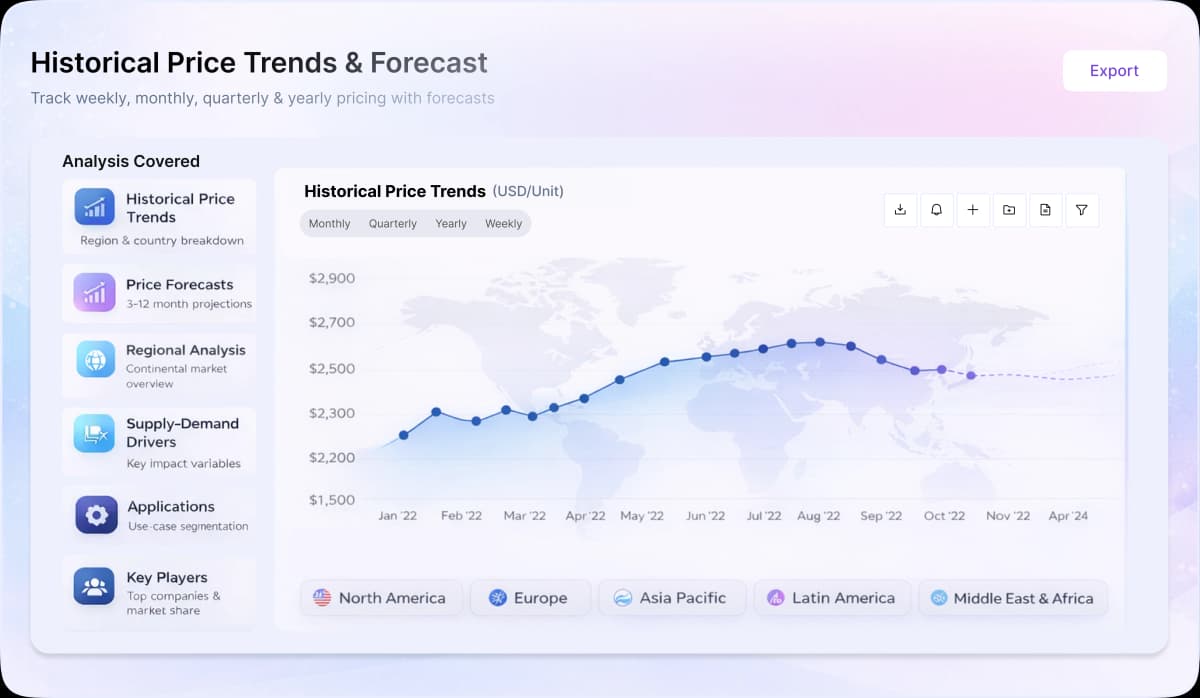
Price Trend Dashboard - What's Included
Price trends across a diverse portfolio of categories and products, spanning board to niche chemicals
Coverage extendable to grade-specific chemicals based on procurement requirements
Regular price tracking supported by robust historical datasets
News, policy updates, and key market drivers impacting price movements
Short-term and long-term price outlooks and forecasts
Supply-demand dynamics and capacity-driven market analysis