Udeesha Tomar
AVP - Strategy and Solutions
Leading procurement research solutions across chemicals, materials, and food & beverages, with expertise in price forecasting and market analytics.
Asia
In the Asian market, the prices of siloxane were relatively stable during Q4’25, with moderate increases. The demand from the automotive, electrical, and personal care industries remained good, leading to regular buying. In the Chinese market, the demand was active, but the prices of energy and the tariffs of electricity affected the cost of production. However, the export market showed a slight increase after the change in trade policy, motivating the producers to maintain the production rate to meet both local and export markets. In the Indian market, the prices were relatively stable due to the demand from the festival season, while the local production met the demand.
Europe
In Europe, siloxane prices were relatively stable in Q4'25. Supplies were sufficient, but high energy costs as well as cost pressures from raw materials contributed some upward pressure to prices. Demand from industry, including the construction, personal care, and specialty chemical segments, was stable but not robust enough to drive prices up. Procurement activities were careful, with market conditions and cost pressures being closely monitored. Logistics and shipping costs were manageable, which helped sustain a good level of supply from major regions. Prices were relatively flat, indicating a market that was well supplied relative to demand.
North America
In the North American market, the prices of siloxane have been relatively stable, with minor fluctuations in the Q4’25 period. Demand in the automobile, construction, and industrial sectors was robust, although the seasonal impact, as well as the end-of-year maintenance in semiconductor-related production, impacted the buying patterns slightly. The supply chain was closely monitored, taking into consideration the disruptions in the past in the import and production of the material. The cost of the feedstock, such as silicon metal, saw a decrease in some cases, thereby maintaining the stability in the overall pricing.
Analyst Insight
According to Procurement Resource, Siloxane prices are expected to remain stable, although any variations in the cost of the feedstock may impact the overall scenario.
Related Report
Get real-time price assessments, periodic trends, forecasts and price driver insights across key global markets.
Unlock Price Insights NowOur Clients

Turn price intelligence into action with the Procurement Resource Database. Log in or subscribe to unlock live price trends, historical charts, supplier databases, cost curves, and analyst-backed insights across chemicals, agriculture, energy, packaging, and more. Use these tools to benchmark your contracts, plan budgets with confidence, and stay ahead of market moves on every product you buy.

0
+Products
0
+Regions
0
+Subscriptions
Asia
In Asia, siloxane prices showed a modest rebound during the third quarter of 2025. After several months of weakness, the market improved in July and early August as silicon production declined in northern China, leading to tighter raw material availability. This reduction in supply supported a mild price recovery.
Demand also strengthened from downstream sectors such as construction, automotive, and electronics, which boosted trading activity. However, by September, seasonal slowdowns and reduced buying interest led to a slight dip in prices. Despite this, the Asian siloxane market stayed more active than other regions, supported by consistent exports and steady industrial growth.
Europe
In Europe, the siloxane market remained largely steady throughout Q3’25. Buyers adopted a cautious stance, waiting to assess export trends from Asia before making large-volume purchases. Demand from end-use industries like automotive, healthcare, and electronics continued at a moderate pace without any sharp increases. The broader European chemical sector faced challenges from high energy costs and weak manufacturing activity, which kept price movements limited. Even with restructuring announcements and plant closures in the region, the siloxane market stayed balanced, reflecting stable but subdued trade sentiment.
North America
In North America, siloxane prices remained stable during the third quarter. Local producers-maintained output levels aligned with domestic needs, preventing oversupply. Industrial demand, particularly from manufacturing, electronics, and sealant applications, stayed consistent. Discussions around improving domestic silicon and chemical production highlighted efforts toward long-term supply security but did not influence near-term prices. Overall, the North American market was steady with balanced supply and demand conditions.
Analyst Insight
According to Procurement Resource, Siloxane prices are expected to remain under mild pressure in the near term. Any potential increase would depend on a stronger demand recovery and the pace of new production capacity expansions in major manufacturing regions.
A siloxane is a functional group in the chemistry of organosilicon. The oligomeric and polymeric hydrides are constituents of the parent siloxanes. Additionally, siloxanes include branching compounds, which may be identified by the fact that each pair of silicon centres is separated from another by one oxygen atom. Siloxanes are categorised as linear or cyclic volatile methyl siloxanes, polydimethylsiloxanes, or PDMS, or polyethermethylsiloxanes, or PEMS, based on their molecular weights.


used to fabricate polymer, Production of skin care creams, Production of adhesives
The Dow Chemical Company, Evonik Industries AG, Elkem ASA, Shin-Etsu Chemical Co, Ltd., Momentive, KCC Corporation, Wacker Chemie AG
CurrencyUS$ (Data can also be provided in local currency)
Supplier Database AvailabilityYes
Customization ScopeThe report can be customized as per the requirements of the customer
Post-Sale Analyst Support360-degree analyst support after report delivery
Note: Our supplier search experts can assist your procurement teams in compiling and validating a list of suppliers indicating they have products, services, and capabilities that meet your company's needs.
It is created utilising the dimethyldichlorosilane method. Polydimethylsiloxane and cyclic dimethylsiloxanes are produced as a result of the dichloride's hydrolysis. The cyclic siloxanes, including Octamethylcyclotetrasiloxane, are removed from the mixture by distillation. A more volatile cyclic siloxane is produced by equilibrating the combination of the polymer and ring with strong bases like KOH.

AVP - Strategy and Solutions
Leading procurement research solutions across chemicals, materials, and food & beverages, with expertise in price forecasting and market analytics.
Our Price Analysis Methodology

Experience how Procurement Resource transforms raw material price data into clear, decision ready intelligence. Optimise your performance with reliable, expert market data and analysis. Schedule your demo today to experience a live walk-through where our experts will showcase interactive price charts, forecasted prices, and insights driving the prices for your key commodities, tailored to your workflows. Contact us now!
Our Team will be happy to assist you
We are just a text away
Still Need Help?
Unlock full access to Procurement Resource's price databases, interactive charts, and short-term forecasts for thousands of commodities. Elevate your sourcing decisions by comparing prices across regions, downloading historical data, and layering in analyst-backed insights, all with our flexible plans that scale as your portfolio grows.
Still have any Questions
Contact Us


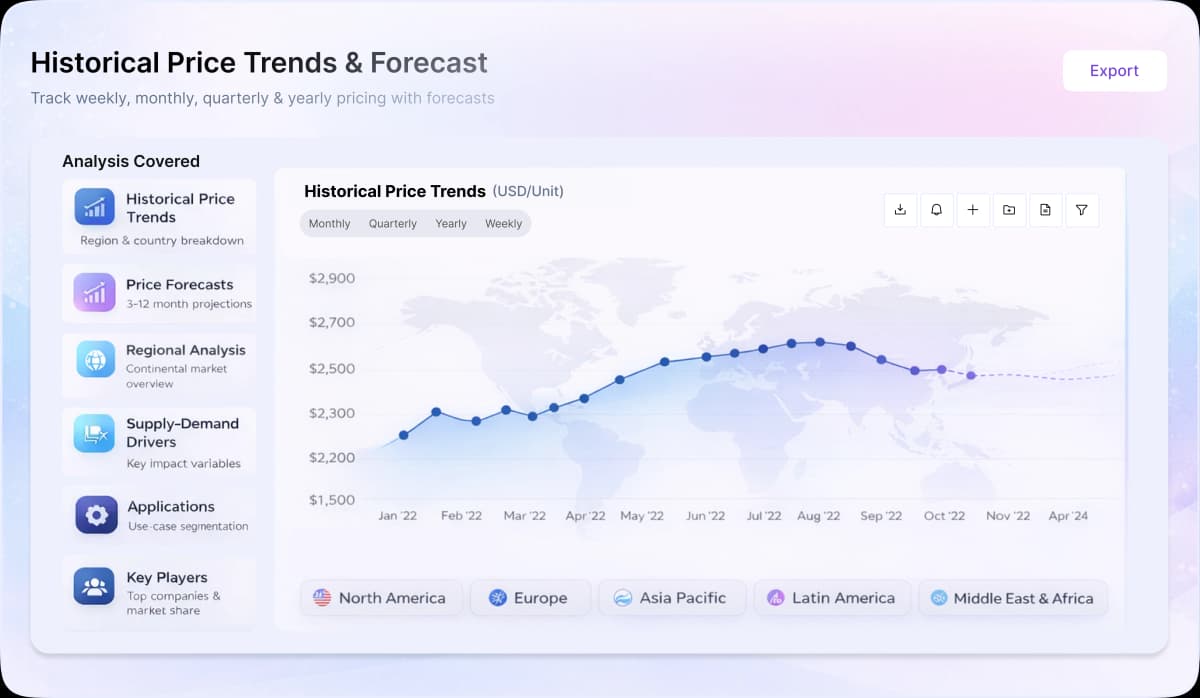
Price Trend Dashboard - What's Included
Price trends across a diverse portfolio of categories and products, spanning board to niche chemicals
Coverage extendable to grade-specific chemicals based on procurement requirements
Regular price tracking supported by robust historical datasets
News, policy updates, and key market drivers impacting price movements
Short-term and long-term price outlooks and forecasts
Supply-demand dynamics and capacity-driven market analysis