Udeesha Tomar
AVP - Strategy and Solutions
Leading procurement research solutions across chemicals, materials, and food & beverages, with expertise in price forecasting and market analytics.
Asia
In China, Sodium Azide prices fluctuated during Q1 2025, primarily following the movement of ammonia prices, its key feedstock. Prices initially declined at the beginning of the quarter due to an oversupplied ammonia market and weak demand. Industrial production slowed before the Spring Festival, and downstream consumers delayed orders, contributing to lower price levels. As the quarter progressed, maintenance-related outages in northern plants temporarily tightened ammonia supply, leading to a brief price increase for Sodium Azide.
However, once operations resumed and supply stabilized, prices leveled off again. Overall, the quarter was characterized by price volatility driven more by supply-side shifts than by any significant demand changes. Meanwhile, in India, the quarter started on a stronger note. Ammonia prices increased in the initial weeks, supporting stable pricing for Sodium Azide. Steady industrial purchasing and a gradual recovery in downstream demand contributed to market stability.
However, as the quarter progressed, ammonia prices softened slightly, leading to a slowdown in purchasing activity. Market participants became more cautious, causing a slight dip in Sodium Azide prices in the latter half of the quarter. While the market did not experience a sharp downturn, it lost the momentum gained earlier and settled into a more subdued pace towards the end of the period.
Europe
In Europe, Sodium Azide market conditions closely mirrored those in China. Early in the quarter, prices saw slight increases as demand improved following the reopening of downstream industries. However, as the quarter progressed, softer ammonia prices and ample product supply led to a gradual price decline. Industrial demand remained steady but lacked any significant upward momentum. By the end of the quarter, prices remained within a narrow range, balanced by stable supply and demand dynamics, with no major shifts from either side.
North America
North America followed a similar trend to China during Q1 2025. Prices remained relatively stable at the start but experienced a slight uptick mid-quarter, primarily due to lower ammonia supply caused by unplanned maintenance. However, this price increase was short-lived, as demand from the agricultural sector remained low, and industrial usage was not strong enough to sustain the upward trend. As supply constraints eased and cautious buying persisted, Sodium Azide prices gradually returned to previous levels. By the end of the quarter, market participants adopted a wait-and-see approach, focusing more on inventory management than on aggressive restocking.
Analyst Insight
According to Procurement Resource, the Sodium Azide price curve is expected to see slight improvements in the coming months as demand from downstream industries picks up.
Related Report
Get real-time price assessments, periodic trends, forecasts and price driver insights across key global markets.
Unlock Price Insights NowOur Clients

Turn price intelligence into action with the Procurement Resource Database. Log in or subscribe to unlock live price trends, historical charts, supplier databases, cost curves, and analyst-backed insights across chemicals, agriculture, energy, packaging, and more. Use these tools to benchmark your contracts, plan budgets with confidence, and stay ahead of market moves on every product you buy.

0
+Products
0
+Regions
0
+Subscriptions
Asia
In China, sodium azide prices gradually declined during the latter half of 2024. The primary driver was the continued decline in ammonia prices as production units resumed operations, leading to an increase in supply levels. Meanwhile, agricultural and industrial demand remained weak, failing to absorb the surplus. This kept both ammonia and sodium azide markets under pressure. Purchasers remained cautious, maintaining low inventories, which forced manufacturers to lower prices to clear excess stock. As the year ended, there were no signs of a market recovery, and overall market sentiment remained subdued.
Meanwhile, India's market displayed a more stable trend. Ammonia prices declined at a slower pace, primarily due to weak but consistent demand. This helped stabilize sodium azide production costs, but prices remained relatively subdued. The pharmaceutical sector continued its regular purchases, providing slight support to pricing. However, sellers had little room to raise prices, so most maintained stable rates and focused on sustaining sales volume. The market remained steady without significant fluctuations, avoiding major price spikes or crashes.
Europe
The European market followed a similar trajectory to China in the second half of 2024. The decline in ammonia prices lowered sodium azide production costs, but demand remained inelastic. Energy prices softened slightly at the beginning of the period, which supported producer margins, but as colder weather set in, they began to rise again. Downstream demand remained weak, particularly from the pharmaceutical and chemical sectors, as buyers refrained from placing large orders. In response, manufacturers reduced output. By the end of the year, prices declined further with limited movement in either direction and no signs of recovery.
North America
In North America, sodium azide prices followed a similar pattern to those in China and Europe. Ammonia prices fell throughout the latter half of the year, contributing to weaker sodium azide pricing. Inventory levels remained stable, but purchasing activity was cautious. Bulk buyers delayed purchases, anticipating further price declines. Producers adopted a conservative approach, fulfilling immediate orders while avoiding major restocking. Pricing softened throughout the period, driven more by market hesitancy and oversupply than by sudden shifts in market conditions.


Sodium azide is a highly reactive substance that can undergo quick decomposition in conditions of mechanical shock or heating to give nitrogen gas. This ability of sodium azide is well exploited in the air bag systems in the automotive sector. It also has high solubility in water and thus can also act as a preservative in the food sector for inhibiting the growth of bacteria and fungi. Further, due to its versatility in chemical reactions—particularly those involving the synthesis of organic compounds, sodium azide finds usage as a reagent in chemical laboratories.
NaN3
Airbag gas, Preservative, Antifreeze, Explosive booster, Chemical reagent
Sodium salt of hydrazoic acid
Island Veer Chemie Pvt Ltd, ARNISH LABORATORIES PRIVATE LIMITED, Azide & Allied Chemicals, RCHEM Group, American Pacific, PharmaCompass
Note: Our supplier search experts can assist your procurement teams in compiling and validating a list of suppliers indicating they have products, services, and capabilities that meet your company's needs.
The reaction between sodium nitrate and sodium amide requires specific conditions. Thus, the elevated temperature of 175 degrees Celsius is required to produce sodium azide via this route.

AVP - Strategy and Solutions
Leading procurement research solutions across chemicals, materials, and food & beverages, with expertise in price forecasting and market analytics.
Our Price Analysis Methodology

Experience how Procurement Resource transforms raw material price data into clear, decision ready intelligence. Optimise your performance with reliable, expert market data and analysis. Schedule your demo today to experience a live walk-through where our experts will showcase interactive price charts, forecasted prices, and insights driving the prices for your key commodities, tailored to your workflows. Contact us now!
Our Team will be happy to assist you
We are just a text away
Still Need Help?
Unlock full access to Procurement Resource's price databases, interactive charts, and short-term forecasts for thousands of commodities. Elevate your sourcing decisions by comparing prices across regions, downloading historical data, and layering in analyst-backed insights, all with our flexible plans that scale as your portfolio grows.
Still have any Questions
Contact Us


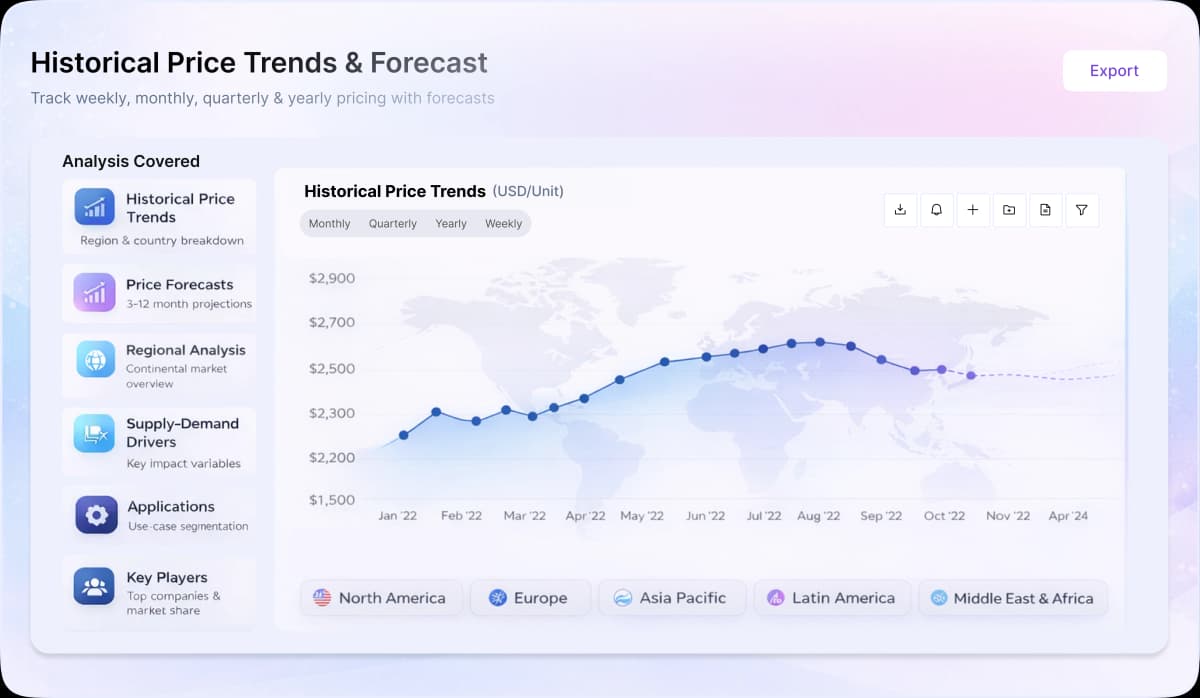
Price Trend Dashboard - What's Included
Price trends across a diverse portfolio of categories and products, spanning board to niche chemicals
Coverage extendable to grade-specific chemicals based on procurement requirements
Regular price tracking supported by robust historical datasets
News, policy updates, and key market drivers impacting price movements
Short-term and long-term price outlooks and forecasts
Supply-demand dynamics and capacity-driven market analysis