Udeesha Tomar
AVP - Strategy and Solutions
Leading procurement research solutions across chemicals, materials, and food & beverages, with expertise in price forecasting and market analytics.
Asia
In Asia, TPE prices strengthened during Q1’26, led by China. Higher styrene and butadiene costs pushed up production costs for styrenic TPE grades, while stronger polypropylene trade supported polymer sentiment. China’s Q1 industrial value added rose 6.1% year-on-year, and retail sales of clothes, shoes, hats, and textiles increased 9.3%, supporting TPE demand in footwear, flexible goods, and molded consumer products. India followed a firm trend due to steady demand from footwear, automotive components, packaging, and consumer goods. Higher freight costs after the Strait of Hormuz disruption raised landed costs for imported feedstocks and finished elastomers.
Europe
European TPE prices remained firm in Q1’26 as energy, logistics, and feedstock costs increased. Euro area industrial producer prices rose 3.4% month-on-month in March, while energy prices increased 11.1%, raising costs for compounding, extrusion, molding, and transport. However, downstream demand stayed cautious. Retail trade volume in the euro area declined 0.2% month-on-month in February, limiting buying from consumer goods, footwear, and packaging converters. Automotive demand provided some support, but buyers largely purchased against short-term requirements.
North America
North American TPE prices were mostly stable with mild firmness. Local feedstock availability reduced the impact of global naphtha volatility, but resin and rubber-plastic cost indicators rose toward March. Demand from automotive, packaging, medical goods, and molded parts remained steady. The region was less exposed than Asia and Europe, but freight uncertainty and higher crude-linked costs still supported cautious price increases.
Analyst Insight
According to Procurement Resource, in the near term, TPE prices may remain firm if crude-linked feedstocks and freight stay volatile. Stronger automotive and consumer goods demand could support further gains.
Get real-time price assessments, periodic trends, forecasts and price driver insights across key global markets.
Unlock Price Insights NowOur Clients

Turn price intelligence into action with the Procurement Resource Database. Log in or subscribe to unlock live price trends, historical charts, supplier databases, cost curves, and analyst-backed insights across chemicals, agriculture, energy, packaging, and more. Use these tools to benchmark your contracts, plan budgets with confidence, and stay ahead of market moves on every product you buy.

0
+Products
0
+Regions
0
+Subscriptions
Asia
In H2 2025, the Asian TPE market remained fundamentally stable, supported by strong demand from automotive, electric vehicle (EV), consumer electronics, and footwear industries. China continued to dominate regional consumption, with EV production and lightweight material adoption driving demand for advanced elastomer solutions. Improved availability of synthetic rubber and petrochemical feedstocks helped maintain balanced supply conditions, while competitive exports from Chinese producers ensured adequate material availability across the region. Sustainability trends also gained momentum, with manufacturers increasingly investing in recyclable and bio-based TPE grades to meet evolving regulatory and customer requirements. Despite periodic fluctuations in crude oil-derived feedstocks and currency movements, the market remained well supplied and demand-driven throughout the second half of the year.
Europe
The European TPE market witnessed moderate growth in H2 2025, primarily supported by automotive lightweighting initiatives, increasing EV adoption, and rising demand for sustainable materials. Manufacturers continued to focus on recyclable elastomer solutions as circular economy regulations and environmental compliance requirements became more stringent. However, industrial activity across parts of Europe remained subdued, limiting demand growth from construction and general manufacturing sectors. Competition from imported Asian materials remained intense, prompting buyers to diversify sourcing strategies and prioritize cost-efficient procurement. Nevertheless, stable automotive demand and the growing use of TPEs in consumer goods and infrastructure applications helped maintain balanced market fundamentals across the region.
North America
In North America, the TPE market maintained healthy momentum during H2 2025, driven by strong demand from automotive, medical, electrical, and consumer goods sectors. Vehicle production, healthcare applications, and infrastructure-related manufacturing supported steady consumption, while improved feedstock availability reduced supply-side concerns compared with previous years. Market participants increasingly focused on sustainable and recyclable elastomer technologies, aligning with broader corporate ESG initiatives and regulatory expectations. The continued shift toward lightweight materials and durable polymer solutions further strengthened TPE adoption across key end-use industries. Overall, stable supply chains, resilient industrial demand, and ongoing innovation in specialty elastomer applications supported a balanced and constructive market environment throughout the second half of 2025.
A class of materials known as thermoplastic elastomers (TPEs) combines the properties of ordinary thermoplastics with elastomers. TPEs, like thermoplastics, may be repeatedly melted and reformed, unlike typical elastomers. They have exceptional flexibility, robustness, and elasticity, much like rubber, but they don't need to be vulcanized.

TPEs are weatherable, have strong chemical resistance, and may be manufactured using conventional plastic molding procedures. These materials are used in consumer products, medical equipment, automobile components, and other industrial products where a compromise between rubber-like characteristics and ease of processing is necessary.
Metal Cleaning, Electroplating, Chiral synthesis, Textile production, Cosmetics, Wine production
Thermoplastic rubber (TPR), Thermoplastic polyurethane (TPU), Thermoplastic elastomer rubber (TPER), Elastoplastic
Advanced Elastomer Systems L.P., Arkema S.A., BASF SE, Bayer Material Science LLC, China Petroleum and Chemical Corporation, Dynasol Elastomers LLC, Evonik Industries, LCY Chemical Corporation, Nippon Polyurethane Industry Company Ltd
CurrencyUS$ (Data can also be provided in local currency)
Supplier Database AvailabilityYes
Customization ScopeThe report can be customized as per the requirements of the customer
Post-Sale Analyst Support360-degree analyst support after report delivery
Note: Our supplier search experts can assist your procurement teams in compiling and validating a list of suppliers indicating they have products, services, and capabilities that meet your company's needs.
This process involves the copolymerization of monomers via block or graft polymerization. It produces long-chain of molecules with hard and soft segments in different layouts. Graft polymerization involves joining or grafting branches of one polymer chain to another.
Udeesha Tomar
AVP - Strategy and Solutions
Leading procurement research solutions across chemicals, materials, and food & beverages, with expertise in price forecasting and market analytics.
Our Price Analysis Methodology

Experience how Procurement Resource transforms raw material price data into clear, decision ready intelligence. Optimise your performance with reliable, expert market data and analysis. Schedule your demo today to experience a live walk-through where our experts will showcase interactive price charts, forecasted prices, and insights driving the prices for your key commodities, tailored to your workflows. Contact us now!
Our Team will be happy to assist you
We are just a text away
Still Need Help?
Unlock full access to Procurement Resource's price databases, interactive charts, and short-term forecasts for thousands of commodities. Elevate your sourcing decisions by comparing prices across regions, downloading historical data, and layering in analyst-backed insights, all with our flexible plans that scale as your portfolio grows.
Still have any Questions
Contact Us


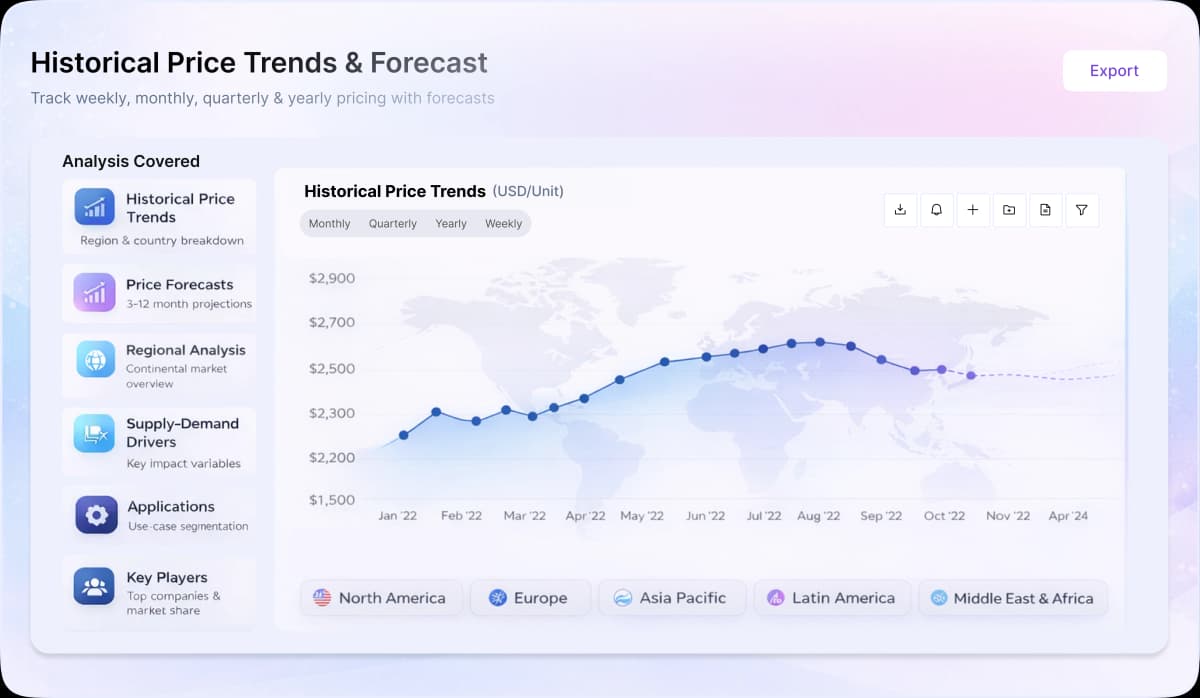
Price Trend Dashboard - What's Included
Price trends across a diverse portfolio of categories and products, spanning board to niche chemicals
Coverage extendable to grade-specific chemicals based on procurement requirements
Regular price tracking supported by robust historical datasets
News, policy updates, and key market drivers impacting price movements
Short-term and long-term price outlooks and forecasts
Supply-demand dynamics and capacity-driven market analysis