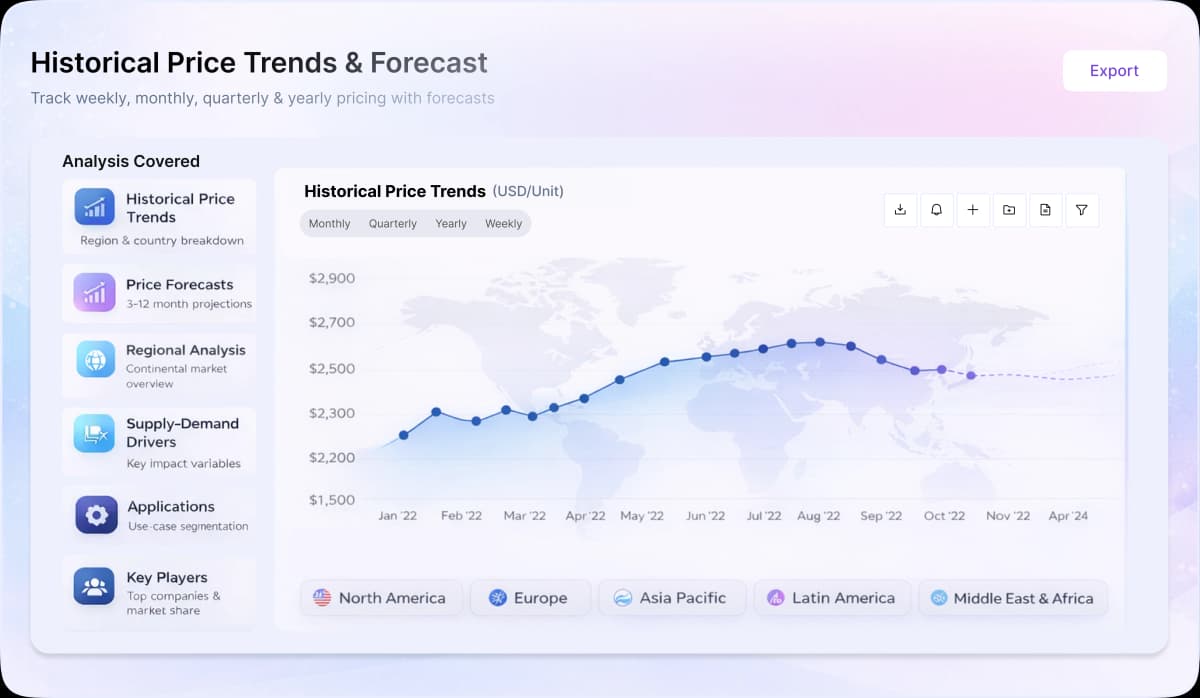
Triethyl Phosphite Price Trend Analysis 2026: Supply Demand Analysis, Price Drivers, Market Insights, Historical Prices & Latest News

Procurement Resource Database

Laptop screen

Turn price intelligence into action with the Procurement Resource Database. Log in or subscribe to unlock live price trends, historical charts, supplier databases, cost curves, and analyst-backed insights across chemicals, agriculture, energy, packaging, and more. Use these tools to benchmark your contracts, plan budgets with confidence, and stay ahead of market moves on every product you buy.

Triethyl Phosphite Dashboard Inclusions

Triethyl Phosphite Price Dasboard

0

+

Products

0

+

Regions

0

+

Subscriptions

Asia

In 2024, the triethyl phosphite market in Asia experienced moderate fluctuations. During the first half of the year, prices rose slightly due to increased feedstock costs, particularly phosphorus trichloride, which became more expensive following supply constraints and fluctuating phosphorus yellow availability.

However, demand from downstream sectors such as agrochemicals and plastic additives remained relatively soft, limiting major price hikes. By Q3 and Q4, prices began to ease as feedstock availability stabilized and regional demand weakened. Manufacturers adopted cautious pricing strategies in response to oversupply concerns and limited export opportunities, especially from China.

Europe

In Europe, triethyl phosphite prices remained mostly stable throughout 2024. Feedstock prices showed only minor changes, and supply chains operated smoothly despite occasional logistical hurdles. Demand from key end-use industries like specialty chemicals and coatings was steady but not strong enough to create upward pressure. Early in the year, there was some cost pressure from phosphorus trichloride, but this was balanced out by low downstream demand. The market sentiment stayed conservative, and price movements were contained within a narrow range. Buyers remained cautious, and many preferred to delay large-scale purchases unless absolutely necessary.

North America

The North American triethyl phosphite market saw slight upward price movements in the first half of 2024 due to temporary supply disruptions and increased raw material costs. Events like weather-related logistics issues and increased freight costs briefly pushed prices up. However, downstream demand from agriculture and industrial sectors was inconsistent, which prevented long-term price gains. By the second half of the year, prices began to settle as supply chains adjusted and procurement activity slowed. The market maintained overall stability, supported by strategic stock management and steady local production.


About Triethyl Phosphite

In appearance, Triethyl Phosphite is a clear colourless liquid with a strong foul odour. It is less dense than water and not soluble in water. Its vapours are heavier than air. This colourless liquid is utilised as a ligand in organometallic chemistry and as a reagent in organic synthesis.

Triethyl Phosphite Product Detail
Chemical Formula

C6H15O3P

Cas Number
122-52-1
Molecular Weight
166.16 g/mol
Industrial Uses

Lubricant, Chemical industry, Agrochemical, Fertiliser, Pesticide, Raw material

Synonyms

Phosphorous acid, triethyl ester, Triethoxyphosphine, Triethylphosphite

Supplier Database

Acros Organics, Ascender Chemical Co.,Ltd.(AS.C), Wuhan Kemi-Works Chemical Co., Ltd.

Regional Coverage

Asia Pacific

China, India, Indonesia, Pakistan, Bangladesh, Japan, Philippines, Vietnam, Iran, Thailand, South Korea, Iraq, Saudi Arabia, Malaysia, Nepal, Taiwan, Sri Lanka, UAE, Israel, Hongkong, Singapore, Oman, Kuwait, Qatar, Australia, and New Zealand

Europe

Germany, France, United Kingdom, Italy,Spain, Russia, Turkey, Netherlands, Poland, Sweden, Belgium, Austria, Ireland Switzerland, Norway, Denmark, Romania, Finland, Czech Republic, Portugal and Greece

North America

United States and Canada

Latin America

Brazil, Mexico, Argentina, Columbia, Chile, Ecuador, and Peru

Africa

South Africa, Nigeria, Egypt, Algeria, Morocco

CurrencyUS$ (Data can also be provided in local currency)

Supplier Database AvailabilityYes

Customization ScopeThe report can be customized as per the requirements of the customer

Post-Sale Analyst Support360-degree analyst support after report delivery


Note: Our supplier search experts can assist your procurement teams in compiling and validating a list of suppliers indicating they have products, services, and capabilities that meet your company's needs.

Triethyl Phosphite Production Processes

  • Production of Triethyl Phosphite via Phosphorous Trichloride

Triethyl Phosphite can be produced in a closed system by a reaction of phosphorous trichloride and ethanol in the presence of an inorganic or organic base. This is further purified by distillation to obtain the desired product.

Our Price Analysis Methodology

Schedule Demo

Schedule A Demo

Experience how Procurement Resource transforms raw material price data into clear, decision ready intelligence. Optimise your performance with reliable, expert market data and analysis. Schedule your demo today to experience a live walk-through where our experts will showcase interactive price charts, forecasted prices, and insights driving the prices for your key commodities, tailored to your workflows. Contact us now!

Our Team will be happy to assist you

We are just a text away

Still Need Help ?

Europe & Africa

+44 7573 171117

[email protected]

USA & Canada

+1 307 363 1045

[email protected]

APAC

+91 8850629517

[email protected]

Other Related Reports

NPK Fertiliser Production from Rock Phosphate

This report presents a detailed cost analysis of NPK fertiliser production from rock phosphate, ammonia, phosphoric acid, and nitric acid using the nitrophosphate process, also known as the Odda process.

NP Fertiliser Production from Rock Phosphate

This report presents a detailed cost analysis of NP fertiliser production from rock phosphate, ammonia, carbon dioxide, and nitric acid using the nitrophosphate process, also known as the Odda process.

DASDA (Diamino Stilbene Disulfonic Acid) Production via Catalytic Reduction

This report presents a detailed cost analysis of DASDA production from 4,4'-dinitro-2,2'-stilbenedisulphonic acid using the catalytic reduction process.

DMC Production via Catalytic Redox Process

This report presents a detailed cost analysis of DMC production from methylnitrite using the catalytic redox process.

Bone Phosphate of Lime Production via Calcination

This report presents a detailed cost analysis of BPL production from phosphate rock, phosphoric acid, and soda ash using the calcination process.

Unlock full access to Procurement Resource's price databases, interactive charts, and short-term forecasts for thousands of commodities. Elevate your sourcing decisions by comparing prices across regions, downloading historical data, and layering in analyst-backed insights, all with our flexible plans that scale as your portfolio grows.

Still have any Questions

Contact Us
Mastercard
Wire
VISA
Stripe

Related News

View All

Why Procurement Database

Extensive Commodity Price Database

Extensive Commodity Price Database

Track prices, market movements, supply-demand dynamics, and industry developments across hundreds of commodities through a centralized intelligence platform built for informed procurement decisions.

Reliable Price Forecasting & Market Outlooks

Reliable Price Forecasting & Market Outlooks

Understand market fluctuations using analyst-backed forecasts, historical pricing patterns, and evolving industry trends to strengthen sourcing strategies and budget planning.

Data Driven Cost & Procurement Optimization

Data Driven Cost & Procurement Optimization

Leverage cost models, pricing benchmarks, and procurement insights to evaluate purchasing opportunities, improve negotiations, and enhance operational efficiency.

Global Coverage with region-specific Market Insights

Global Coverage with region-specific Market Insights

Access region-specific price trends, trade activities, capacity changes, and supply chain developments influencing commodity markets worldwide.

1/4