Cooler Forecast Pulls Natural Gas Down
Milder weather predictions for the eastern US in the second half of June reduced expectations for high cooling demand, causing Nymex natural gas futures to tumble and indicating near-term price weakness.
| Product | Region | Incoterm Basis | Price | Last Updated Month |
|---|---|---|---|---|
| Xylene | China | FOB | USD 991.86/MT | May 2026 |
| Xylene | India | FOB | USD 1,059.20/MT | May 2026 |
| Xylene | USA | FOB | USD 1,178.39/MT | May 2026 |
| Xylene | Brazil | CIF | USD 991.86/MT | May 2026 |
| Xylene | Netherlands | FOB | USD 1,085.31/MT | May 2026 |
| Xylene | China | FOB | USD 1,024.15/MT | April 2026 |
| Xylene | India | FOB | USD 1,263.42/MT | April 2026 |
| Xylene | USA | FOB | USD 1,470.00/MT | April 2026 |
| Xylene | Brazil | CIF | USD 1,145.25/MT | April 2026 |
| Xylene | Netherlands | FOB | USD 1,150.15/MT | April 2026 |
Stay updated with the latest Xylene prices, historical data, and tailored regional analysis
Milder weather predictions for the eastern US in the second half of June reduced expectations for high cooling demand, causing Nymex natural gas futures to tumble and indicating near-term price weakness.
Renewed fighting between US and Iran has slowed shipping through the Gulf of Hormuz, disrupting supply routes. Benchmark crude prices have climbed sharply from pre-conflict levels, reflecting heightened geopolitical risk. The upward price pressure is likely to continue while tensions persist.
Asia
Xylene prices in China declined from ~USD 1,024.15/MT to ~USD 948.00/MT during Q2’26, showing a ~7.4% decrease. The Asian market faced strong volatility as early-quarter supply concerns from crude and refined-product disruptions eased later. Chinese refineries maintained stable operations, imported material continued arriving and trader inventories remained sufficient, reducing price support. Demand from polyester, coatings, solvents and isomerisation applications remained weak, with buyers focusing on immediate requirements. Crude oil processing in China reached 53.72 million tonnes in May, while chemical raw-material output growth remained limited, reflecting cautious downstream demand. Temporary support appeared from PX plant maintenance, but improved availability and weak seasonal demand pressured prices again.
Europe
European xylene markets were initially supported by higher feedstock and import costs due to crude supply disruptions but weakened later as upstream pressure eased. Chemical operating rates remained below historical averages, limiting demand from solvents, coatings, plastics and polyester applications. Industrial activity showed only limited improvement, preventing significant inventory rebuilding among buyers. Additional PX supply from regional capacity additions also reduced supply concerns. The market remained cost-sensitive, but weak chemical demand restricted further price increases.
North America
Xylene prices in the United States declined to ~USD 1,103.00/MT in June from ~USD 1,470.00/MT in April, showing a ~25.0% decrease. The market received early support from refinery disruptions, strong petroleum exports and competition between aromatics production and gasoline blending. US petroleum-product exports remained elevated, encouraging refiners to prioritise transportation fuels over aromatic production. Chemical demand provided support, with improved industrial orders and manufacturing activity supporting xylene-consuming applications. However, lower crude and naphtha costs later reduced production pressure, while improved availability pushed prices lower.
Analyst Insight
According to Procurement Resource, xylene prices are expected to remain influenced by refinery operating decisions, crude movements and downstream polyester demand, with supply availability likely limiting major price increases.
Related Report
Need latest Xylene price?
Get real-time price assessments, periodic trends, forecasts and price driver insights across key global markets.
Unlock Price Insights NowOur Clients

Turn price intelligence into action with the Procurement Resource Database. Log in or subscribe to unlock live price trends, historical charts, supplier databases, cost curves, and analyst-backed insights across chemicals, agriculture, energy, packaging, and more. Use these tools to benchmark your contracts, plan budgets with confidence, and stay ahead of market moves on every product you buy.
0
+Products
0
+Regions
0
+Subscriptions
In Asia, xylene prices showed a relatively mixed pattern in Q1’25, influenced by varying feedstock trends and downstream demand stability. Early in the quarter, regional prices remained steady due to moderate consumption from industries such as PET and solvents.
However, toward the end of the quarter, a slight upward trend was observed. This was mainly driven by increased feedstock naphtha costs and signs of improved economic activity in key markets. While industrial demand did not surge significantly, steady offtake and tightening supply supported the price recovery in March.
Europe
In Europe, particularly Germany, xylene prices mostly declined during Q1’25. The market experienced downward pressure in February and early March due to overproduction and stockpiling. Despite naphtha prices trending higher at times, the oversupply forced producers to cut prices to manage inventory levels. Demand from end-user sectors like PET and phthalic anhydride remained consistent, but it wasn’t strong enough to counteract the impact of high supply. Moreover, weak performance in the automotive and construction sectors further reduced demand for xylene-based derivatives, especially during February, reinforcing the price slide.
North America
In North America, xylene prices also declined over the quarter, mainly due to falling feedstock naphtha and crude oil costs. The drop in input prices reduced production costs, which encouraged producers to adjust xylene prices downward. Although demand from major sectors such as PET and phthalic anhydride remained stable, reduced activity in the automotive and construction segments continued to weigh on overall market sentiment. The stable downstream consumption prevented sharper price declines, keeping the market balanced despite weaker upstream cues.
Xylene refers to any one of three isomers or a mixture of three isomers of dimethylbenzene, which have same chemical formula ((CH3)2C6H4) but different molecular structure. The three isomers, that is, ortho (o), meta (m), and para (p), differ structurally only in the placement of the methyl groups.
Xylene is utilised as solvents, as components of aviation fuel, and as raw materials for the production of dyes, fibres, etc. Each of the 3 compounds has a central benzene ring with two methyl groups attached as substituents. In appearance they are all colourless, flammable liquids, some of which are of great commercial value.
(CH3)2C6H4
Solvent, Chemical intermediates, High-motor and aviation, Gasoline blending agents, Breathing devices (inhalers)
1330-20-7, Xylol, Dimethylbenzene
Exxon Mobil Corporation, Shell Chemicals, Reliance Industries Limited, China Petroleum & Chemical Corporation (Sinopec Corp.), Valero Marketing and Supply Company
CurrencyUS$ (Data can also be provided in local currency)
Supplier Database AvailabilityYes
Customization ScopeThe report can be customized as per the requirements of the customer
Post-Sale Analyst Support360-degree analyst support after report delivery
Note: Our supplier search experts can assist your procurement teams in compiling and validating a list of suppliers in
In this process, toluene and benzene are utilised for the production of Xylenes. Toluene and benzene are methylated to finally produce Xylenes, where the ratio of all the three isomers differ in value that can also be shifted to favour the more valued p-xylene using other processes or catalysts.


dicating they have products, services, and capabilities that meet your company's needs.

Our Price Analysis Methodology

Business Insights Analyst
Helping procurement and sourcing teams navigate complex markets through data-driven research, category intelligence, and actionable insights - with a focus on identifying market trends, analyzing supply-side developments, and delivering clear intelligence that supports informed business decisions.

Experience how Procurement Resource transforms raw material price data into clear, decision ready intelligence. Optimise your performance with reliable, expert market data and analysis. Schedule your demo today to experience a live walk-through where our experts will showcase interactive price charts, forecasted prices, and insights driving the prices for your key commodities, tailored to your workflows. Contact us now!
Our Team will be happy to assist you
We are just a text away
Still Need Help?
This report presents a detailed cost analysis of m-xylene production from mixed xylenes using the adsorptive separation process.
This study presents the cost structure of Purified Terephthalic Acid (PTA) production wherein p-xylene is used as the process feedstock through a catalytic oxidation process.
This process to produce DMT is a typical oxidation process. The next process which follows is methyl-esterification process.
Unlock full access to Procurement Resource's price databases, interactive charts, and short-term forecasts for thousands of commodities. Elevate your sourcing decisions by comparing prices across regions, downloading historical data, and layering in analyst-backed insights, all with our flexible plans that scale as your portfolio grows.
Still have any Questions
Contact Us


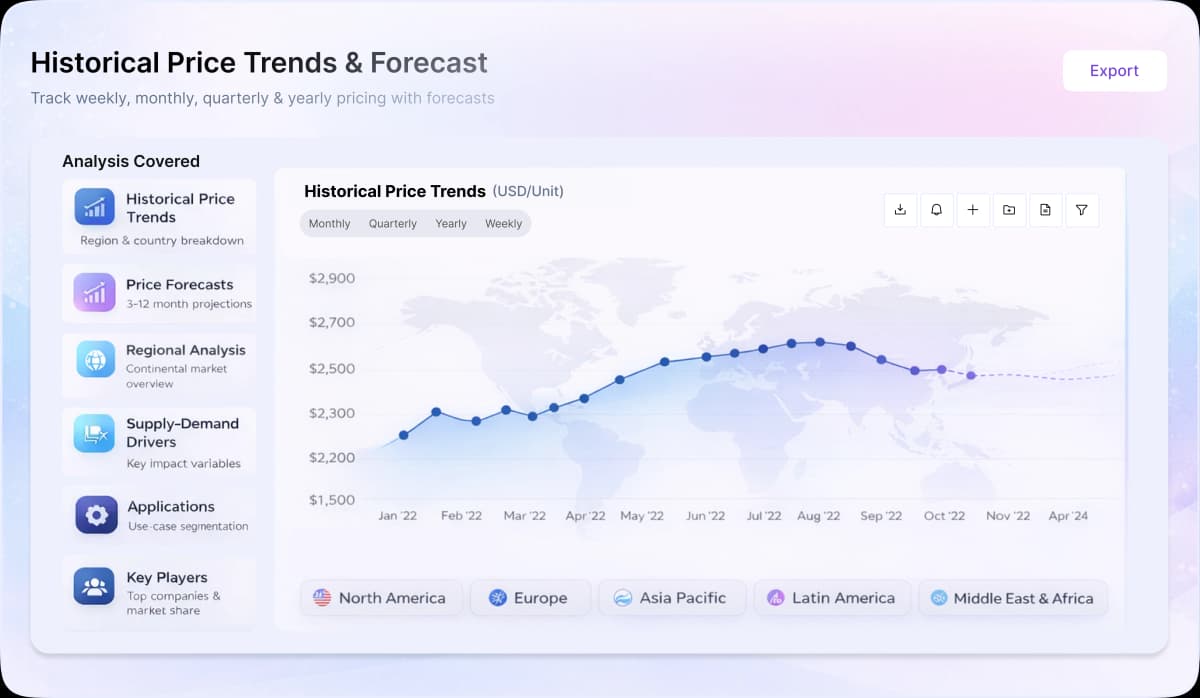
Price Trend Dashboard - What's Included
Price trends across a diverse portfolio of categories and products, spanning board to niche chemicals
Coverage extendable to grade-specific chemicals based on procurement requirements
Regular price tracking supported by robust historical datasets
News, policy updates, and key market drivers impacting price movements
Short-term and long-term price outlooks and forecasts
Supply-demand dynamics and capacity-driven market analysis