Prakhar Panchbhaiya
Assistant Manager: Business Insights and Content
Supporting procurement teams with category intelligence, market research, price trends, supply-demand analysis, and strategic sourcing insights across key industries.
Natural rubber futures across Asian exchanges edged higher after a resumption of hostilities between the United States and Iran cast fresh doubt over the durability of their interim peace arrangement. Tit-for-tat exchanges strained the agreement and again slowed tanker traffic through the Strait of Hormuz, a principal artery for global energy shipping, lifting crude oil benchmarks and providing price support to natural rubber, which competes for market share with synthetic rubber derived from petroleum feedstocks.
The energy channel is the primary transmission mechanism linking crude oil movements to natural rubber pricing. When petroleum prices rise, the production cost of synthetic rubber increases and narrows its competitive advantage, directing buyers toward the natural alternative. The renewed Hormuz disruption reinforced this relationship by reintroducing supply-side risk into energy markets that had briefly stabilised following the initial peace deal reached earlier in the month.
Request the Latest Natural Rubber Prices Data - Access Price Insights Now
Currency dynamics provided a secondary layer of support for rubber trade. The Japanese yen continued to hover near a multi-decade low against the US dollar, making yen-denominated rubber contracts on the Osaka Exchange more attractively priced for international buyers. A sustained period of yen weakness reduces the effective cost of Japanese rubber futures for holders of stronger currencies, which can stimulate offshore buying interest and provide additional price floor support.
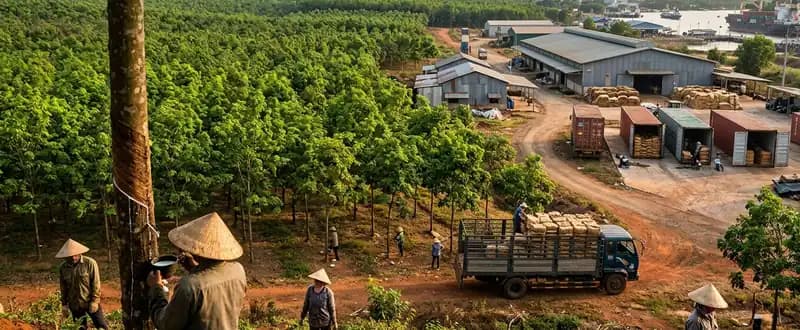
The advance was not unlimited. Exchange market data confirmed a ramp-up in natural rubber production across the three largest producing regions in Southeast Asia. Thailand, Indonesia, and Vietnam all registered increases in tapping activity and latex collection following the seasonal wintering period, during which reduced yields constrain physical availability. As these regions entered the higher-output phase of their annual production cycle, the additional supply entering the market provided a counterweight to the energy-driven price support and capped the scale of the gains.
Synthetic rubber markets also diverged from natural rubber's direction. Butadiene rubber contracts declined on one of the major Shanghai exchanges, reflecting softer demand and feedstock dynamics within the petrochemical chain rather than the broader energy trend. The divergence between natural and butadiene rubber prices on the same day illustrates that the two markets, while related, can respond differently to the same macroeconomic inputs depending on their specific supply and demand conditions.
For procurement teams sourcing natural rubber for tyre, automotive, and industrial applications, the environment presents competing forces: geopolitical risk in the energy complex providing upside pressure, and improving seasonal supply from the three largest producing nations providing a ceiling. Which force prevails through the remainder of the summer tapping season will determine the near-term direction of physical rubber prices.
Assistant Manager: Business Insights and Content
Supporting procurement teams with category intelligence, market research, price trends, supply-demand analysis, and strategic sourcing insights across key industries.



We are Just a Text away