Need latest Acetic Acid prices?
Get real-time price assessments, periodic trends, forecasts and price driver insights across key global markets.
Unlock Price Insights NowOur Clients
| Product | Region | Incoterm Basis | Price | Last Updated Month |
|---|---|---|---|---|
| Acetic Acid | China | FOB | USD 609.12/MT | April 2026 |
| Acetic Acid | USA | FOB | USD 540.02/MT | April 2026 |
| Acetic Acid | Germany | FOB | USD 710.12/MT | April 2026 |
| Acetic Acid | India | FOB | USD 695.95/MT | April 2026 |
| Acetic Acid | Japan | FOB | USD 651.12/MT | April 2026 |
| Acetic Acid | China | FOB | USD 465.00/MT | March 2026 |
| Acetic Acid | China | FOB | USD 402.00/MT | February 2026 |
| Acetic Acid | USA | FOB | USD 510.00/MT | February 2026 |
| Acetic Acid | Germany | FOB | USD 497.00/MT | February 2026 |
| Acetic Acid | India | FOB | USD 436.00/MT | February 2026 |
| Acetic Acid | Japan | FOB | USD 422.00/MT | February 2026 |
Stay updated with the latest Acetic Acid prices, historical data, and tailored regional analysis
Asia
In China, prices were about 2.93 RMB/kg (FOB) in January and increased to around 3.05 RMB/kg in March, with prices rising by approximately 13% quarter-on-quarter and 5% from February to March. The market trend reflected supply-side tightening early in the quarter due to plant maintenance, followed by inventory pressure and weak demand in February. In March, prices rebounded as operating rates remained constrained and inventories declined, while methanol feedstock costs rose sharply due to reduced imports and geopolitical factors. Downstream support improved, with acetic anhydride prices increasing in March, reinforcing demand fundamentals. In India, prices were about 34 INR/kg (FOB) in January and around 40.53 INR/kg in March, with a 10% increase from February to March. The rise was primarily linked to higher import costs, supply constraints, and increased logistics expenses due to disruptions in global trade flows. The Middle East conflict and congestion at the Strait of Hormuz significantly impacted freight rates and delayed shipments, tightening regional availability.
Europe
In Europe, acetic acid prices followed an upward trajectory, driven by elevated feedstock costs and energy price volatility. The Middle East conflict led to a surge in crude oil and natural gas prices, increasing production costs across the chemical value chain. Additionally, rising logistics costs and supply chain disruptions linked to the Strait of Hormuz congestion added upward pressure. However, downstream demand remained constrained due to weak industrial activity and cautious procurement patterns, limiting the pace of price increases.
North America
The North American market also witnessed firm pricing, supported by higher feedstock costs and global supply tightening. Elevated crude-linked raw material costs and increased freight expenses contributed to upward price momentum. Demand conditions remained moderate, with buyers focusing on inventory management amid persistent price volatility.
Analyst Insight
According to Procurement Resource, acetic acid prices are expected to remain volatile, with trends dependent on geopolitical developments; easing tensions may reduce cost pressures, while continued disruptions could sustain elevated levels.
Get real-time price assessments, periodic trends, forecasts and price driver insights across key global markets.
Unlock Price Insights NowOur Clients

Turn price intelligence into action with the Procurement Resource Database. Log in or subscribe to unlock live price trends, historical charts, supplier databases, cost curves, and analyst-backed insights across chemicals, agriculture, energy, packaging, and more. Use these tools to benchmark your contracts, plan budgets with confidence, and stay ahead of market moves on every product you buy.

0
+Products
0
+Regions
0
+Subscriptions
Asia
The Chinese acetic acid market during the fourth quarter exhibited mixed trends. The average prices were about 362 USD/MT (FOB) in October and around 376 USD/MT in December. Prices declined through the early portion of the quarter amid cautious downstream purchasing behaviour and moderate trading activity.
However, the trend reversed notably as multiple producers implemented maintenance shutdowns that reduced capacity utilization and mitigated inventory pressures. Supply tightening supported progressive price recovery through the latter half of the quarter, with quotations strengthening consistently toward year-end. Demand from the packaging, textile, and coating sectors remained steady, with buyers maintaining prudent just-in-time procurement strategies that limited inventory buildup.
Indian acetic acid markets demonstrated consistent strengthening across the fourth quarter as production costs increased and supply dynamics tightened. The prices were about 328 USD/MT (FOB) in October and around 369 USD/MT in December. Prices advanced progressively from early quarter levels, reflecting firmer cost structures and steady downstream consumption patterns.
Demand from coating, pharmaceutical, and chemical derivative sectors maintained stable purchasing activity, supporting the upward price trajectory. Market sentiment remained constructive as suppliers faced limited competitive pressure, enabling sustained price appreciation through year-end.


Europe
European acetic acid markets faced sustained downward pressure throughout the fourth quarter as demand weakness outweighed supply-side factors. The prices were about 643 USD/MT (CIF) in October and around 622 USD/MT in December in Germany.
The markets experienced steady price erosion as consumption from resins, coatings, and construction industries remained subdued. Seasonal demand declines accelerated toward year-end as buyers reduced purchasing ahead of holiday periods.
Logistics challenges at major ports provided limited pricing support amid broader demand weakness. Elevated inventory levels across distribution channels and declining feedstock methanol costs enabled suppliers to maintain lower offer levels. Purchasing behaviour reflected conservative inventory management, with customers limiting orders to immediate requirements.
North America
North American acetic acid markets exhibited gradual downward price movement during the fourth quarter, aligning with global chemical market trends. The prices were about 414 USD/MT (FOB) in October and around 395 USD/MT in December. Prices declined progressively as supply availability remained adequate and downstream demand showed limited growth momentum. Manufacturing activity maintained steady but uninspiring consumption rates.
Feedstock dynamics offered mixed signals, with methanol providing some support while overall input pressures remained manageable. Trade flows stayed relatively stable, though import activity moderated as shipping rates declined. Year-end destocking and slowing seasonal demand from construction applications added downward pressure as the quarter concluded.
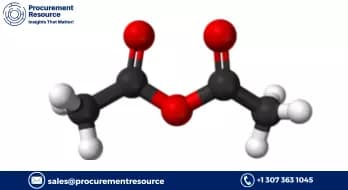
Acetic Acid is known to be a colourless liquid organic compound with a pungent smell. When undiluted, it is often coined as glacial acetic acid. Vinegar is no less than 4% acetic acid in volume, thus, making acetic acid the primary element of vinegar apart from water. It has a distinctive sour taste and it contains a methyl group linked to a carboxyl group. It is primarily manufactured as a precursor to PVA (polyvinyl acetate), household vinegar, and cellulose acetate.
C2H4O2
Intermediates, Acetic Anhydride, Ester, Vinyl Acetate Monomer, Vinegar, Polymeric materials
Ethanoic acid, 64-19-7, Ethylic Acid, Acetic Acid, Glacial
LyondellBasell Industries Holdings B.V., British Petroleum Plc, Celanese Corporation, Eastman Chemical Company, Jiangsu SOPO (Group) Co., Ltd, Yankuang Group
CurrencyUS$ (Data can also be provided in local currency)
Supplier Database AvailabilityYes
Customization ScopeThe report can be customized as per the requirements of the customer
Post-Sale Analyst Support360-degree analyst support after report delivery
Note: Our supplier search experts can assist your procurement teams in compiling and validating a list of suppliers indicating they have products, services, and capabilities that meet your company's needs.
While producing Acetic Acid from methanol, the process of carbonylation is carried out. Carbon monoxide is utilised as a source of carbonylation and the reaction is carried out in the presence of a catalyst along with water, producing Acetic Acid.
Our Price Analysis Methodology

Experience how Procurement Resource transforms raw material price data into clear, decision ready intelligence. Optimise your performance with reliable, expert market data and analysis. Schedule your demo today to experience a live walk-through where our experts will showcase interactive price charts, forecasted prices, and insights driving the prices for your key commodities, tailored to your workflows. Contact us now!
Our Team will be happy to assist you
We are just a text away
Still Need Help ?
This feasibility study examines the cost of vinyl acetate production using acetic acid and acetylene. In this process, the reaction of acetylene with acetic anhydride in a catalysed medium and high temperature results in the formation of Ethylidene diacetate.
This study presents the economics of Vinyl Acetate production from acetic anhydride and ethylene via a typical vapor-phase oxidation process.
This report presents a detailed cost analysis of SMCA production from molten Monochloroacetic Acid (MCA).
The following report deals with the economics of the production of acetic acid via carbonylation of methanol using carbon monoxide as a source of carbonyl group.
Unlock full access to Procurement Resource's price databases, interactive charts, and short-term forecasts for thousands of commodities. Elevate your sourcing decisions by comparing prices across regions, downloading historical data, and layering in analyst-backed insights, all with our flexible plans that scale as your portfolio grows.
Still have any Questions
Contact Us


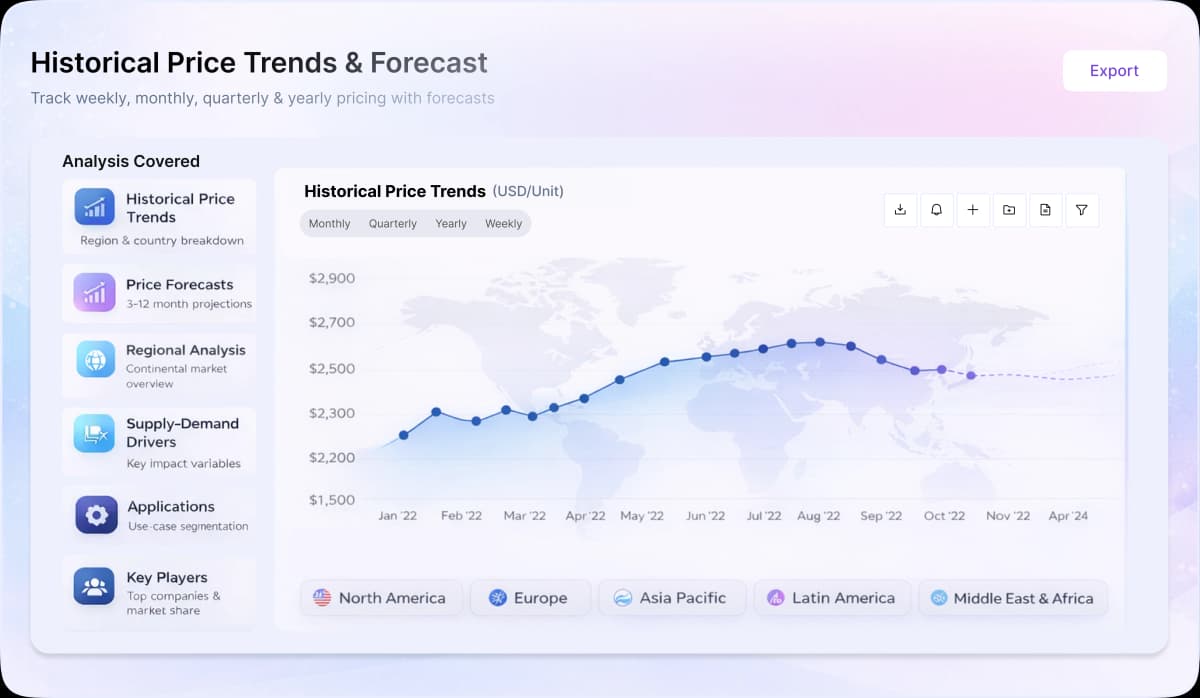
Price Trend Dashboard - What's Included
Price trends across a diverse portfolio of categories and products, spanning board to niche chemicals
Coverage extendable to grade-specific chemicals based on procurement requirements
Regular price tracking supported by robust historical datasets
News, policy updates, and key market drivers impacting price movements
Short-term and long-term price outlooks and forecasts
Supply–demand dynamics and capacity-driven market analysis