Need latest Adipic Acid prices?
Get real-time price assessments, periodic trends, forecasts and price driver insights across key global markets.
Unlock Price Insights NowOur Clients
| Product | Region | Incoterm Basis | Price | Last Updated Month |
|---|---|---|---|---|
| Adipic Acid | China | FOB | USD 1,473.96/MT | April 2026 |
| Adipic Acid | USA | CIF | USD 1,560.96/MT | April 2026 |
| Adipic Acid | Germany | CIF | USD 1,600.24/MT | April 2026 |
| Adipic Acid | India | CIF | USD 1,523.84/MT | April 2026 |
| Adipic Acid | Japan | CIF | USD 1,515.91/MT | April 2026 |
| Adipic Acid | China | FOB | USD 1,454.10/MT | March 2026 |
| Adipic Acid | China | FOB | USD 1,207.00/MT | February 2026 |
| Adipic Acid | USA | CIF | USD 1,292.00/MT | February 2026 |
| Adipic Acid | Germany | CIF | USD 1,302.00/MT | February 2026 |
| Adipic Acid | India | CIF | USD 1,237.00/MT | February 2026 |
| Adipic Acid | Japan | CIF | USD 1,214.00/MT | February 2026 |
Stay updated with the latest Adipic Acid prices, historical data, and tailored regional analysis
Asia
In Asia, adipic acid prices showed a clear upward trajectory through Q1’26. In China, the prices were ~7.41 RMB/kg (Spot) in January and ~10.03 RMB/kg in March, with prices increasing by ~36.73%. The market strengthened in January as rising benzene and cyclohexanone prices increased production costs, while downstream nylon and polyurethane industries actively restocked ahead of the holiday period, supporting demand. In February, prices continued to rise initially due to elevated crude-linked feedstock costs and post-holiday restocking, but later softened as demand weakened and supply remained sufficient. However, the prices increased significantly in March amid geopolitical uncertainty, which led to an increase in the cost of feedstock, and prices needed to be raised to compensate for this increase. Disciplined supply by producers that restricted low-price sales on account of reduced margins, along with cautious purchasing by end users, supported the prices by the close of the quarter.
Europe
In Europe, the prices of adipic acid were largely driven by the movements in feedstock costs and global supply dynamics. The increase in the cost of inputs such as benzene and crude oil resulted in higher production expenses that positively impacted the prices during the quarter. Nevertheless, the demand from the downstream sector, such as nylon applications, remained cautious, limiting price hikes.
North America
The price trend of adipic acid in North America was consistent with the uptrend in the European market. Adipic Acid prices continued to rise, backed by the high feedstock costs and steady demand from the major downstream markets. Production economics continued to be pressured by the increasing cost of inputs, resulting in producers maintaining strong pricing policies. The demand for nylon and its associated uses was stable, but conservative consumerism prevented further growth.
Analyst Insight
According to Procurement Resource, the adipic acid prices are expected to remain firm, supported by sustained feedstock costs and ongoing geopolitical tension.

Related Report
Get real-time price assessments, periodic trends, forecasts and price driver insights across key global markets.
Unlock Price Insights NowOur Clients

Turn price intelligence into action with the Procurement Resource Database. Log in or subscribe to unlock live price trends, historical charts, supplier databases, cost curves, and analyst-backed insights across chemicals, agriculture, energy, packaging, and more. Use these tools to benchmark your contracts, plan budgets with confidence, and stay ahead of market moves on every product you buy.

0
+Products
0
+Regions
0
+Subscriptions
| Product | Category | Region | Price | Last Updated Month |
| Adipic Acid | Chemicals | China | 991 USD/MT | October 2025 |
| Adipic Acid | Chemicals | China | 964 USD/MT | December 2025 |
Asia
The Asian adipic acid market exhibited a mixed trend during the fourth quarter of 2025. Chinese markets witnessed progressive price declines through the early and middle portions of the quarter as raw material costs for cyclohexanone and benzene weakened, reducing production cost support. The prices were about 991 USD/MT (Spot) in October and around 964 USD/MT in December. Downstream demand from key end-use sectors, including nylon and polyurethane applications, remained sluggish, with buyers demonstrating cautious need-based purchasing strategies that limited transaction volumes.
Supply conditions remained ample as domestic manufacturers maintained high operating rates, contributing to inventory pressures that compelled producers to lower ex-factory pricing continuously. However, the final month witnessed a reversal as benzene markets demonstrated strengthening that restored cost support, while increased rigid demand from end-users improved trading activity and prompted manufacturers to raise ex-factory prices modestly, though overall quarter-end pricing remained below initial levels.
Europe
European adipic acid markets demonstrated fluctuating price patterns during the fourth quarter, mirroring the Asian region's trajectory with progressive declines followed by late-quarter stabilization. Feedstock costs for cyclohexanone and benzene followed global trends, weakening through the initial two months and limiting production cost support. Downstream sectors, including automotive, textile, and industrial applications, demonstrated subdued consumption patterns as broader economic uncertainties influenced purchasing decisions. Supply availability remained adequate as regional production facilities operated at consistent rates. Prices declined through most of the quarter before the late-period recovery observed in Asian markets similarly influenced European pricing as raw material costs firmed.
North America
North American adipic acid markets experienced oscillating price movements during the fourth quarter, following patterns consistent with Asian and European regions. Prices declined progressively through the initial months before demonstrating modest recovery in the final phase. Feedstock cost dynamics aligned with global trends, with benzene and cyclohexane derivative markets providing diminishing support through most of the period. Downstream demand from nylon, engineering plastics, and polyurethane applications remained measured, with buyers maintaining conservative inventory positions. The combination of adequate supply and cautious end-user purchasing sustained downward pricing momentum through most of the quarter before late-period raw material cost increases provided support.
Adipic acid, a crystalline, white powder, is one of the most important dicarboxylic acids. It is primarily utilised in the production of nylon. It occurs rarely in nature. Small but considerate volumes of adipic acid are used in food products as a food additive. It has a tart taste and it is utilised as a flavouring and a gelling agent in jello or gelatines. It is also utilised in some calcium carbonate antacids to make them tart.
C6H10O4
Nylon, Paper additives, Copolyamides and terpolymers, Unsaturated polyester resins (UPRS) , Plasticisers , Chemical intermediate, Solvents and lubricants, Electronics, Soil conditioners, Glass protection agents and briquetting agents, Leather tanning agents, Flue gas desulphurisation scrubbers, Cleaning aids
Hexanedioic acid, Butane-1,4-dicarboxylic acid, Hexane-1,6-dioic acid , 1,4-Butanedicarboxylic acid
Asahi Kasei Corporation, Ascend Performance Materials LLC, Lanxess AG, Solvay SA, Invista (Koch Industries, Inc.)
CurrencyUS$ (Data can also be provided in local currency)
Supplier Database AvailabilityYes
Customization ScopeThe report can be customized as per the requirements of the customer
Post-Sale Analyst Support360-degree analyst support after report delivery
While producing Adipic Acid via oxidisation of cyclohexanol and cyclohexanone (together known as KA oil), cyclohexanol is first converted to the ketone, which releases nitrous acid. At last, KA oil is oxidised with the help of nitric acid to finally produce Adipic Acid through a multistep pathway.
Our Price Analysis Methodology

Experience how Procurement Resource transforms raw material price data into clear, decision ready intelligence. Optimise your performance with reliable, expert market data and analysis. Schedule your demo today to experience a live walk-through where our experts will showcase interactive price charts, forecasted prices, and insights driving the prices for your key commodities, tailored to your workflows. Contact us now!
Our Team will be happy to assist you
We are just a text away
Still Need Help ?
This report presents a detailed cost analysis of adipic acid production from cyclohexene using oxidative cleavage process.
This report presents a detailed cost analysis of adipic acid production from butadiene via carbonylation. In this process, adipic acid is formed as the result of carbonylation of butadiene.
This report presents a detailed cost analysis of adipic acid production from cyclohexanone and cyclohexanol, together called KA oil (ketone-alcohol oil), via oxidation.
Unlock full access to Procurement Resource's price databases, interactive charts, and short-term forecasts for thousands of commodities. Elevate your sourcing decisions by comparing prices across regions, downloading historical data, and layering in analyst-backed insights, all with our flexible plans that scale as your portfolio grows.
Still have any Questions
Contact Us


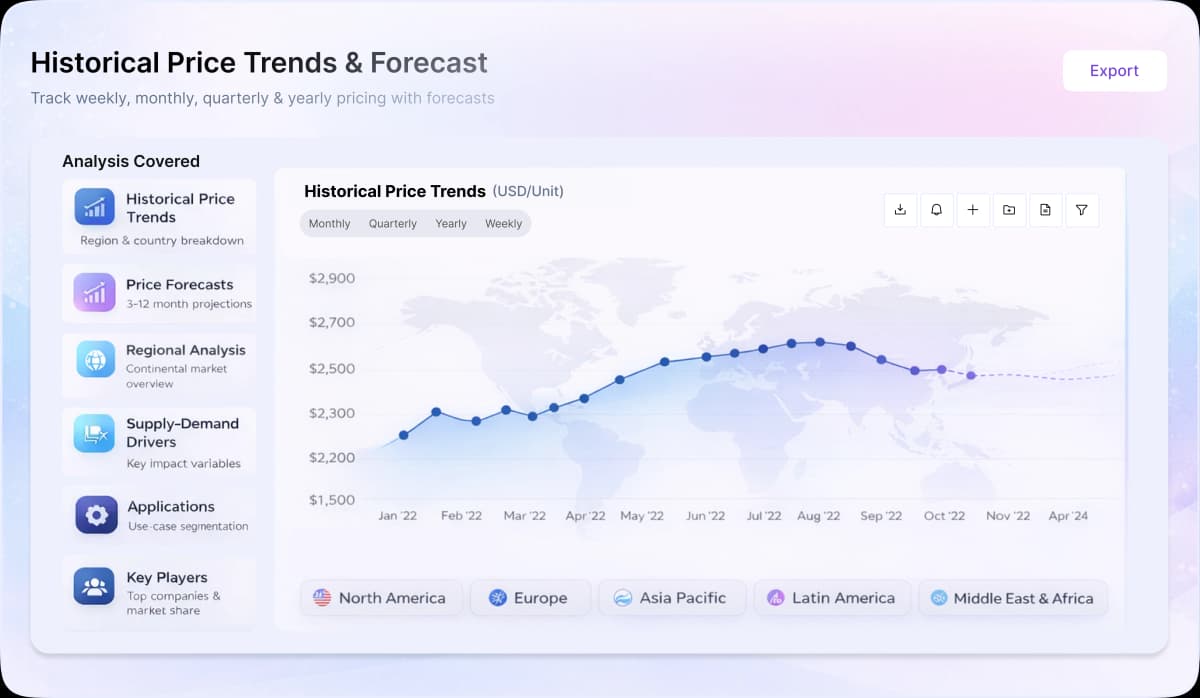
Price Trend Dashboard - What's Included
Price trends across a diverse portfolio of categories and products, spanning board to niche chemicals
Coverage extendable to grade-specific chemicals based on procurement requirements
Regular price tracking supported by robust historical datasets
News, policy updates, and key market drivers impacting price movements
Short-term and long-term price outlooks and forecasts
Supply–demand dynamics and capacity-driven market analysis