Allyl PEG Price Trend Analysis 2026: Latest News, Market Insights, Supply Demand Analysis, Historical Prices & Price Drivers

Pragati Agarwal profile photo
Written ByPragati Agarwal

Procurement Resource Database

Laptop screen

Turn price intelligence into action with the Procurement Resource Database. Log in or subscribe to unlock live price trends, historical charts, supplier databases, cost curves, and analyst-backed insights across chemicals, agriculture, energy, packaging, and more. Use these tools to benchmark your contracts, plan budgets with confidence, and stay ahead of market moves on every product you buy.

0

+

Products

0

+

Regions

0

+

Subscriptions

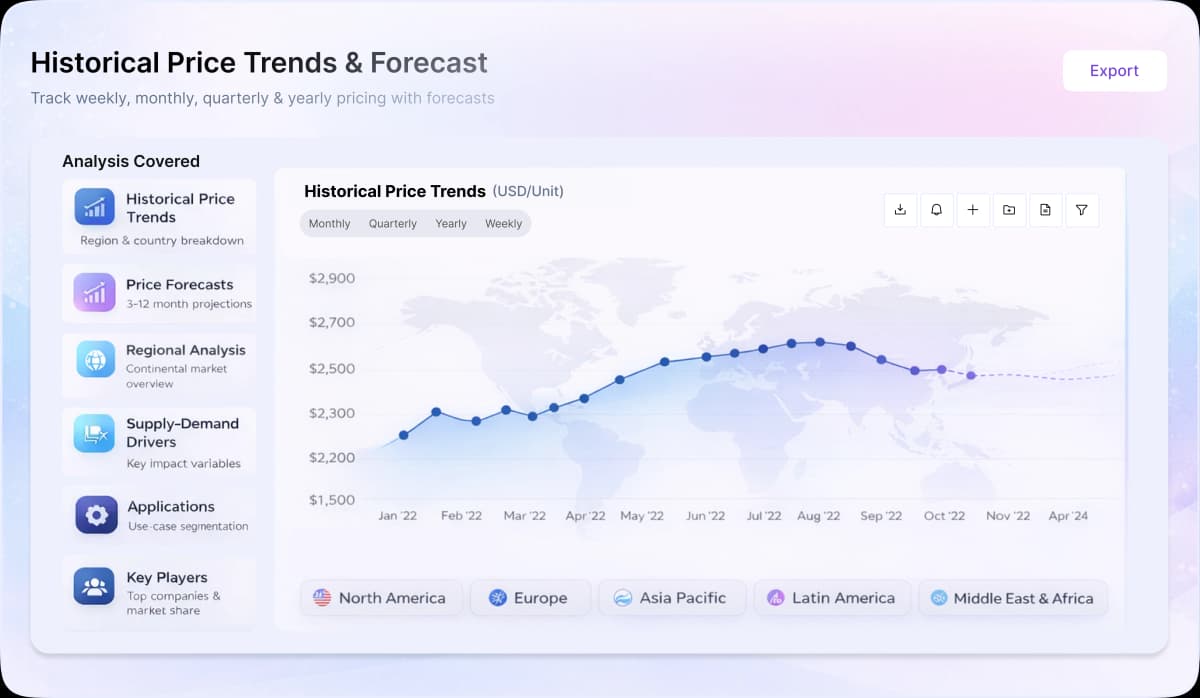
Allyl PEG uses allyl chloride and polyethylene glycol for its manufacturing, and thus, their market behaviors closely replicate each other. The year 2023 was a turbulent one for the allyl PEG market prices. For the majority time span, swift and short ranged fluctuations were witnessed in the price curve. The year started on a positive note as the prices started to firm in the first quarter, particularly in the Asian markets. However, as the months progressed, the prices started sliding down, primarily because of low upstream cost support.

A persistent downfall in crude oil prices resulted in the noted depreciation in production costs. This continued until the end of the third quarter. Further, the year-ending quarter witnessed an even steeper fall in the allyl PEG price graph. Owing to the supply chain restrictions and the erupted conflict in the Middle East, the global trade dynamics were disturbed. Market demands for Allyl PEG declined substantially, and the prices fell further down. Overall, mixed market sentiments were witnessed.

About Allyl PEG

Allyl PEG, also known as APEG, is created through the reaction of ethylene oxide or EO and allyl alcohol. It is a reactive poly-ether that is used to make polycarboxylate-based water reducing agents. Liquid-based allyl PEG can be stored in iron-based drums, whereas flakes can be packed in woven bags made or composed of polypropylene.

Allyl PEG Product Detail

Chemical Formula

C3H5(C2H4O)nOH

Industrial Uses

Manufacture of PCA type water reducing agent, Production of synthetic polymers

Synonyms

Allyl polyethylene glycol, Polyoxyethylene allyl, Allyl ether

Supplier Database

Lotte Chemical, Clariant, Shanghai Bronkow Chemical, Jiangsu Haishihua, Liaoning Kelong, Fengchen Group

Regional Coverage

Asia Pacific

China, India, Indonesia, Pakistan, Bangladesh, Japan, Philippines, Vietnam, Iran, Thailand, South Korea, Iraq, Saudi Arabia, Malaysia, Nepal, Taiwan, Sri Lanka, UAE, Israel, Hongkong, Singapore, Oman, Kuwait, Qatar, Australia, and New Zealand

Europe

Germany, France, United Kingdom, Italy,Spain, Russia, Turkey, Netherlands, Poland, Sweden, Belgium, Austria, Ireland Switzerland, Norway, Denmark, Romania, Finland, Czech Republic, Portugal and Greece

North America

United States and Canada

Latin America

Brazil, Mexico, Argentina, Columbia, Chile, Ecuador, and Peru

Africa

South Africa, Nigeria, Egypt, Algeria, Morocco

CurrencyUS$ (Data can also be provided in local currency)

Supplier Database AvailabilityYes

Customization ScopeThe report can be customized as per the requirements of the customer

Post-Sale Analyst Support360-degree analyst support after report delivery

Note: Our supplier search experts can assist your procurement teams in compiling and validating a list of suppliers indicating they have products, services, and capabilities that meet your company's needs.

Allyl PEG Production Processes

  • Production of Allyl PEG using Polymer Capping

The polymer capping process is used to produce allyl PEG from polyethylene glycol ether and allyl chloride. Polyethylene glycol (methyl-terminated) reacts with allyl chloride to produce allyloxy-methyl terminated polyethylene glycol ether, also known as allyl PEG.

Frequently Asked Questions

The allyl PEG outlook for 2026 stays range-bound to soft. Comfortable upstream availability of allyl alcohol and ethylene oxide keeps production economics relaxed, capping supplier pricing power. Demand from polycarboxylate-ether superplasticisers tied to construction activity remains steady but measured, while balanced regional trade and competitive producer offers limit appreciation. A meaningful upward shift requires either tighter allyl alcohol or ethylene oxide costs or stronger construction-driven superplasticiser demand; absent either, prices will likely stay soft with limited directional momentum globally.
Allyl PEG prices are driven primarily by upstream allyl alcohol and ethylene oxide feedstock costs, since these are combined via polymer capping to produce the finished product. Because ethylene oxide pricing is closely tied to crude and naphtha markets, crude-linked cost swings feed through to allyl PEG production economics. Demand from the polycarboxylate-ether (PCE) superplasticiser segment is the dominant downstream driver, so construction activity sets the pace of offtake: firmer construction spending lifts demand and tightens the market, while measured or soft construction activity leaves supply comfortable and limits supplier pricing power.
Allyl PEG production is concentrated among five manufacturers: Clariant and Lotte Chemical as the leading established producers, alongside Shanghai Bronkow Chemical, Jiangsu Haishihua, and Liaoning Kelong Fine Chemical. Asia Pacific is the dominant production and consumption hub, with Europe and North America acting as key import markets. This concentration among a small producer base creates meaningful supply security exposure for buyers, particularly given the product's tight linkage to construction-driven PCE superplasticiser demand.

Allyl PEG is produced via polymer capping, reacting methyl-terminated polyethylene glycol ether with allyl chloride. The PEG ether feedstock is derived from ethylene oxide, while allyl chloride is produced from propylene (sourced from crude oil and natural gas) and chlorine gas (via the energy-intensive chlor-alkali process). The finished allyl PEG is a reactive polyether used primarily to manufacture polycarboxylate-based water-reducing agents for high-performance concrete, and secondarily in synthetic polymers for coatings, adhesives, and pharmaceutical drug delivery systems.

Construction is the dominant demand driver, as allyl PEG is the key reactive intermediate for polycarboxylate-ether superplasticisers used in high-performance concrete. Polymer producers consume it to make synthetic polymers for coatings and adhesives, while automotive, electronics, and consumer-goods manufacturers draw demand through adhesive and coating applications. Pharmaceutical and healthcare sectors use it in drug delivery and tissue-engineering formulations. Because construction activity is cyclical, stronger building and infrastructure spending lifts superplasticiser demand and tightens the market, while softer construction activity leaves supply comfortable.
Allyl PEG is supplied as a colorless to slightly yellow liquid or solid (flake) form, with liquid stored in iron drums and flakes packed in polypropylene woven bags. The grades differ in physical state and handling, determining suitability for downstream processing. Liquid grades are preferred for direct reaction in polycarboxylate superplasticizer manufacturing, while flake grades offer easier transport and storage for polymer and adhesive producers. Form selection affects dosing precision, storage costs, and equipment compatibility.
Procurement Resource assesses allyl PEG prices through a structured methodology combining primary engagement with producers, suppliers and traders, secondary market data, monitoring of feedstock and input costs, trade-flow and inventory tracking, and exchange or spot benchmarks. These inputs are validated and translated into a transparent price assessment and outlook. The detailed methodology is available on the Procurement Resource website.

Our Price Analysis Methodology

About the Author

Pragati Agarwal profile photo

Pragati Agarwal

Senior Business Insights Analyst

Delivering price trend analysis and procurement market insights at Procurement Resource, with expertise in identifying commodity patterns, supporting purchasing strategies, and improving cost efficiency through actionable market intelligence.

Schedule Demo

Schedule A Demo

Experience how Procurement Resource transforms raw material price data into clear, decision ready intelligence. Optimise your performance with reliable, expert market data and analysis. Schedule your demo today to experience a live walk-through where our experts will showcase interactive price charts, forecasted prices, and insights driving the prices for your key commodities, tailored to your workflows. Contact us now!

Our Team will be happy to assist you

We are just a text away

+1

Still Need Help?

Europe & Africa

+44 7573 171117

[email protected]

USA & Canada

+1 307 363 1045

[email protected]

APAC

+91 8850629517

[email protected]

Unlock full access to Procurement Resource's price databases, interactive charts, and short-term forecasts for thousands of commodities. Elevate your sourcing decisions by comparing prices across regions, downloading historical data, and layering in analyst-backed insights, all with our flexible plans that scale as your portfolio grows.

Still have any Questions

Contact Us
Mastercard
Wire
VISA
Stripe

Why Procurement Database

Commodity Market Intelligence

Commodity Market Intelligence

Track prices, market movements, supply-demand dynamics, and industry developments across hundreds of commodities through a centralized intelligence platform built for informed procurement decisions.

Price Forecasts & Market Outlooks

Price Forecasts & Market Outlooks

Understand market fluctuations using analyst-backed forecasts, historical pricing patterns, and evolving industry trends to strengthen sourcing strategies and budget planning.

Cost & Procurement Optimization

Cost & Procurement Optimization

Leverage cost models, pricing benchmarks, and procurement insights to evaluate purchasing opportunities, improve negotiations, and enhance operational efficiency.

Global & Regional Market Insights

Global & Regional Market Insights

Access region-specific price trends, trade activities, capacity changes, and supply chain developments influencing commodity markets worldwide.

1/4