Udeesha Tomar
AVP - Strategy and Solutions
Leading procurement research solutions across chemicals, materials, and food & beverages, with expertise in price forecasting and market analytics.
| Product | Region | Incoterm Basis | Price | Time Period |
|---|---|---|---|---|
| Bisphenol A | China | FOB | USD 1,538.59/MT | April 2026 |
| Bisphenol A | India | CIF | USD 1,588.47/MT | April 2026 |
| Bisphenol A | USA | CIF | USD 1,625.59/MT | April 2026 |
| Bisphenol A | Brazil | CIF | USD 1,659.69/MT | April 2026 |
| Bisphenol A | Canada | CIF | USD 1,625.59/MT | April 2026 |
| Bisphenol A | China | FOB | USD 1,562.00/MT | March 2026 |
| Bisphenol A | India | CIF | USD 2,152.90/MT | March 2026 |
Stay updated with the latest bisphenol a prices, historical data, and tailored regional analysis
Asia
In the Asian region, Bisphenol A prices increased during Q1’26, with the sharpest rise recorded in March. In January, the market remained mostly stable as buyers followed a need-based procurement strategy amid weak off-season demand. However, sentiment improved from February as phenol and acetone costs increased and supply availability tightened. The Iran war and closure of the Strait of Hormuz further strengthened cost pressure by disrupting crude-linked feedstock chains and raising concerns over import flows. Downstream polycarbonate and epoxy resin producers increased purchases to secure raw material, which supported the upward price trend.
Europe
Bisphenol A prices in Europe moved upward during Q1’26 due to rising feedstock and logistics costs. The region faced higher energy-linked production costs after the Middle East conflict affected crude oil movement and freight sentiment. Phenol and acetone availability remained a key concern for producers, while cautious but steady downstream demand from epoxy resin, coatings, adhesives, and polycarbonate sectors supported the market. Buyers avoided large inventories early in the quarter but returned for essential procurement as replacement costs increased.
North America
Bisphenol A prices in North America rose during Q1’26, mainly supported by higher upstream costs and supply-side pressure. Crude oil volatility after the Iran war lifted benzene-related cost pressure, while freight and import uncertainty added to market firmness. Downstream demand from epoxy resin and polycarbonate sectors remained moderate, but buyers increased procurement to avoid later cost escalation. Limited spot availability and cautious seller offers also supported the upward trend.
Analyst Insight
According to Procurement Resource, BPA may remain firm if Hormuz-related logistics risks continue, but demand resistance from PC, epoxy resin, and coatings could limit further gains.
Related Report
Get real-time price assessments, periodic trends, forecasts and price driver insights across key global markets.
Unlock Price Insights NowOur Clients

Turn price intelligence into action with the Procurement Resource Database. Log in or subscribe to unlock live price trends, historical charts, supplier databases, cost curves, and analyst-backed insights across chemicals, agriculture, energy, packaging, and more. Use these tools to benchmark your contracts, plan budgets with confidence, and stay ahead of market moves on every product you buy.

0
+Products
0
+Regions
0
+Subscriptions
Asia
In the Asian region, particularly in China, the BPA market struggled due to sluggish demand from key sectors like polycarbonate (PC) and epoxy resin. The oversupply situation was exacerbated by high production rates, and despite some maintenance at phenol-ketone facilities, supply remained abundant.
Weak downstream demand from construction and real estate further dampened consumption, particularly in the PC and epoxy resin markets. This oversupply, combined with low feedstock prices, led to further price declines. Inventory levels remained high, and producers had difficulty stimulating demand despite some export surges.
Europe
In Europe, the BPA market followed a similar trend. Weak demand from construction and automotive sectors, combined with high inventories, resulted in continued downward pressure on prices. The reduced activity in the construction industry and slow consumer sentiment contributed to lower demand for BPA-based products like PC and epoxy resins. Economic uncertainties further suppressed buying activity, and seasonal factors played a role in restricting demand, keeping prices on a decline. With high stock levels and limited purchasing, the European market mirrored the broader global challenges faced by the BPA industry.
North America
In North America, the market also saw reduced prices during Q4, driven by weak demand from downstream industries like construction and automotive. Similar to Europe, North America experienced sluggish demand in key sectors, leading to an oversupply of BPA and a continued decline in prices. Retailers and manufacturers in the U.S. remained cautious, reducing procurement activities amid economic uncertainties and excess inventory.
Bisphenol A (BPA) is a chemical molecule that is largely utilised in the production of plastics. It is a colourless solid that is soluble in most organic solvents but extremely insoluble in water. BPA is manufactured on an industrial scale through the condensation of phenol and acetone, and global production is predicted to reach 10 million tonnes by 2022.
The remaining 5% of BPA is used in a variety of applications, many of which are plastic-based. BPA is a prominent component of numerous high-performance plastics, whose manufacturing is minimal in comparison to other polymers but nevertheless amounts to thousands of tonnes per year. Minor levels of BPA are also employed as additives or modifiers in certain commodities.


C15H16O2
Plastic industry, Coating of pipelines, Medical devices, Safety glasses, windows and helmets
Diphenylpropane, BPA
The Dow Chemical Company, Teijin Co., Ltd, LG Chem, SABIC, Kumho P&B Chemicals. Inc.
CurrencyUS$ (Data can also be provided in local currency)
Supplier Database AvailabilityYes
Customization ScopeThe report can be customized as per the requirements of the customer
Post-Sale Analyst Support360-degree analyst support after report delivery
Note: Our supplier search experts can assist your procurement teams in compiling and validating a list of suppliers indicating they have products, services, and capabilities that meet your company's needs.
In the process using acetone and phenol, the chemicals are reacted in the presence of a cation-change resin catalyst which further produces bisphenol A.
Udeesha Tomar
AVP - Strategy and Solutions
Leading procurement research solutions across chemicals, materials, and food & beverages, with expertise in price forecasting and market analytics.
Our Price Analysis Methodology

Experience how Procurement Resource transforms raw material price data into clear, decision ready intelligence. Optimise your performance with reliable, expert market data and analysis. Schedule your demo today to experience a live walk-through where our experts will showcase interactive price charts, forecasted prices, and insights driving the prices for your key commodities, tailored to your workflows. Contact us now!
Our Team will be happy to assist you
We are just a text away
Still Need Help?
This report presents a detailed cost analysis of bisphenol A production from acetone via condensation.
This report presents the cost structure of Tetrabromobisphenol A (TBBPA) production with the aid of bisphenol A (BPA) and bromine.
This report presents a detailed cost analysis of polycarbonate production from bisphenol A (BPA or Bis-A) and diphenyl carbonate.
This report presents a detailed cost analysis of polycarbonate production from bisphenol A (BPA or Bis-A) and carbonyl chloride via condensation polymerisation.
Unlock full access to Procurement Resource's price databases, interactive charts, and short-term forecasts for thousands of commodities. Elevate your sourcing decisions by comparing prices across regions, downloading historical data, and layering in analyst-backed insights, all with our flexible plans that scale as your portfolio grows.
Still have any Questions
Contact Us


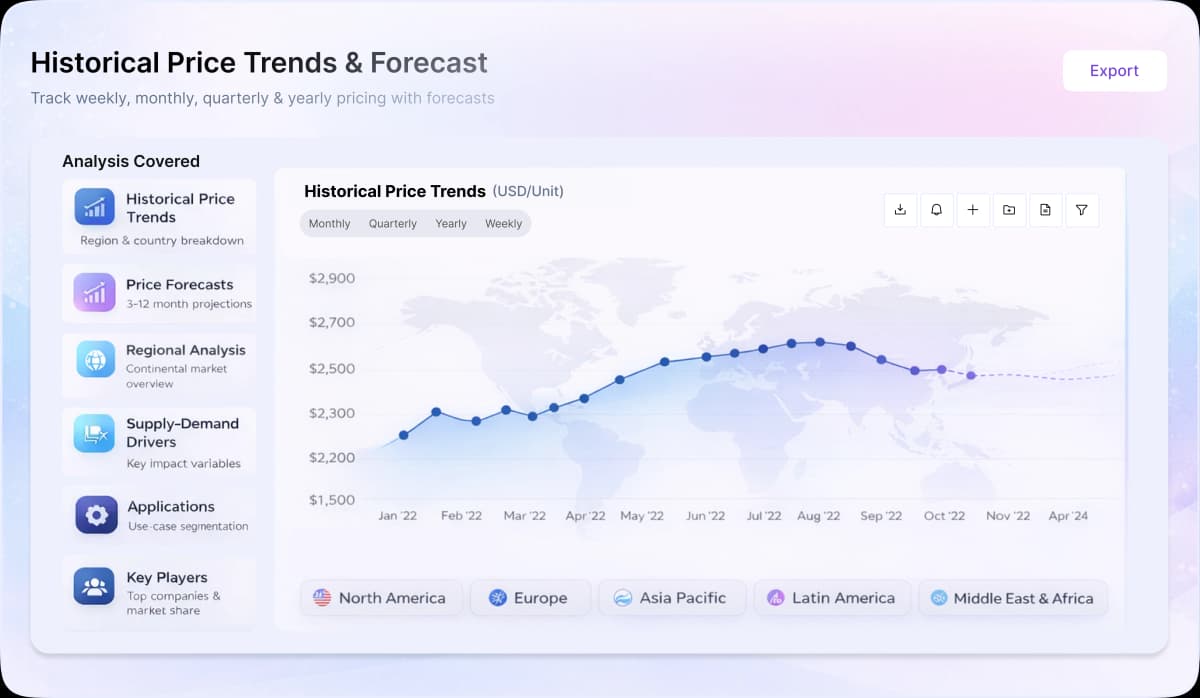
Price Trend Dashboard - What's Included
Price trends across a diverse portfolio of categories and products, spanning board to niche chemicals
Coverage extendable to grade-specific chemicals based on procurement requirements
Regular price tracking supported by robust historical datasets
News, policy updates, and key market drivers impacting price movements
Short-term and long-term price outlooks and forecasts
Supply-demand dynamics and capacity-driven market analysis