

Udeesha Tomar
AVP - Strategy and Solutions
Leading procurement research solutions across chemicals, materials, and food & beverages, with expertise in price forecasting and market analytics.

Asia
In Asia, C16 fatty acid prices in H2’25 showed a steady to firmer trend as the region dealt with ongoing instability in the palm oil market. Indonesia and Malaysia continued to face old plantations, slow replanting, heavy rainfall, and labor gaps, which reduced palm oil output and pushed up costs for palm-based derivatives such as palmitic acid.
At the same time, global edible oil prices moved unevenly, but palm oil remained sensitive to weather, trade rules, and strong local use. These factors kept raw material costs elevated for Asian processors. Meanwhile, demand from home-care, food, and chemical users stayed stable across the region. As a result, C16 prices in Asia remained firm and showed mild upward movement through the second half of the year.
Europe
In Europe, C16 fatty acid prices in H2’25 stayed elevated, supported by higher import dependence and added compliance costs. The approach of the EU deforestation-free regulation (EUDR) made supply chains tighter, as buyers needed clearer traceability from Southeast Asian producers. This slowed sourcing at times and increased risk premiums for compliant palm-based materials. Although European demand did not surge, consumption in key markets such as Germany, Italy, and France remained stable, supporting price firmness. Europe’s position as a net importer also meant that any supply disruption in producing countries quickly lifted local offers. Overall, European C16 prices held firm with slight upward pressure during the period.
North America
In North America, C16 fatty acid prices in H2’25 followed a firm tone, driven by higher global palm oil costs and consistent downstream demand. The United States imported larger volumes of palm oil for food use, but supply bottlenecks in Southeast Asia limited how much relief importers could get. Even though the strong US dollar offered some cushion, rising overseas costs and tight availability kept market levels supported. Demand from personal-care, cleaning, and specialty chemical applications remained steady, which helped keep C16 prices stable to slightly higher through the second half.
Related Report
Need Latest Fatty Acid - C16 Prices?
Get real-time price assessments, periodic trends, forecasts and price driver insights across key global markets.
Our Clients































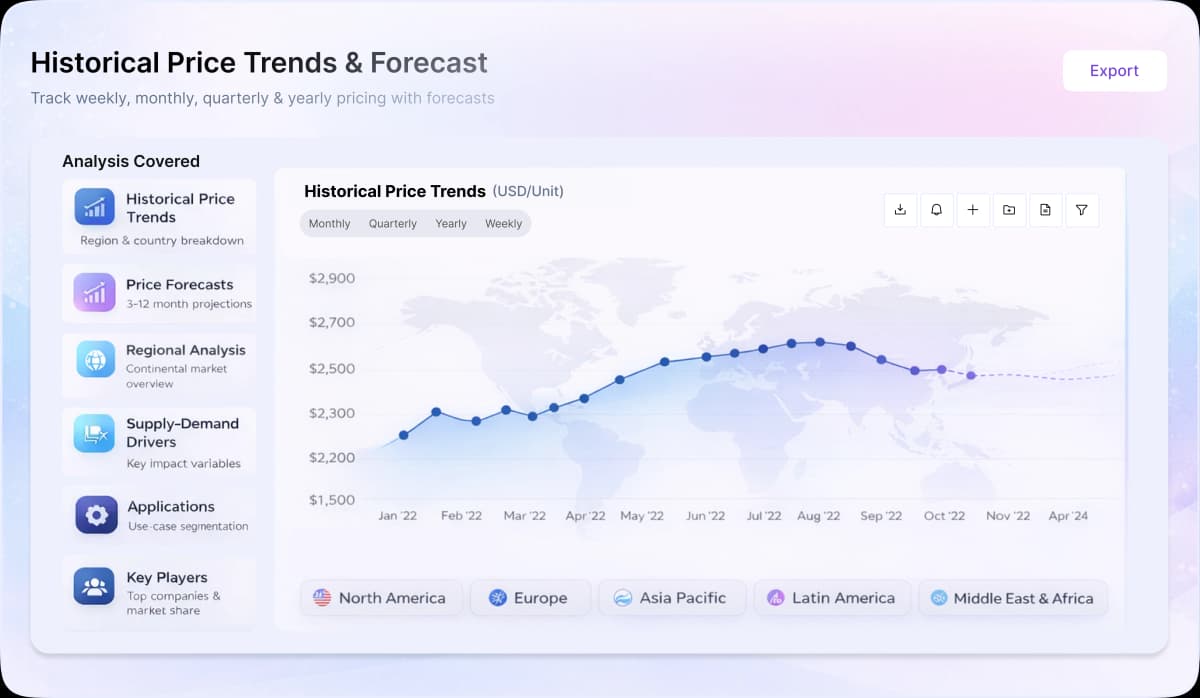
Turn price intelligence into action with the Procurement Resource Database. Log in or subscribe to unlock live price trends, historical charts, supplier databases, cost curves, and analyst-backed insights across chemicals, agriculture, energy, packaging, and more. Use these tools to benchmark your contracts, plan budgets with confidence, and stay ahead of market moves on every product you buy.
0
+Products
0
+Regions
0
+Subscriptions
Asia
In spite of the fact that Indonesia and Malaysia produce relatively little palm oil, the Asian fatty acid market showed signs of strength as a result of strong palm oil feedstock performance on the world market. Logistical challenges, combined with rising fatty acid prices, kept trading offers in India stable.
The government's Dual Control Policy, combined with a lack of feedstock and output limits, pushed industrial units such as Jiangsu Shengtai (with an 80 KTPA capacity) and Deyuan Gaoke (with a 100 KTPA capacity) to temporarily close their doors.
Several production facilities were short on mid-cut fatty alcohols for a significant amount of the quarter, which increased the country's demand to import the product. Even though downstream buyers placed sufficient orders for the product in response to market optimism, demand from the detergent and personal care industries posed difficulties. Indian fatty acid prices were hovering around 3130 USD/MT in the last year. In December, prices in India were 3440 USD/MT on a FOB basis, while prices in China were 3440 USD/MT on a FOB basis.
Europe
Amid rising input costs that were unexpectedly high, the European fatty acid industry remained bullish in the fourth quarter of 2021. Because of a global shortage of palm oil feedstock and supply delays, as well as extraordinarily high energy prices, input costs continued to rise. In addition to port container constraints and movement limitations imposed as a result of the increasing number of Omicron cases in the region, spot trading activity was further impeded.
As a result of the recurrence of Covid instances, Germany had a considerable increase in soap and detergent consumption, which resulted in an increase in downstream industry inquiries for Fatty Acid and strengthened manufacturers' confidence in their ability to supply steady contract prices.
Prices rose to their highest levels of the year in December, when they closed at 4080 USD/MT FOB, as a result of heightened market limitations in the downstream sectors towards the conclusion of the third quarter. The demand for personal care products played a role in the rise in pricing patterns, as well as other factors.
North America
Increasing palm oil feedstock prices on the international market and constrained supply as a result of vessel delays from Asian countries helped to drive up the price of fatty acids in October to their highest level since 2007.
Additionally, the scarcity of trucks for delivering consignments to downstream businesses contributed to the manufacturers' disillusionment during the first few weeks of the quarter, on top of the high input costs. Demand fundamentals in the downstream personal care and detergent categories, on the other hand, were predicted to outpace supply.
Although palm oil prices experienced a minor decline in the last months of the year as a result of improved port movements and lower freight charges, the region's fatty acid prices were restrained in the North American region.
A decline in demand for fatty acid as a result of low downstream activity over the Christmas and New Year holidays boosted bearishness in December's last days, as seen by the collapse in fatty acid prices to 1760 USD/MT DEL in the last few days of December.
Fatty Acid - C16 or palmitic acid is a saturated long-chain fatty acid with a 16-carbon backbone. Fatty Acid-C16 is found naturally in products like the palm oil and palm kernel oil. It is also found in food products like butter, cheese, milk, and meat.
C16H32O2
Commercial and industrial products, Curing activator and polymer, Finishing agents, Fuels and fuel additives, Intermediates, Lubricants and lubricant additives, rubber component, Surface active agents, agricultural products (non-pesticidal), arts, crafts, and hobby materials, Cleaning and furnishing care products, Industrial organic chemicals used in commercial and consumer products., Laundry and dishwashing products, personal care products, Plastic and rubber products, Rubber tires
Hexadecanoic Acid, Palmitic Acid, Cetylic Acid
Eastman Chemical Company, BASF SE, Oleon NV, Pacific Oleochemicals Sdn Bhd, Colgate-Palmolive Company, Longyan Zhuoyue New Energy Co. Ltd.
CurrencyUS$ (Data can also be provided in local currency)
Supplier Database AvailabilityYes
Customization ScopeThe report can be customized as per the requirements of the customer
Post-Sale Analyst Support360-degree analyst support after report delivery
Note: Our supplier search experts can assist your procurement teams in compiling and validating a list of suppliers indicating they have products, services, and capabilities that meet your company's needs.
In general, the production process of Fatty Acid involves hydrolytic or lipolytic splitting (reaction with water using high pressure and temperature or enzymes) of any oil or fat to finally obtain Fatty Acid as the product.
Our Price Analysis Methodology
AVP - Strategy and Solutions
Leading procurement research solutions across chemicals, materials, and food & beverages, with expertise in price forecasting and market analytics.

Experience how Procurement Resource transforms raw material price data into clear, decision ready intelligence. Optimise your performance with reliable, expert market data and analysis. Schedule your demo today to experience a live walk-through where our experts will showcase interactive price charts, forecasted prices, and insights driving the prices for your key commodities, tailored to your workflows. Contact us now!
Our Team will be happy to assist you
We are just a text away
Still Need Help?
Europe & Africa
+44 7573 171117
Sales@procurementresource.com
USA & Canada
+1 307 363 1045
Sales@procurementresource.com
APAC
+91 8850629517
Sales@procurementresource.com
This report presents a detailed cost analysis of bio-adipic acid production from fatty acids (like coconut oil) using direct fermentation.
Milk is acidified using acids like dilute hydrochloric acid or sulfuric acid, until the isoelectric point of casein is achieved.
The report is a detailed study of economics of production of oxalic acid by the reaction of nitric acid with glucose/ sugar.
Unlock full access to Procurement Resource's price databases, interactive charts, and short-term forecasts for thousands of commodities. Elevate your sourcing decisions by comparing prices across regions, downloading historical data, and layering in analyst-backed insights, all with our flexible plans that scale as your portfolio grows.
Still have any Questions
Contact Us



Price Trend Dashboard - What's Included
Price trends across a diverse portfolio of categories and products, spanning board to niche chemicals
Coverage extendable to grade-specific chemicals based on procurement requirements
Regular price tracking supported by robust historical datasets
News, policy updates, and key market drivers impacting price movements
Short-term and long-term price outlooks and forecasts
Supply–demand dynamics and capacity-driven market analysis

Cargill, the Foremost Global Provider to Pledge that Its Complete Edible Oil Range to be Based on WHO’s Industrially Produced Trans-Fatty Acids Best Practices

The Chinese Domestic Market Price for Hydrochloric Acid Fell by 14.81 percent During Mid of January

The Fatty Acids Present in the Palm Oil has been Linked to the Stimulation of Cancer Spread

Track prices, market movements, supply-demand dynamics, and industry developments across hundreds of commodities through a centralized intelligence platform built for informed procurement decisions.

Understand market fluctuations using analyst-backed forecasts, historical pricing patterns, and evolving industry trends to strengthen sourcing strategies and budget planning.

Leverage cost models, pricing benchmarks, and procurement insights to evaluate purchasing opportunities, improve negotiations, and enhance operational efficiency.
Access region-specific price trends, trade activities, capacity changes, and supply chain developments influencing commodity markets worldwide.