Isopropyl Alcohol Price Trend Analysis 2026: Price Drivers, Supply Demand Analysis, Historical Prices, Market Insights & Latest News

Udeesha Tomar profile photo
Written ByUdeesha Tomar

Procurement Resource Database

Laptop screen

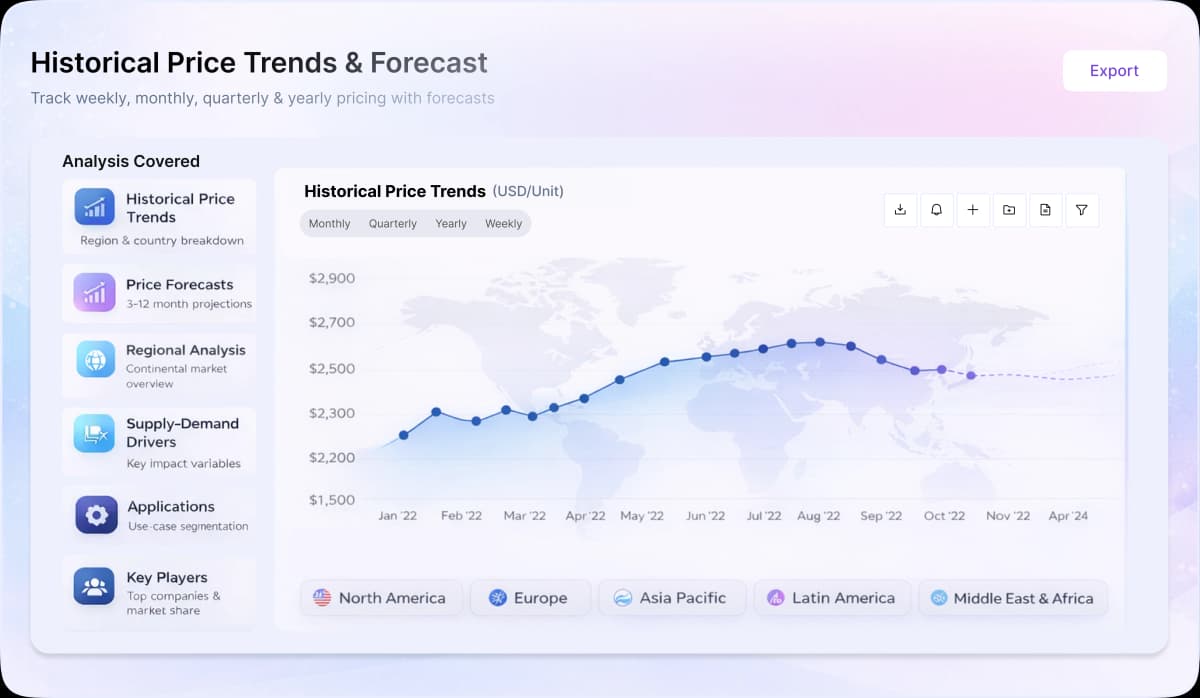
Turn price intelligence into action with the Procurement Resource Database. Log in or subscribe to unlock live price trends, historical charts, supplier databases, cost curves, and analyst-backed insights across chemicals, agriculture, energy, packaging, and more. Use these tools to benchmark your contracts, plan budgets with confidence, and stay ahead of market moves on every product you buy.

Isopropyl Alcohol Dashboard Inclusions

Isopropyl Alcohol Price Dasboard

0

+

Products

0

+

Regions

0

+

Subscriptions

Product Category Region Price Last Updated Month
Isopropyl Alcohol Chemicals USA 738 USD/MT December’25

Asia

In Q4’25, Isopropyl Alcohol prices in Asia generally showed a weak to soft trend. In China, spot prices declined as supply remained ample while demand stayed slow. The petrochemical industry continued to face overcapacity issues, especially in propylene-based chains, which directly affected IPA production economics. Even though crude oil prices provided some cost support at times, it was not strong enough to lift IPA prices. Downstream demand from coatings, pharmaceuticals, and electronics remained cautious, with buyers purchasing only based on immediate needs. Export competition within Asia also increased, adding pressure on sellers. Overall, the market sentiment stayed bearish, and China largely drove the regional weakness with spot prices settling at around 738 USD/MT towards the end of December’25.

Europe

In Europe, IPA prices remained mostly stable but under mild pressure during Q4’25. Demand from pharmaceutical and personal care sectors stayed steady, but industrial consumption remained slow due to weak economic activity. The supply was ample, supported by regular imports and stable domestic production. Lower propane and LPG prices across Europe reflected comfortable feedstock availability, which limited cost-side pressure. Even cold weather toward late Q4 failed to significantly improve market sentiment. Buyers remained cautious, and contract negotiations focused more on supply security rather than price increases.

North America

In North America, Isopropyl Alcohol prices showed limited movement during Q4’25. Feedstock propylene markets experienced mixed signals, with temporary supply tightness offset by weak downstream demand. High propane and LPG inventories indicated strong overall supply conditions, which reduced upward pressure on IPA costs. Demand from healthcare remained supportive, but industrial and chemical sectors showed slower buying interest. Logistics disruptions due to weather had only short-term effects, and the market stayed balanced overall.


About Isopropyl Alcohol

Isopropyl alcohol appears to be a colourless, flammable chemical molecule with a pungent odour. The most basic sort of secondary alcohol is one in which the alcohol carbon atom is connected to two additional carbon atoms. It is both a structural isomer of 1-propanol and a structural isomer of ethyl methyl ether. It is a frequent constituent in chemical compounds such as antiseptics, disinfectants, and detergents, and is utilised in the creation of a wide range of industrial and domestic chemicals.

Isopropyl Alcohol Product Detail

Chemical Formula

C3H8O

Molecular Weight
60.1 g/mol
Industrial Uses

Cosmetic and Personal care, Pharmaceutical, Food and Beverage, Paints and Coatings, Chemical

Synonyms

2-Propanol, Isopropanol, Isopropyl Alcohol, Rubbing Alcohol

Supplier Database

The Dow Chemical Company, Exxon Mobil, Shell Chemicals Europe B.V., INEOS Enterprises Group Limited, Super Chemical Technology Co. Ltd

Regional Coverage

Asia Pacific

China, India, Indonesia, Pakistan, Bangladesh, Japan, Philippines, Vietnam, Iran, Thailand, South Korea, Iraq, Saudi Arabia, Malaysia, Nepal, Taiwan, Sri Lanka, UAE, Israel, Hongkong, Singapore, Oman, Kuwait, Qatar, Australia, and New Zealand

Europe

Germany, France, United Kingdom, Italy,Spain, Russia, Turkey, Netherlands, Poland, Sweden, Belgium, Austria, Ireland Switzerland, Norway, Denmark, Romania, Finland, Czech Republic, Portugal and Greece

North America

United States and Canada

Latin America

Brazil, Mexico, Argentina, Columbia, Chile, Ecuador, and Peru

Africa

South Africa, Nigeria, Egypt, Algeria, Morocco

CurrencyUS$ (Data can also be provided in local currency)

Supplier Database AvailabilityYes

Customization ScopeThe report can be customized as per the requirements of the customer

Post-Sale Analyst Support360-degree analyst support after report delivery

Note: Our supplier search experts can assist your procurement teams in compiling and validating a list of suppliers indicating they have products, services, and capabilities that meet your company's needs.

Isopropyl Alcohol Production Processes

  • Production of Isopropyl Alcohol from Propene

Isopropyl alcohol is made from high-quality (or polymer-grade) propene. Direct hydration of gaseous propene with water in the presence of acidic catalysts is used to produce this product, which is very popular in the United States. As a by-product, propyl alcohol is obtained in relatively small amounts.

Frequently Asked Questions

During Q1 2026, isopropyl alcohol prices increased sharply in India and China. In India, prices rose by approximately 50%, while China recorded a similar increase. The surge was driven by higher propylene and acetone costs, constrained spot availability, logistics disruptions affecting regional supply chains, and stronger procurement from pharmaceutical, disinfectant, coatings, electronics-cleaning, and industrial solvent sectors. Tight supply conditions amplified the impact of feedstock inflation, resulting in substantial price gains across Asian markets.
Quarter-on-quarter, isopropyl alcohol prices recorded strong gains in both India and China. In India, prices increased by ~18% from Q4 2025 to Q1 2026, while in China they rose by ~19% over the same period. The Q-o-Q increase reflected a firmer average price level due to feedstock pressure, supply constraints, and stronger downstream procurement.
The isopropyl alcohol outlook for 2026 remains firm, supported by demand from pharmaceuticals, disinfectants, personal care, electronics cleaning, coatings, inks, and industrial solvents. Prices are expected to remain sensitive to acetone, propylene, refinery operating rates, and logistics costs. Semiconductor-grade and high-purity IPA demand may also strengthen as electronics and chip manufacturing requirements increase.
The main factors affecting isopropyl alcohol prices in Q1 2026 were rising propylene and acetone costs, constrained supply availability, logistics disruptions, and stronger downstream demand. Higher feedstock prices increased production costs, while active procurement from pharmaceutical, disinfectant, electronics-cleaning, coatings, and industrial solvent sectors supported stronger market sentiment and higher spot prices.
Major isopropyl alcohol markets include China, India, the United States, Japan, South Korea, Germany, Taiwan, Singapore, Saudi Arabia, and the Netherlands. Key companies include Dow, ExxonMobil,Kuraray, KH Neochem, LG Chem, LCY Chemical, Tokuyama, Deepak Fertilisers and Petrochemicals, Mitsui Chemicals, LyondellBasell, INEOS, and Moeve Chemicals. These companies operate across solvent, pharmaceutical, electronics, and petrochemical applications.
A major recent development was Moeve Chemicals’ first isopropyl alcohol plant in Spain, located at Palos de la Frontera. Scheduled to begin production in 2026, the facility will have a capacity of approximately 80,000 tonnes per year. Located within the Andalusian Green Hydrogen Valley, the project is intended to support more sustainable chemical production and strengthen European IPA supply availability.
Isopropyl alcohol is mainly produced through direct or indirect hydration of propylene and through acetone hydrogenation. The value chain includes propylene or acetone supply, reaction, purification, distillation, storage, packaging, bulk distribution, and downstream use in pharmaceuticals, disinfectants, personal care, paints, coatings, inks, electronics cleaning, chemical synthesis, industrial cleaning, and laboratory solvents.
Isopropyl alcohol is mainly sold as industrial-grade, pharmaceutical-grade, electronic-grade, semiconductor-grade, reagent-grade, and high-purity solvent grade. Industrial-grade IPA is used in coatings, inks, adhesives, and cleaning products. Pharmaceutical and electronic grades require tighter control of water, acidity, metals, residue, and organic impurities. Semiconductor-grade IPA requires very high purity for wafer cleaning and precision electronics use.
A notable market development in 2026 was continued investment in high-purity and semiconductor-grade isopropyl alcohol production to support expanding chip manufacturing capacity. Producers increased focus on ultra-high-purity IPA used for wafer cleaning and semiconductor fabrication, reflecting growing demand from advanced electronics and artificial-intelligence-related semiconductor projects. Recent investments in North America and Europe highlighted the strategic importance of securing regional supply of electronic-grade IPA
Procurement Resource employs a structured methodology combining primary research, secondary market data, analytical models, and validation processes to assess isopropyl alcohol prices and trends. Price evaluations incorporate supply-demand dynamics, feedstock movements, trade flows, and value chain analysis, supported by continuous market monitoring to ensure accurate and reliable insights.

About the Author

Udeesha Tomar profile photo

Udeesha Tomar

AVP - Strategy and Solutions

Leading procurement research solutions across chemicals, materials, and food & beverages, with expertise in price forecasting and market analytics.

Our Price Analysis Methodology

Schedule Demo

Schedule a demo

Experience how Procurement Resource transforms raw material price data into clear, decision ready intelligence. Optimise your performance with reliable, expert market data and analysis. Schedule your demo today to experience a live walk-through where our experts will showcase interactive price charts, forecasted prices, and insights driving the prices for your key commodities, tailored to your workflows. Contact us now!

Our Team will be happy to assist you

We are just a text away

+1

Still Need Help?

Europe & Africa

+44 7573 171117

[email protected]

USA & Canada

+1 307 363 1045

[email protected]

APAC

+91 8850629517

[email protected]

Other Related Reports

Isopropyl Alchohol Production from Acetone

This report provides the cost structure of isopropyl alcohol production by hydrogenation of crude acetone.

Unlock full access to Procurement Resource's price databases, interactive charts, and short-term forecasts for thousands of commodities. Elevate your sourcing decisions by comparing prices across regions, downloading historical data, and layering in analyst-backed insights, all with our flexible plans that scale as your portfolio grows.

Still have any Questions

Contact Us
Mastercard
Wire
VISA
Stripe

Related News

View All

Why Procurement Database

Commodity Market Intelligence

Commodity Market Intelligence

Track prices, market movements, supply-demand dynamics, and industry developments across hundreds of commodities through a centralized intelligence platform built for informed procurement decisions.

Price Forecasts & Market Outlooks

Price Forecasts & Market Outlooks

Understand market fluctuations using analyst-backed forecasts, historical pricing patterns, and evolving industry trends to strengthen sourcing strategies and budget planning.

Cost & Procurement Optimization

Cost & Procurement Optimization

Leverage cost models, pricing benchmarks, and procurement insights to evaluate purchasing opportunities, improve negotiations, and enhance operational efficiency.

Global & Regional Market Insights

Global & Regional Market Insights

Access region-specific price trends, trade activities, capacity changes, and supply chain developments influencing commodity markets worldwide.

1/4