Oil Prices Rise, Fueling Inflation Concerns
Crude oil prices are rising, adding pressure to domestic inflation. The volatility is expected to continue influencing commodity market trends.

Crude oil prices are rising, adding pressure to domestic inflation. The volatility is expected to continue influencing commodity market trends.
The conflict between the U.S., Israel and Iran has disrupted oil flows through the Strait of Hormuz, pushing up crude oil prices. Higher crude costs have lifted gasoline and diesel prices, contributing to broader inflation. Supply constraints are expected to keep prices elevated until mid‑2027.
Phosgene, a highly reactive intermediate synthesised from chlorine and carbon monoxide, is a building block for isocyanates used in polyurethane foam and coatings, polycarbonate resins, agrochemical intermediates, pharmaceutical synthesis, and fine chemicals. As it is rarely stored or transported in bulk, pricing closely mirrors chlorine feedstock economics, captive production rates, and procurement by integrated isocyanate and polycarbonate manufacturers.
Through H1 2026, phosgene prices traced a range bound path with moderate oscillations. In Q1, chlorine supply stayed relatively balanced across major producing regions, lending stability to production costs. Asian markets, which host the largest captive capacity, maintained steady operating rates as domestic polyurethane manufacturers kept procurement measured. European buyers stayed cautious against subdued construction and automotive activity, while North American demand drew support from insulation and specialty coatings applications. In Q2, incremental tightening in chlorine availability introduced modest upward cost pressure that passed through into offer levels. Pharmaceutical and agrochemical intermediate producers maintained consistent intake, supporting a firmer tone, even as polycarbonate consumers managed inventories cautiously amid moderate electronics demand. By mid year the market had settled into balance, with neither supply shortfalls nor demand surges strong enough to break the established corridor.
Analyst Insight
According to Procurement Resource, phosgene prices should remain range bound through H2 2026, with direction hinging on chlorine feedstock costs and polyurethane and polycarbonate demand.
Related Report
Need Latest Phosgene Prices?
Get real-time price assessments, periodic trends, forecasts and price driver insights across key global markets.
Our Clients































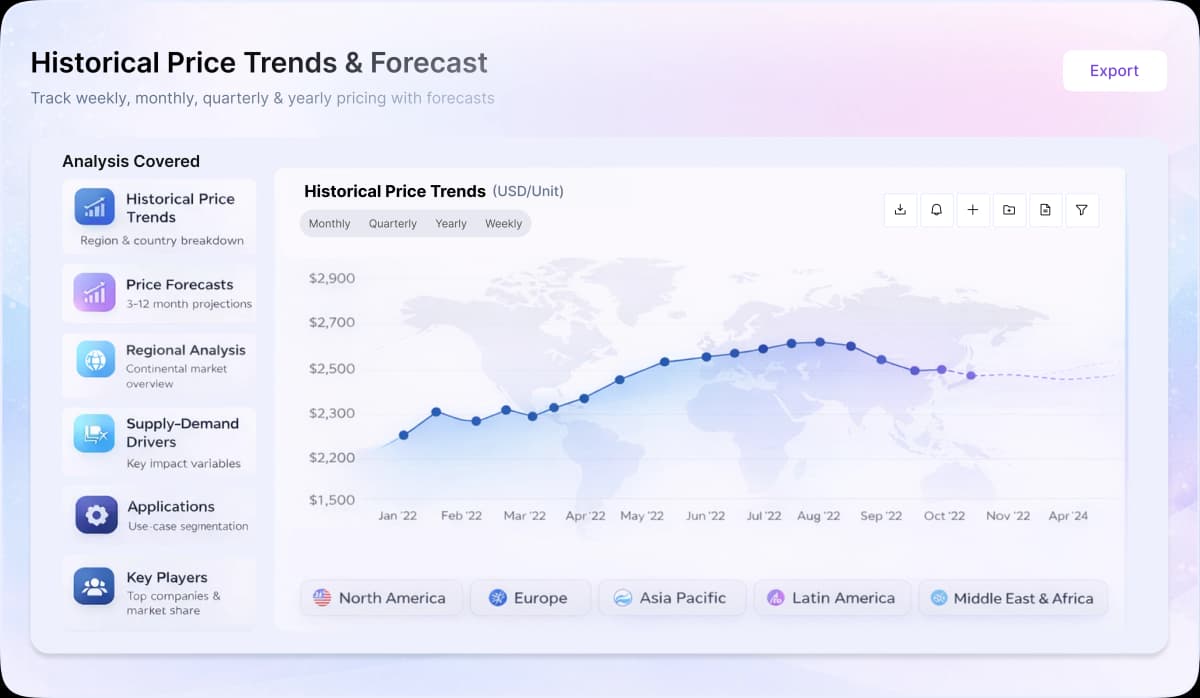
Turn price intelligence into action with the Procurement Resource Database. Log in or subscribe to unlock live price trends, historical charts, supplier databases, cost curves, and analyst-backed insights across chemicals, agriculture, energy, packaging, and more. Use these tools to benchmark your contracts, plan budgets with confidence, and stay ahead of market moves on every product you buy.
0
+Products
0
+Regions
0
+Subscriptions
The global phosgene market demonstrated range-bound price movements during the fourth quarter, fluctuating within an established trading band as feedstock chlorine cost dynamics and downstream consumption patterns created alternating pressures. The opening period witnessed upward movement as production economics tightened temporarily, supported by steady demand from isocyanate production for polyurethanes manufacturing and measured procurement from polycarbonate resin applications. The middle portion marked the upper boundary as buyers accelerated purchases to secure volumes, with pharmaceutical intermediate production and agrochemical synthesis operations generating consistent baseline demand. However, the latter portion witnessed downward movement toward the lower range as cost pressures eased and supply availability normalized. Isocyanate producers and polycarbonate manufacturers adopted conservative inventory strategies as downstream end-use sectors showed limited growth momentum. By quarter-close, prices had retreated to levels comparable with the opening period, confirming the range-bound nature of trading as supply-demand fundamentals prevented sustained directional movement beyond established boundaries.
It's a colourless gas with an odor that's akin to freshly chopped grasses or hay. Phosgene is a valuable commercial component, particularly in the production of urethanes and polycarbonate polymers. According to the VSEPR hypothesis, phosgene is a planar molecule. It is one of the most basic acyl chlorides, having been generated from carbonic acid.
COCl2
Agrochemicals, Pharmaceuticals, Polycarbonates, Dyes, Fine Chemicals
Carbonic dichloride, Carbonyl chloride, Phosgen, Chloroformyl chloride, Carbon oxychloride, Carbonic chloride
Wanhua Chemical Group Co., Ltd, Vertellus Holdings, PMC ISOCHEM, JH-Products, Bayer AG, Dow Chemical, DuPont, Rubican
CurrencyUS$ (Data can also be provided in local currency)
Supplier Database AvailabilityYes
Customization ScopeThe report can be customized as per the requirements of the customer
Post-Sale Analyst Support360-degree analyst support after report delivery
Note: Our supplier search experts can assist your procurement teams in compiling and validating a list of suppliers indicating they have products, services, and capabilities that meet your company's needs.
Phosgene is synthesised from chlorine and reacted with carbon monoxide in the presence of activated charcoal as a catalyst.
Our Price Analysis Methodology

AVP - Strategy and Solutions
Leading procurement research solutions across chemicals, materials, and food & beverages, with expertise in price forecasting and market analytics.
Experience how Procurement Resource transforms raw material price data into clear, decision ready intelligence. Optimise your performance with reliable, expert market data and analysis. Schedule your demo today to experience a live walk-through where our experts will showcase interactive price charts, forecasted prices, and insights driving the prices for your key commodities, tailored to your workflows. Contact us now!
Our Team will be happy to assist you
We are just a text away
Still Need Help?
Unlock full access to Procurement Resource's price databases, interactive charts, and short-term forecasts for thousands of commodities. Elevate your sourcing decisions by comparing prices across regions, downloading historical data, and layering in analyst-backed insights, all with our flexible plans that scale as your portfolio grows.
Still have any Questions
Contact Us



Price Trend Dashboard - What's Included
Price trends across a diverse portfolio of categories and products, spanning board to niche chemicals
Coverage extendable to grade-specific chemicals based on procurement requirements
Regular price tracking supported by robust historical datasets
News, policy updates, and key market drivers impacting price movements
Short-term and long-term price outlooks and forecasts
Supply–demand dynamics and capacity-driven market analysis

Track prices, market movements, supply-demand dynamics, and industry developments across hundreds of commodities through a centralized intelligence platform built for informed procurement decisions.

Understand market fluctuations using analyst-backed forecasts, historical pricing patterns, and evolving industry trends to strengthen sourcing strategies and budget planning.

Leverage cost models, pricing benchmarks, and procurement insights to evaluate purchasing opportunities, improve negotiations, and enhance operational efficiency.
Access region-specific price trends, trade activities, capacity changes, and supply chain developments influencing commodity markets worldwide.
