
Prakhar Panchbhaiya
Assistant Manager: Business Insights and Content
Supporting procurement teams with category intelligence, market research, price trends, supply-demand analysis, and strategic sourcing insights across key industries.

Asia
The Asian market for isopropyl myristate experienced mixed pressures during the said quarter. Production costs remained elevated as key feedstock prices showed upward movement, particularly driven by rising international values. However, manufacturers faced significant headwinds from the demand side. The traditional year-end slowdown hit harder than usual, with downstream industries like cosmetics and personal care adopting cautious purchasing sentiment. Buyers resisted higher-priced materials, preferring to operate on minimal inventory. Regional supply conditions varied, with some production facilities undergoing maintenance, creating temporary tightness in certain areas. Despite these supply constraints, the overall market struggled to sustain upward momentum due to weak consumption patterns across segments.
Europe
European prices followed a relatively stable trajectory through the quarter, though underlying tensions persisted. The cost structure remained firm as upstream raw material expenses stayed elevated throughout the period. However, demand from pharmaceutical and cosmetic applications remained subdued. Manufacturers and distributors maintained conservative stock levels, avoiding commitment to large volumes. The supply situation was generally balanced, with no major disruptions reported. Exports from Asia continued steadily, though buyers showed little urgency in procurement activities.
North America
North America witnessed similar dynamics, with prices holding within a narrow range. Feedstock availability was adequate, though costs provided a firm support to the market pricing. Demand from personal care and pharmaceutical sectors remained moderate, with no significant boost from holiday-related consumption. Buyers maintained a needs-based approach, waiting for clear signals before increasing purchase volumes. Domestic production operated steadily without major supply concerns.
Analyst Insight
According to Procurement Resource, the Isopropyl Myristate market appears likely to remain range-bound in the near term. While cost support may prevent sharp declines, weak demand fundamentals suggest limited potential until downstream consumption improves.
Related Report
Need Latest Isopropyl Myristate Prices?
Get real-time price assessments, periodic trends, forecasts and price driver insights across key global markets.
Our Clients































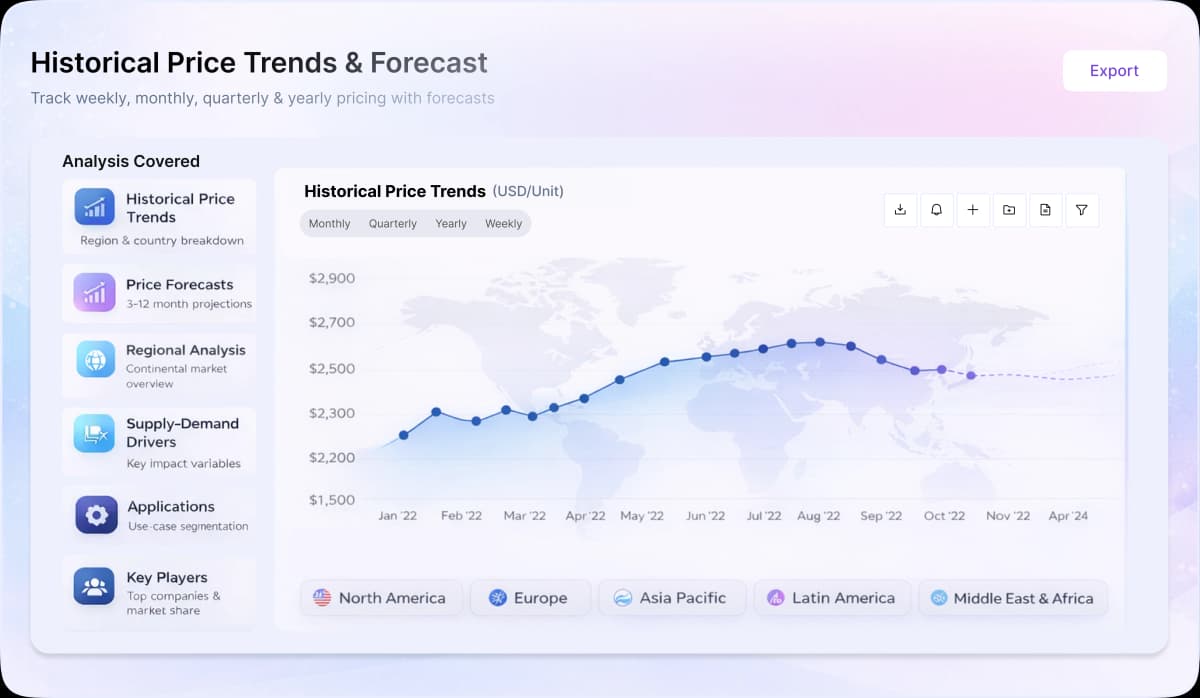
Turn price intelligence into action with the Procurement Resource Database. Log in or subscribe to unlock live price trends, historical charts, supplier databases, cost curves, and analyst-backed insights across chemicals, agriculture, energy, packaging, and more. Use these tools to benchmark your contracts, plan budgets with confidence, and stay ahead of market moves on every product you buy.
0
+Products
0
+Regions
0
+Subscriptions
Asia
In Asia, Isopropyl Myristate prices showed slight upward movement during the third quarter of 2025. The rise was supported by cost increases in key feedstocks such as isopropanol and myristic acid, both of which saw mild supply tightness at times. The market also felt indirect pressure from fluctuations in the propylene market.
Limited spot supply in China during late June and maintenance activities at several production plants briefly pushed feedstock costs higher. However, downstream demand from the personal care, cosmetic, and pharmaceutical industries remained moderate, as buyers purchased only when needed. Higher shipping costs within Asia further added to production expenses. Overall, the Asian market stayed slightly firm but not bullish, supported mainly by feedstock dynamics.
Europe
In Europe, Isopropyl Myristate prices remained mostly stable during Q3’25, though there were minor fluctuations due to energy and logistics costs. The region had steady access to feedstocks, but high operational expenses limited any downward movement in prices. Demand from cosmetics, skincare, and pharmaceutical manufacturers stayed consistent, supported by post-summer restocking.
While imports from Asia offered some supply flexibility, costlier transportation and currency fluctuations prevented any sharp price declines. Producers maintained balanced inventories, and trading remained moderate. The stable environment in both demand and raw material supply helped keep European IPM prices within a narrow range.
North America
In North America, IPM prices showed steady to slightly firm trends through the quarter. Feedstock isopropanol prices remained influenced by global propylene fluctuations and refinery maintenance schedules, while myristic acid supplies were stable.
End-user industries such as personal care, pharma, and industrial formulations maintained regular demand, though not strong enough to drive large price changes. The market mood was cautious, with buyers preferring smaller lot purchases amid steady production and adequate inventories. No major disruptions occurred on the supply side, keeping the region’s pricing largely balanced.
Isopropyl Myristate or Propyl Myristate Iso is a clear colourless chemical compound. It appears as an oily liquid. It can be dissolved in organic solvents while it is insoluble in water. It is one of the crucial additives for high-grade cosmetics. It is often utilised as an emulsifier and as a moistening agent in cosmetics.
C17H34O2
Cosmetics, Binding agents, Emollients, Perfuming agents, Skin conditioning, Intermediates, Solvents
Isopropyl myristate (IPM) , Tetradecanoic acid, 1-methylethyl ester, Myristic acid isopropyl ester, Estergel
Evonik Industries AG, Ernesto Ventós, S.A., Hallstar Corporate, Kao Corporation, Moellhausen S.p.A, Organo Chem (India)
CurrencyUS$ (Data can also be provided in local currency)
Supplier Database AvailabilityYes
Customization ScopeThe report can be customized as per the requirements of the customer
Post-Sale Analyst Support360-degree analyst support after report delivery
Note: Our supplier search experts can assist your procurement teams in compiling and validating a list of suppliers indicating they have products, services, and capabilities that meet your company's needs.
Isopropyl Myristate is prepared at industrial level through the esterification of myristic acid and isopropanol, which is alkali refined to neutralise the catalyst, and finally the obtained product is distilled to produce Isopropyl Myristate.
Our Price Analysis Methodology
Assistant Manager: Business Insights and Content
Supporting procurement teams with category intelligence, market research, price trends, supply-demand analysis, and strategic sourcing insights across key industries.
Experience how Procurement Resource transforms raw material price data into clear, decision ready intelligence. Optimise your performance with reliable, expert market data and analysis. Schedule your demo today to experience a live walk-through where our experts will showcase interactive price charts, forecasted prices, and insights driving the prices for your key commodities, tailored to your workflows. Contact us now!
Our Team will be happy to assist you
We are just a text away
Still Need Help?
The report involves the industrial production of acrolein by oxidation of propene.
Unlock full access to Procurement Resource's price databases, interactive charts, and short-term forecasts for thousands of commodities. Elevate your sourcing decisions by comparing prices across regions, downloading historical data, and layering in analyst-backed insights, all with our flexible plans that scale as your portfolio grows.
Still have any Questions
Contact Us



Price Trend Dashboard - What's Included
Price trends across a diverse portfolio of categories and products, spanning board to niche chemicals
Coverage extendable to grade-specific chemicals based on procurement requirements
Regular price tracking supported by robust historical datasets
News, policy updates, and key market drivers impacting price movements
Short-term and long-term price outlooks and forecasts
Supply–demand dynamics and capacity-driven market analysis

Track prices, market movements, supply-demand dynamics, and industry developments across hundreds of commodities through a centralized intelligence platform built for informed procurement decisions.

Understand market fluctuations using analyst-backed forecasts, historical pricing patterns, and evolving industry trends to strengthen sourcing strategies and budget planning.

Leverage cost models, pricing benchmarks, and procurement insights to evaluate purchasing opportunities, improve negotiations, and enhance operational efficiency.
Access region-specific price trends, trade activities, capacity changes, and supply chain developments influencing commodity markets worldwide.