RBD Palm Stearin Price Trend Analysis 2026: Market Insights, Historical Prices, Price Drivers, Supply Demand Analysis & Latest News

Pragati Agarwal profile photo
Written ByPragati Agarwal

Procurement Resource Database

Laptop screen

Turn price intelligence into action with the Procurement Resource Database. Log in or subscribe to unlock live price trends, historical charts, supplier databases, cost curves, and analyst-backed insights across chemicals, agriculture, energy, packaging, and more. Use these tools to benchmark your contracts, plan budgets with confidence, and stay ahead of market moves on every product you buy.

0

+

Products

0

+

Regions

0

+

Subscriptions

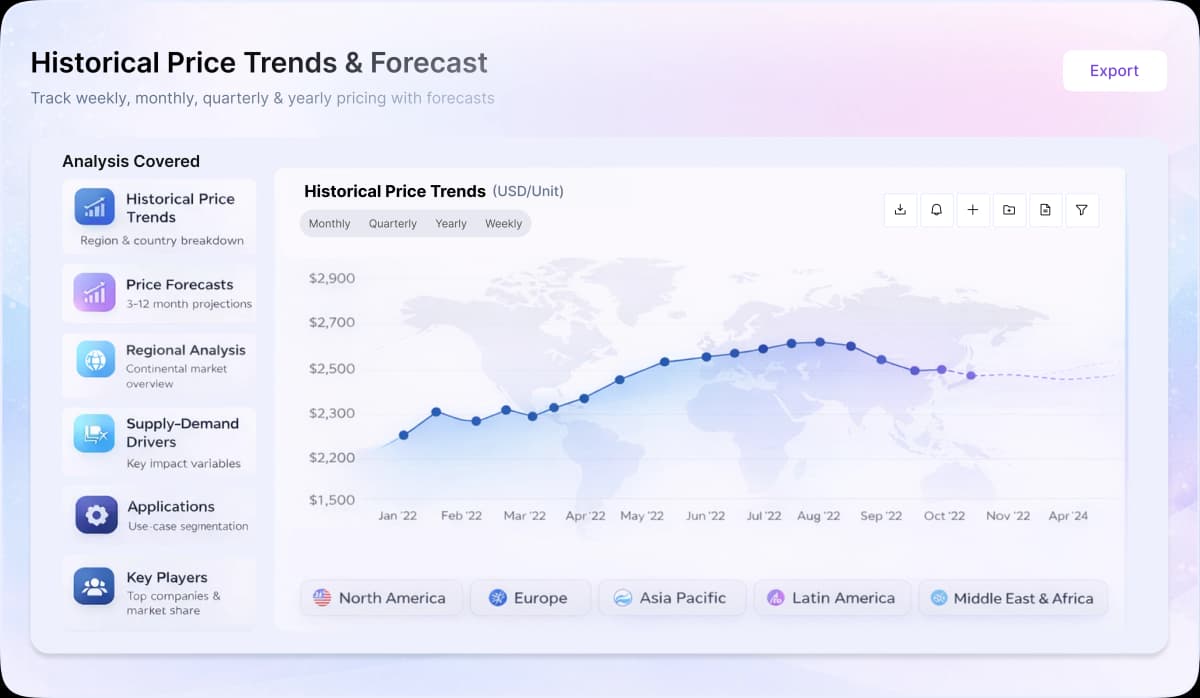
RBD palm stearin prices exhibited a broadly volatile pattern during the second half of 2025, closely tracking movements in upstream crude palm oil markets across the period. Prices entered the half on a firm footing, rising progressively through the early weeks as seasonal tightening in palm fruit production and steady demand from food manufacturing and oleochemical sectors supported values. The upward trend gained further momentum as the period advanced, with prices reaching a peak around mid-period. Supply constraints from key producing regions in Southeast Asia, combined with active procurement from Chinese and regional buyers, contributed to the elevated price environment during this phase.

A clear reversal followed as palm oil production recovered seasonally and supply flows improved. Prices declined steadily through the latter portion of the half, weighed down by increasing inventory availability, softening import demand from major consuming markets, and reduced buying urgency among downstream processors. The declining trend persisted through much of the final quarter, with prices reaching their lowest levels of the period before a modest uptick emerged in the closing weeks, reflecting selective restocking activity ahead of the year-end.


About RBD Palm Stearin

RBD Palm stearin is the solid component of refined, bleached, deodorised palm oil obtained through controlled temperature partial crystallisation. Palm stearin is used to make polysaccharide-based coating alternatives, margarine, shortening, cocoa butter substitutes, lard substitutes, and emulsion products. Palm stearin enhances the physicochemical, functional, and sensory qualities of a wide variety of food products.

RBD Palm Stearin Product Detail

Industrial Uses

Coating substitution material, Margarine, Pig lard replacers, Cocoa butter replacers

Supplier Database

Bunge Ltd, Cargill Incorporated, Wilmar International Ltd, Fuji Oil Holdings Inc.

Regional Coverage

Asia Pacific

China, India, Indonesia, Pakistan, Bangladesh, Japan, Philippines, Vietnam, Iran, Thailand, South Korea, Iraq, Saudi Arabia, Malaysia, Nepal, Taiwan, Sri Lanka, UAE, Israel, Hongkong, Singapore, Oman, Kuwait, Qatar, Australia, and New Zealand

Europe

Germany, France, United Kingdom, Italy,Spain, Russia, Turkey, Netherlands, Poland, Sweden, Belgium, Austria, Ireland Switzerland, Norway, Denmark, Romania, Finland, Czech Republic, Portugal and Greece

North America

United States and Canada

Latin America

Brazil, Mexico, Argentina, Columbia, Chile, Ecuador, and Peru

Africa

South Africa, Nigeria, Egypt, Algeria, Morocco

CurrencyUS$ (Data can also be provided in local currency)

Supplier Database AvailabilityYes

Customization ScopeThe report can be customized as per the requirements of the customer

Post-Sale Analyst Support360-degree analyst support after report delivery

Note: Our supplier search experts can assist your procurement teams in compiling and validating a list of suppliers indicating they have products, services, and capabilities that meet your company's needs.

RBD Palm Stearin Production Processes

  • Production of RBD Palm Stearin via Dry Fractionation Process

RBD Palm Stearin is obtained via dry fractionation by heating the RBD palm oil, followed by homogenisation. Upon cooling, the solid crystallised mass is obtained which is filtered to separate RBD palm olein and RBD palm stearin.

Frequently Asked Questions

The outlook for RBD palm stearin through 2026 points to range-bound to moderately soft prices, as recovering palm fruit output across Indonesia and Malaysia keeps supply comfortable and eases first-half tightness. Cost-push support from firm crude palm oil values and steady Indian refining demand should provide a floor, but measured Chinese buying, selective European interest amid elevated freight costs, and competitive soybean and sunflower oil pricing will cap upside. A meaningful recovery would require a renewed Southeast Asian supply disruption or a sustained crude palm oil feedstock rally.

RBD palm stearin prices are shaped by several interconnected factors. Crude palm oil provides direct cost-push support to refined stearin, since fractionation economics follow CPO with minimal lag. Constrained palm fruit production in key Southeast Asian origins tightens upstream availability and underpins values. Indian refining and vanaspati demand adds a stable floor, while measured Chinese buying and competitive soybean and sunflower oil pricing cap upside.

RBD palm stearin production and export are dominated by Indonesia and Malaysia, which supply the palm fruit and crude palm oil feedstock and host the region's leading integrated refiners and fractionators. Key producers include Wilmar International, SD Guthrie Berhad (formerly Sime Darby Plantation), Golden Agri-Resources, IOI Corporation, Musim Mas Group, Cargill, and Bunge. Major importers are China, India, Pakistan, Bangladesh, and European nations. This heavy Southeast Asian concentration means any supply disruption in Indonesia or Malaysia carries meaningful supply-security risk for global buyers.

RBD palm stearin is a fractionation product of refined palm oil, so its supply cycle follows the palm fruit harvesting calendar in Indonesia and Malaysia. Peak fruit output arrives in the second half of the year, with seasonal improvement from the second quarter. Tighter production in the early months restricts CPO supply and supports refined derivative prices. Indian and Chinese buyers replenish inventories during the higher output window, moderating prices. Annual cycles repeat with weather-dependent yield variations.

Food manufacturing and oleochemical processing are the primary downstream demand drivers for RBD palm stearin. Food producers rely on it as a natural hardening agent in margarine, shortening, bakery fats, snacks, and confectionery, while oleochemical processors use it in soaps, detergents, and candles. Steady procurement from these sectors underpins prices, but moderating Chinese buying, selective European interest, and substitution from competitively priced soybean and sunflower oils can soften the market.

Procurement Resource assesses RBD palm stearin prices through a structured, data-driven methodology that combines primary engagement with producers, suppliers and traders, secondary market data, monitoring of feedstock and input costs, trade-flow and inventory tracking, and exchange or spot benchmarks. All inputs are validated and translated into a transparent price assessment and outlook. The detailed methodology is available on the Procurement Resource website.

Our Price Analysis Methodology

About the Author

Pragati Agarwal profile photo

Pragati Agarwal

Senior Business Insights Analyst

Delivering price trend analysis and procurement market insights at Procurement Resource, with expertise in identifying commodity patterns, supporting purchasing strategies, and improving cost efficiency through actionable market intelligence.

Schedule Demo

Schedule A Demo

Experience how Procurement Resource transforms raw material price data into clear, decision ready intelligence. Optimise your performance with reliable, expert market data and analysis. Schedule your demo today to experience a live walk-through where our experts will showcase interactive price charts, forecasted prices, and insights driving the prices for your key commodities, tailored to your workflows. Contact us now!

Our Team will be happy to assist you

We are just a text away

+1

Still Need Help?

Europe & Africa

+44 7573 171117

[email protected]

USA & Canada

+1 254 254 1750

[email protected]

APAC

+91 8850629517

[email protected]

Other Related Reports

RBD Palm Stearin Production via Milling, Refining and Fractionating

The study offers a detailed cost analysis of RBD Palm Stearin Production via Milling, Refining and Fractionating. In addition, the report incorporates the manufacturing process with detailed process and material flow, operating costs along with financial expenses and depreciation charges.

Unlock full access to Procurement Resource's price databases, interactive charts, and short-term forecasts for thousands of commodities. Elevate your sourcing decisions by comparing prices across regions, downloading historical data, and layering in analyst-backed insights, all with our flexible plans that scale as your portfolio grows.

Still have any Questions

Contact Us
Mastercard
Wire
VISA
Stripe

Related News

View All

Why Procurement Database

Commodity Market Intelligence

Commodity Market Intelligence

Track prices, market movements, supply-demand dynamics, and industry developments across hundreds of commodities through a centralized intelligence platform built for informed procurement decisions.

Price Forecasts & Market Outlooks

Price Forecasts & Market Outlooks

Understand market fluctuations using analyst-backed forecasts, historical pricing patterns, and evolving industry trends to strengthen sourcing strategies and budget planning.

Cost & Procurement Optimization

Cost & Procurement Optimization

Leverage cost models, pricing benchmarks, and procurement insights to evaluate purchasing opportunities, improve negotiations, and enhance operational efficiency.

Global & Regional Market Insights

Global & Regional Market Insights

Access region-specific price trends, trade activities, capacity changes, and supply chain developments influencing commodity markets worldwide.

1/4