Need latest Yellow Phosphorus prices?
Get real-time price assessments, periodic trends, forecasts and price driver insights across key global markets.
Unlock Price Insights NowOur Clients
| Product | Region | Incoterm Basis | Price | Last Updated Month |
|---|---|---|---|---|
| Yellow Phosphorus | China | FOB | USD 4,250.61/MT | April 2026 |
| Yellow Phosphorus | India | CIF | USD 4,300.49/MT | April 2026 |
| Yellow Phosphorus | USA | CIF | USD 4,337.61/MT | April 2026 |
| Yellow Phosphorus | Brazil | CIF | USD 4,371.71/MT | April 2026 |
| Yellow Phosphorus | Canada | CIF | USD 4,337.61/MT | April 2026 |
| Yellow Phosphorus | China | FOB | USD 3,811.07/MT | March 2026 |
| Yellow Phosphorus | India | CIF | USD 3,866.07/MT | March 2026 |
| Yellow Phosphorus | USA | CIF | USD 3893/MT | March 2026 |
| Yellow Phosphorus | Brazil | CIF | USD 3909/MT | March 2026 |
| Yellow Phosphorus | Canada | CIF | USD 3898/MT | March 2026 |
Stay updated with the latest Yellow Phosphorus prices, historical data, and tailored regional analysis
Asia
In Asia, yellow phosphorus prices increased during Q1’26, driven by structural supply constraints and improving demand conditions. In China, the prices were ~23.26 RMB/kg (Spot FD) in January and ~26.28 RMB/kg in March, reflecting an increase of ~14.21%. In January, prices rose due to improving downstream demand from phosphoric acid and new energy applications, while strict controls on new capacity and environmental regulations limited supply expansion. Supply remained concentrated in key regions, with restrictions on high energy-consuming production tightening availability. In March, prices rose further due to a rebound in downstream demand from glyphosate and phosphorus trichloride, combined with active demand and tighter spot availability. Producers pushed prices by holding back supply, while improved demand from both domestic and export markets strengthened market sentiment. China’s dominant role in global phosphorus production and tighter international supply further supported exports and pricing power. In India, the prices stood at ~387.11 INR/kg (CIF) in January and ~399.91 INR/kg in March, indicating a growth of ~1.10%. The slight increase was attributed to stable import dependence and demand from downstream sectors. However, increased procurement during the Rabi season also supported the prices for the commodity. Concurrently, the state of global supply chains with heightened tensions in the Middle East has also affected the overall trade dynamics internationally, causing inflation across sectors.
Europe
In Europe, the prices of yellow phosphorus were affected by the global challenges, including supply and demand from the downstream sector. As local production of yellow phosphorus is low and imports are the larger part of the supply, the prices were vulnerable to supply shortages. Stable demand from specialty chemicals and industries helped to keep the prices steady, but procurement patterns hindered more significant growth.
North America
In North America, the prices of yellow phosphorus remained steady, supported by the demand from agricultural chemicals and industry applications in the first quarter of 2026. Markets were driven by global supply shortages, coupled with cost pressure during the quarter. Although the overall price trend remained stable, the dependence on imports exposed the markets to price fluctuations.
Analyst Insight
According to Procurement Resource, yellow phosphorus prices are expected to remain firm, supported by restricted supply, strong downstream demand, and the trade disturbances in the international markets amidst ongoing geopolitical tensions.
Get real-time price assessments, periodic trends, forecasts and price driver insights across key global markets.
Unlock Price Insights NowOur Clients

Turn price intelligence into action with the Procurement Resource Database. Log in or subscribe to unlock live price trends, historical charts, supplier databases, cost curves, and analyst-backed insights across chemicals, agriculture, energy, packaging, and more. Use these tools to benchmark your contracts, plan budgets with confidence, and stay ahead of market moves on every product you buy.

0
+Products
0
+Regions
0
+Subscriptions
Asia
In Asia, yellow phosphorus prices mostly stayed high during Q4’25. Supply from China was limited because domestic demand for agriculture and new energy batteries increased. Many factories managed their production carefully, and inventories were controlled. This made trading more cautious, with buyers only purchasing what they immediately needed. The high cost of sulfur and phosphate rock also put pressure on producers, which kept prices firm. In some areas, exploration of new phosphate resources continued, but the overall supply situation remained tight. As a result, the market in Asia was generally stable but strong, with few large drops in price.
Europe
In Europe, yellow phosphorus prices were steady but showed some pressure from import costs. European buyers relied on imports, mainly from the USA and China, and the limited global supply caused cautious purchasing. Demand from industrial and chemical applications remained moderate, and trading activity was consistent but not very high. Environmental rules and cost pressures affected European producers, which kept them from lowering prices too much. Overall, the European market maintained a stable trend, with prices staying firm despite limited new supply.
North America
In North America, yellow phosphorus prices were mostly stable during Q4’25. Domestic production faced feedstock shortages, and phosphate rock supply was lower than earlier in the year. Imports also decreased, which limited available supply for manufacturers. Despite these constraints, strong export demand, especially to Brazil, supported the market. Buyers in the US were careful due to economic uncertainty and seasonal factors, but producers managed to maintain stable prices. Overall, the North American market was steady with firm trading conditions.
Phosphorus is a chemical element and elemental phosphorus exists in two major forms- Yellow Phosphorous and red phosphorus. In general, phosphorus has a smell similar to that of garlic. Yellow Phosphorous is a soft, waxy solid, which is the most important form of elemental phosphorus. This allotrope is the least stable, the most reactive, and the most volatile one. It is not miscible in water but is miscible in carbon disulphide.


P4
Phosphoric acid of high purity, Semi-conductors, Food processing
White phosphorus, Phosphorus yellow, 12185-10-3 (CAS), tricyclo[1.1.0.0~2,4~]tetraphosphane, Phosphorus white, molten
Guizhou Qianneng Tianhe Phosphorus Industrial Co., Ltd., Sichuan Chuantou Electrometallurgy Co.,Ltd (CTEC), Kazphosphate LLC (Taraz), Filo Chemical B.V., Excel Industries Ltd, Prasol Chemicals Pvt. Ltd.
CurrencyUS$ (Data can also be provided in local currency)
Supplier Database AvailabilityYes
Customization ScopeThe report can be customized as per the requirements of the customer
Post-Sale Analyst Support360-degree analyst support after report delivery
Note: Our supplier search experts can assist your procurement teams in compiling and validating a list of suppliers indicating they have products, services, and capabilities that meet your company's needs.
Yellow Phosphorous production process is an electrothermal process, and thus, the amount of energy required during its production is very high. The most important source in the production of Yellow Phosphorous is phosphate rock, which is also known as fluoroapatite.
Our Price Analysis Methodology

Experience how Procurement Resource transforms raw material price data into clear, decision ready intelligence. Optimise your performance with reliable, expert market data and analysis. Schedule your demo today to experience a live walk-through where our experts will showcase interactive price charts, forecasted prices, and insights driving the prices for your key commodities, tailored to your workflows. Contact us now!
Our Team will be happy to assist you
We are just a text away
Still Need Help ?
The report contains the cost analysis of EDTMP production from phosphorus acid via a modified Mannich-type reaction, ethylenediamine and formaldehyde in the presence of HCl by a modified Mannich-type reaction.
Unlock full access to Procurement Resource's price databases, interactive charts, and short-term forecasts for thousands of commodities. Elevate your sourcing decisions by comparing prices across regions, downloading historical data, and layering in analyst-backed insights, all with our flexible plans that scale as your portfolio grows.
Still have any Questions
Contact Us


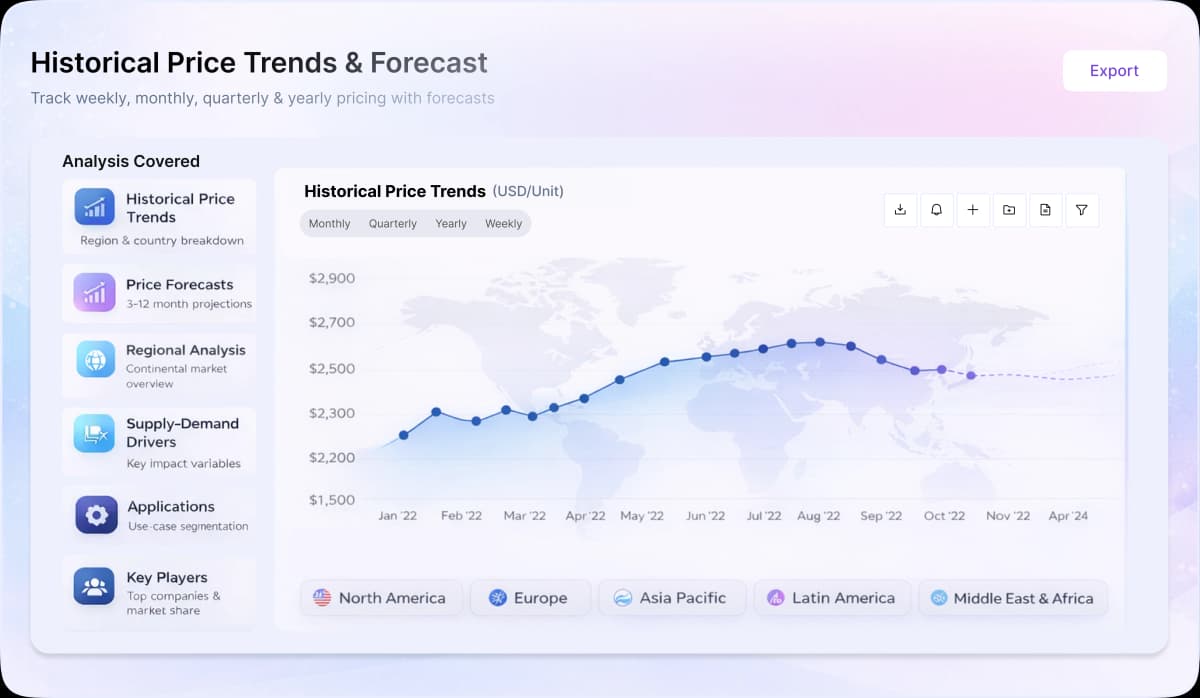
Price Trend Dashboard - What's Included
Price trends across a diverse portfolio of categories and products, spanning board to niche chemicals
Coverage extendable to grade-specific chemicals based on procurement requirements
Regular price tracking supported by robust historical datasets
News, policy updates, and key market drivers impacting price movements
Short-term and long-term price outlooks and forecasts
Supply–demand dynamics and capacity-driven market analysis

To Meet the Increasing Demand Perstorp Proposes to Double-Up Its Carboxylic Acid Output

Cargill, the Foremost Global Provider to Pledge that Its Complete Edible Oil Range to be Based on WHO’s Industrially Produced Trans-Fatty Acids Best Practices

The Fatty Acids Present in the Palm Oil has been Linked to the Stimulation of Cancer Spread