Prakhar Panchbhaiya
Assistant Manager: Business Insights and Content
Supporting procurement teams with category intelligence, market research, price trends, supply-demand analysis, and strategic sourcing insights across key industries.

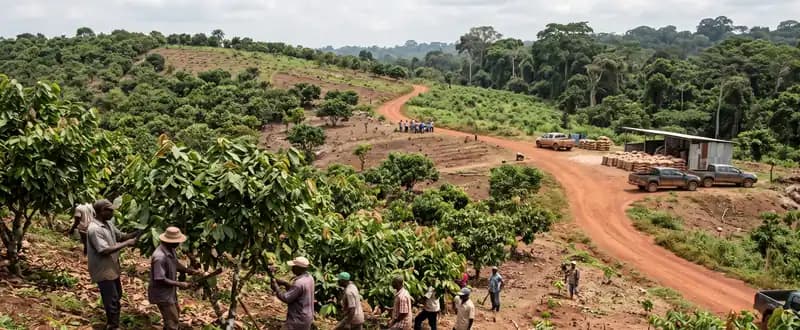
Ghana’s parliament has approved legislation that would give cocoa farms protected status and restrict their conversion to other uses without government permission. The toughest provisions cover land converted for illegal gold mining, with prison terms of 10 to 20 years and fines linked to damaged cocoa trees. Presidential approval was still pending when the measure was reported.
The policy seeks to protect cocoa acreage from competing land uses. Illegal mining has attracted landowners and farmers in areas where mineral extraction can offer faster cash returns than maintaining cocoa trees. Removing producing land reduces future bean availability because newly planted cocoa takes several years to reach commercial output.
Protecting existing farms could support long-term production volumes, but enforcement alone may not improve farmer economics. Growers need enough income to maintain trees, purchase inputs, control disease and replace ageing plants. Farmers who cannot cover these costs may reduce spending even when they are legally prevented from converting the land.
The proposed penalties have also created concern among farming groups. Many growers finance land preparation and farm maintenance themselves. Restrictions that limit how they use their property could discourage new investment unless they are paired with financial or technical support.
Request the Latest Cocoa Prices Data - Access Price Insights Now
For cocoa buyers, the law may reduce one source of acreage loss. It does not remove other supply risks, including poor yields, ageing trees, plant disease and limited access to farm inputs. Procurement teams should avoid treating protected status as a guarantee of higher bean production.
Traceability will become more valuable if the policy proceeds. Buyers may need clearer records showing farm location, legal ownership and approved land use. Suppliers with verified farm maps and documented purchasing networks will be better placed to demonstrate that beans were sourced from protected agricultural areas rather than mining-affected locations.
Long-term contracts can support growers if they provide dependable demand and incentives for quality or farm rehabilitation. Buyers may also work through cooperatives and licensed purchasing organisations to improve access to seedlings, fertilizers and training. These measures can protect supply more effectively than purchasing beans only after harvest.
Cocoa accounts for nearly 15% of Ghana’s export revenue, making the protection of farms an economic priority. Buyers should monitor whether the legislation receives final approval, how permissions are issued and whether farmer-support measures are added. The law could preserve production land, but its supply effect will depend on farmer returns and practical enforcement.
Assistant Manager: Business Insights and Content
Supporting procurement teams with category intelligence, market research, price trends, supply-demand analysis, and strategic sourcing insights across key industries.



.webp&w=1080&q=75)

We are Just a Text away