Prakhar Panchbhaiya
Assistant Manager: Business Insights and Content
Supporting procurement teams with category intelligence, market research, price trends, supply-demand analysis, and strategic sourcing insights across key industries.
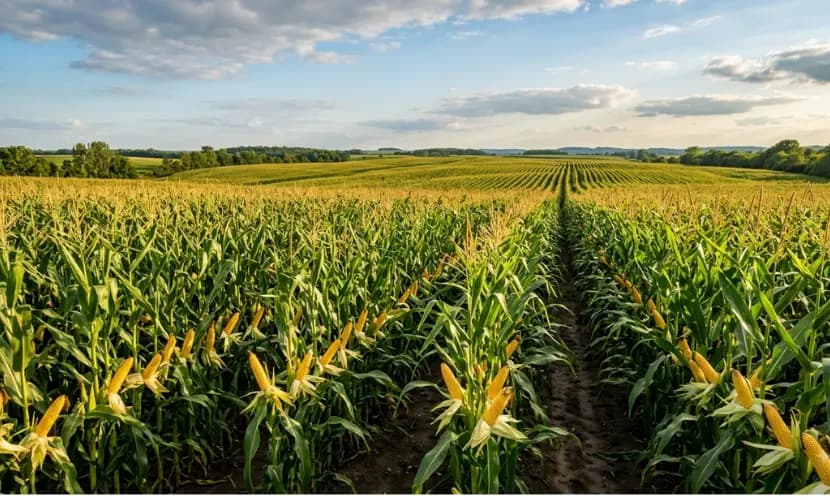
The latest US crop outlook has reduced the expected national corn yield but still points to one of the country's largest maize harvests. The yield projection stands at 180.7 bushels per acre, down from the previous estimate of 183 bushels. A larger expected harvested area offsets the lower output per acre, leaving total production projected at 16.013 billion bushels.
Harvested acreage is expected to reach 88.6 million acres. The increase in area means total production remains slightly above the previous estimate even after the reduction in yield. The crop is still expected to rank as the second-largest US corn harvest on record.
For maize buyers, the combination provides two different purchasing signals. Lower yield indicates that individual fields are expected to produce less grain than previously assumed. Large harvested acreage, however, provides a broad supply base and limits the reduction in total available volume.
Request the Latest Corn Prices Data - Access Price Insights Now
Animal-feed manufacturers are among the largest users affected by changes in maize availability. Ethanol plants, starch processors and food manufacturers compete for the same broad crop, though quality and regional sourcing requirements differ between applications. A large national harvest can provide greater flexibility, but local conditions can still create tighter markets around concentrated consuming regions.
Procurement teams should also distinguish total production from immediately accessible supply. Storage patterns, rail availability, barge movement and farm selling decisions determine how quickly harvested maize reaches industrial users. Large production estimates do not remove regional logistics constraints.
The lower yield estimate also increases the value of monitoring harvest results. Further revisions can occur as field information becomes available and crop conditions become clearer. Buyers fixing large annual volumes can combine contracted base requirements with smaller flexible purchases instead of relying on a single forecast.
Importers of US maize should include freight, currency movement and export-terminal availability when comparing supply with other origins. Domestic buyers can focus more heavily on local basis conditions and transport access.
The production outlook remains large enough to support feed, fuel and processing demand, but the yield reduction shows that crop expectations can shift quickly. Buyers should track actual harvest performance and regional availability rather than basing procurement plans solely on national production totals.
Assistant Manager: Business Insights and Content
Supporting procurement teams with category intelligence, market research, price trends, supply-demand analysis, and strategic sourcing insights across key industries.





We are Just a Text away