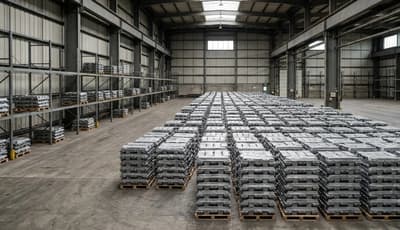
- Around 491,000 tonnes of refined copper has accumulated in US CME warehouses a fivefold increase since early 2025 ahead of a June 30 US tariff decision.
- New Orleans holds roughly two-thirds of CME copper stocks and is near capacity, with some metal sitting dockside and at risk of losing exchange warranting.
- LME and CME copper prices are diverging again, though the current spread is far smaller than the near-$3,000/tonne peak seen in 2025.
- Sulfuric acid shortages from Middle East logistics disruptions and China's export suspension are cutting SX-EW copper output, affecting roughly 20% of global supply.
- Asian manufacturing PMIs are in expansion, grid investment is rising, and AI data center demand is keeping copper consumption firm going into Q3 2026.
Roughly 491,000 tonnes of refined copper approximately 541,000 short tons has moved into CME-listed warehouses in the United States since early 2025, a more than fivefold increase that has transformed the US from a relatively minor inventory hub into the dominant location for global exchange stocks. The build-up has intensified through June 2026 as the market positions ahead of a US Department of Commerce update on refined copper imports due on June 30, which will determine whether a proposed phased tariff on copper actually proceeds.
New Orleans, which currently holds roughly two-thirds of all CME copper stocks, is operating at or near capacity. Some metal is reportedly sitting dockside rather than inside exchange-warranted sheds a distinction that matters for market participants, since copper left exposed without proper storage can lose the clips and bindings required for LME warranting. If the trade reverses and that material needs to reenter global circulation, a portion of it may no longer qualify for exchange delivery.
Request the Latest Copper Prices Data - Access Price Insights Now
Prices on the London Metal Exchange and the Chicago Mercantile Exchange have started to diverge again, echoing the dislocation seen in 2025, though the scale is significantly smaller. The peak COMEX premium over LME in 2025 reached nearly $3,000 per metric ton; the current spread is a fraction of that. A June 1 presidential proclamation adjusting derivative copper tariffs, effective June 8, added complexity without resolving the fundamental uncertainty over whether a permanent tariff on refined imports will be confirmed.
On the supply side, a separate and more immediate pressure point is building. Sulfuric acid shortages driven by a logistics disruption in the Middle East and China's suspension of acid exports through December are tightening the economics of solvent extraction and electrowinning production in Chile and central Africa. Around 20% of global copper output comes from this acid-intensive SX-EW process, and unlike mine strikes or pit wall failures, acid supply constraints translate into production losses within a single quarter rather than over a year. The impact is already being felt at SX-EW operations across the copper belt.
Demand, by contrast, is holding. Manufacturing purchasing managers' indexes across Asia moved into expansion territory and have remained there. Grid investment is accelerating in both the US and Europe, and data center construction driven by AI infrastructure buildout continues to consume copper at scale. For procurement teams sourcing copper for wire and cable, electrical equipment, or EV component manufacturing, the June 2026 picture is one of firm underlying demand colliding with structurally dislocated inventory. The June 30 Commerce Department update will be the single most important price catalyst for the copper complex in the near term.





.webp&w=1080&q=75)