Prakhar Panchbhaiya
Assistant Manager: Business Insights and Content
Supporting procurement teams with category intelligence, market research, price trends, supply-demand analysis, and strategic sourcing insights across key industries.

During the second half of 2025, eugenol prices mostly showed a firm to slightly upward trend. The market was strongly influenced by developments in the clove sector, as eugenol is mainly derived from clove oil. In key clove producing regions, supply remained tight due to limited farm productivity and slow modernization of harvesting and drying practices. This kept raw material availability constrained for much of the period.
Demand for eugenol stayed stable to strong from aroma chemicals, flavors, fragrances, and pharmaceutical applications. The start of new production facilities for clove oil and eugenol in some countries improved processing capacity, but this did not immediately ease market tightness. Buyers remained active, especially from specialty chemical manufacturers seeking consistent supply and quality.
Rising interest in clove-based products, along with efforts by governments and private players to revive clove farming, supported market sentiment. At the same time, higher operating and logistics costs added pressure on producers, limiting any meaningful price correction. Overall, limited clove availability combined with steady industrial demand kept eugenol prices supported throughout H2’25.
Analyst Insight
According to Procurement Resource, Eugenol prices are expected to remain firm, with market direction closely tied to clove harvest recovery and expansion of processing capacity.
Related Report
Need Latest Eugenol Prices?
Get real-time price assessments, periodic trends, forecasts and price driver insights across key global markets.
Our Clients































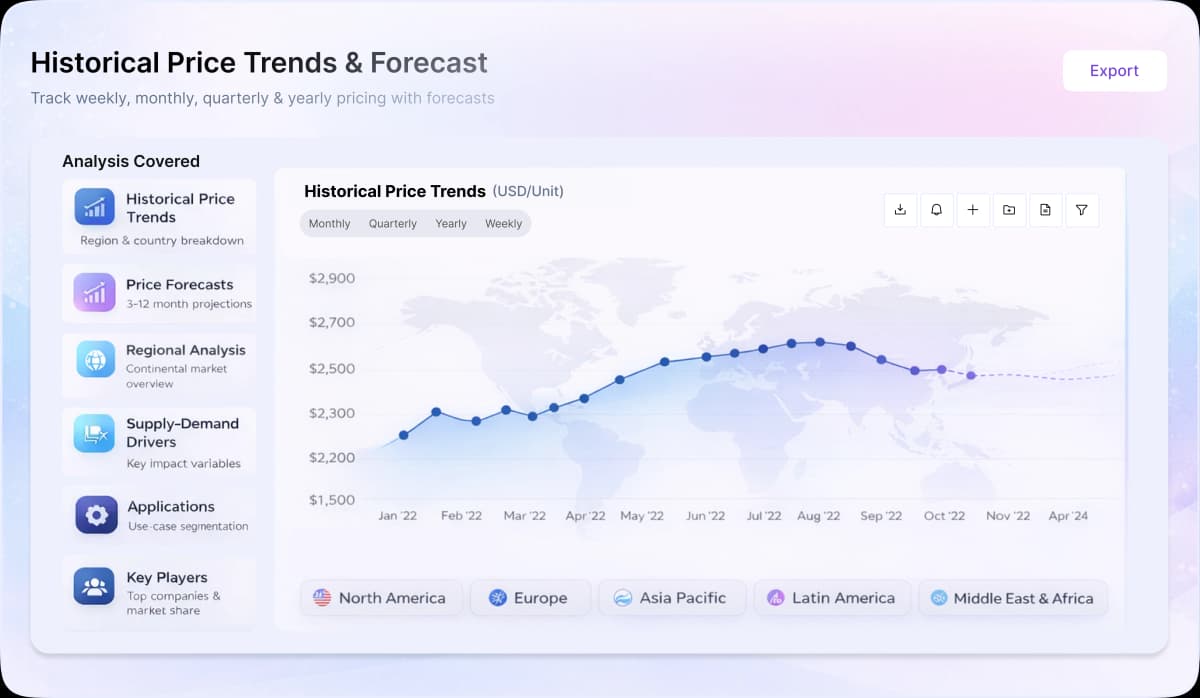
Turn price intelligence into action with the Procurement Resource Database. Log in or subscribe to unlock live price trends, historical charts, supplier databases, cost curves, and analyst-backed insights across chemicals, agriculture, energy, packaging, and more. Use these tools to benchmark your contracts, plan budgets with confidence, and stay ahead of market moves on every product you buy.
0
+Products
0
+Regions
0
+Subscriptions
During the first half of 2025, eugenol prices experienced moderate volatility, largely shaped by fluctuations in clove supply and shifting weather conditions in major producing regions. Indonesia, the world’s leading clove producer, faced declining yields due to increasingly erratic rainfall patterns and extreme weather events. These conditions disrupted both harvesting and drying processes, leading to lower-quality output and reduced supply of clove-derived products like eugenol. Farmers in areas such as Ternate reported a drop in production volume, and many struggled with rising costs and labor shortages, further tightening availability.
At the same time, India’s Thalanad clove, newly granted GI tag status, gained strong momentum in the global spice market. This emerging competitor helped stabilize some of the shortfall from Indonesia but wasn't yet producing at a scale to significantly ease global supply constraints. On the demand side, eugenol usage remained steady across perfumery, pharmaceutical, and flavouring sectors. However, buyers turned cautious due to uncertain quality and unpredictable shipment volumes, which added to short-term pricing pressure.
Eugenol, an allyl chain-substituted guaiacol, is extracted from certain essential oils particularly from the clove oil, cinnamon, nutmeg, etc. It is present in the essential oils and can be derived from many plants, particularly the S. aromaticum (clove). It is a colourless to pale yellow oily liquid with a spicy odour typical of clove. It is widely used for flavouring in foods and as a herbal oil to treat toothache.
C10H12O2
Essential Oils, Odour Agents, Personal Care Products, Flavourings, Dentistry, Local Antiseptic and Anaesthetic, Perfumery
2-Methoxy-4-(prop-2-en-1-yl) phenol, 4-Allyl-2-methoxyphenol, 2-Methoxy-4-(2-propenyl) Phenol, Eugenic Acid, Caryophyllic Acid, Allylguaiacol
Moellhausen S.P.A, Berjé Inc , PT. Van Aroma, Fleurchem, Inc. , Indukern F&F Ingredients, Ultra International B.V.
CurrencyUS$ (Data can also be provided in local currency)
Supplier Database AvailabilityYes
Customization ScopeThe report can be customized as per the requirements of the customer
Post-Sale Analyst Support360-degree analyst support after report delivery
Note: Our supplier search experts can assist your procurement teams in compiling and validating a list of suppliers indicating they have products, services, and capabilities that meet your company's needs.
The oil having Eugenol is chemically treated using a 3% aqueous solution of NaOH. Further, the non-acid components are separated with ether. Finally, the acidification of obtained alkaline solution takes place to isolate the phenols, followed by the fractional distillation under reduced pressure, further producing Eugenol.
Our Price Analysis Methodology
Assistant Manager: Business Insights and Content
Supporting procurement teams with category intelligence, market research, price trends, supply-demand analysis, and strategic sourcing insights across key industries.
Experience how Procurement Resource transforms raw material price data into clear, decision ready intelligence. Optimise your performance with reliable, expert market data and analysis. Schedule your demo today to experience a live walk-through where our experts will showcase interactive price charts, forecasted prices, and insights driving the prices for your key commodities, tailored to your workflows. Contact us now!
Our Team will be happy to assist you
We are just a text away
Still Need Help?
This report provides the cost structure of EPDM rubber production from the suspension polymerization process using polymer grade propylene and ethylene.
This report presents the economics of Polyisoprene production starting from raw sugar.
This report presents the economics of Polyisoprene production starting from glucose. The process comprehends the fermentation of 70 wt % glucose-water syrup into isoprene, followed by solution polymerization step for converting isoprene to Polyisoprene.
This report presents the economics of synthetic rubber production from isoprene through the solution polymerisation process. In this process, a monomer such as isoprene is used as a feed material.
Unlock full access to Procurement Resource's price databases, interactive charts, and short-term forecasts for thousands of commodities. Elevate your sourcing decisions by comparing prices across regions, downloading historical data, and layering in analyst-backed insights, all with our flexible plans that scale as your portfolio grows.
Still have any Questions
Contact Us



Price Trend Dashboard - What's Included
Price trends across a diverse portfolio of categories and products, spanning board to niche chemicals
Coverage extendable to grade-specific chemicals based on procurement requirements
Regular price tracking supported by robust historical datasets
News, policy updates, and key market drivers impacting price movements
Short-term and long-term price outlooks and forecasts
Supply–demand dynamics and capacity-driven market analysis

Track prices, market movements, supply-demand dynamics, and industry developments across hundreds of commodities through a centralized intelligence platform built for informed procurement decisions.

Understand market fluctuations using analyst-backed forecasts, historical pricing patterns, and evolving industry trends to strengthen sourcing strategies and budget planning.

Leverage cost models, pricing benchmarks, and procurement insights to evaluate purchasing opportunities, improve negotiations, and enhance operational efficiency.
Access region-specific price trends, trade activities, capacity changes, and supply chain developments influencing commodity markets worldwide.