
Prakhar Panchbhaiya
Assistant Manager: Business Insights and Content
Supporting procurement teams with category intelligence, market research, price trends, supply-demand analysis, and strategic sourcing insights across key industries.

In the second half of 2025, the price of ginger oleoresin experienced upward pressure in the European market. EU imports increased significantly, driven mainly by China, whose shipments more than doubled compared to the previous year. This surge in supply from China indicated strong demand from EU buyers, particularly in countries like the Netherlands, Germany, and Belgium.
Meanwhile, India and Nigeria saw a notable decline in shipments, creating uneven supply dynamics. Prices, which typically tend to drop during summer months, instead rose due to low initial prices that encouraged bulk purchases by speculators. Fresh ginger remained highly sought after, reflecting growing consumer interest in health benefits and culinary uses. In Asia, farmers faced challenges with disease outbreaks and falling local prices, particularly in India, which likely affected availability of raw material for oleoresin extraction.
At the same time, innovative cultivation methods like sack-based farming in Bangladesh helped stabilize supply and reduce losses, indirectly supporting market prices. Overall, the ginger oleoresin market remained unpredictable in H2’25, influenced by fluctuating supply and shifting demand patterns across regions.
Related Report
Need Latest Ginger Oleoresin Prices?
Get real-time price assessments, periodic trends, forecasts and price driver insights across key global markets.
Our Clients































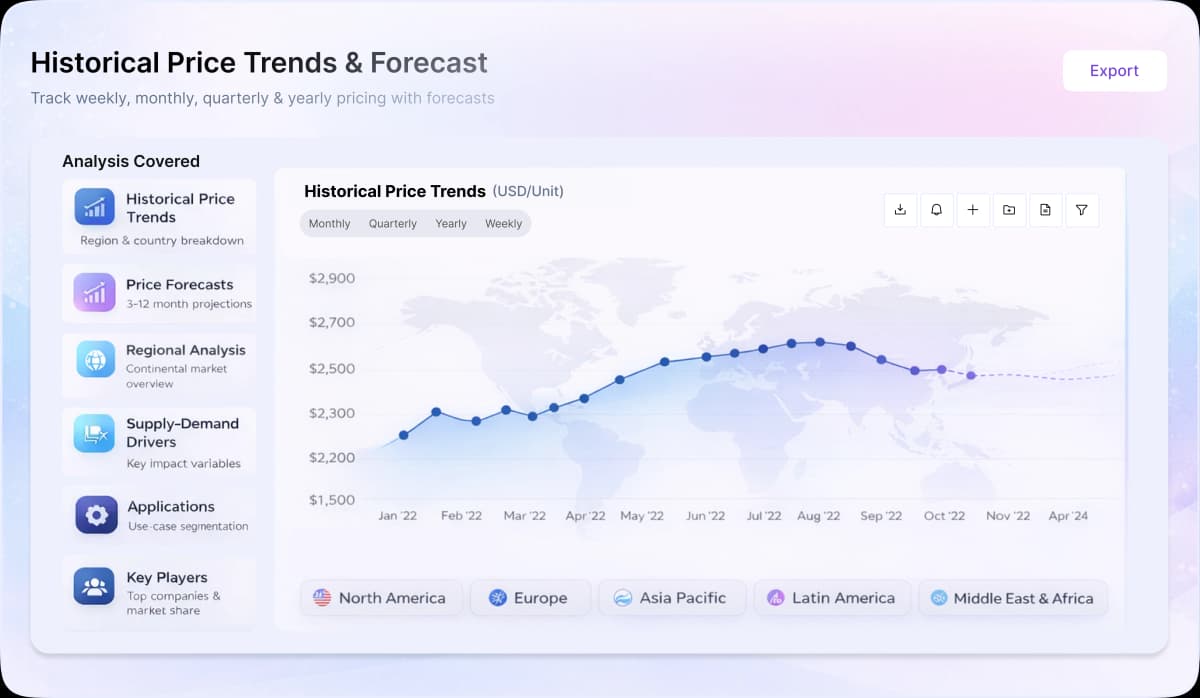
Turn price intelligence into action with the Procurement Resource Database. Log in or subscribe to unlock live price trends, historical charts, supplier databases, cost curves, and analyst-backed insights across chemicals, agriculture, energy, packaging, and more. Use these tools to benchmark your contracts, plan budgets with confidence, and stay ahead of market moves on every product you buy.
0
+Products
0
+Regions
0
+Subscriptions
In the first half of 2025, the price trend for ginger oleoresin showed a steady decline, driven largely by oversupply and weakened export demand across major producing countries. Myanmar, traditionally a key exporter of fresh ginger, witnessed a notable drop in its export volumes.
With international demand falling, local markets in Yangon and Mandalay became more active, but this shift failed to support prices. A surge in production from the southern Shan State only worsened the situation, leading to excess stock and subdued market sentiment.
Meanwhile, in India, a similar pattern emerged. The previous year’s record-high ginger prices encouraged large-scale cultivation across multiple states, including Karnataka, Madhya Pradesh, and Chhattisgarh. However, this resulted in a bumper harvest and a market glut, especially as international buyers turned to cheaper alternatives from Thailand and Vietnam.
Retail prices dropped sharply, and many Indian farmers struggled to cover their rising input costs. Disruptions in trade routes due to border tensions also hurt exports to Afghanistan and Pakistan, adding further pressure.
In China, increased acreage and higher yields contributed to heavy inventories. Despite good quality in some regions, much of the produce was not suitable for high-end export markets, especially in the northeast. As a result, traders became cautious, further pushing prices down. The global ginger market saw increased competition, tighter margins, and weak buyer interest, which filtered through to the oleoresin segment, dragging prices lower.
Ginger Oleoresin is derived or extracted by the solvent extraction of ground-dried rhizomes of ginger or Zingiber officinale. This product has the properties of refreshing aroma of ginger. When evaluated in dilution, it has a pungent and biting sensation. It is also known for its free-flowing, homogeneous, dark brown liquid.
Batters and bread mixes, Marinades, Salad dressing, Sauces, Seasonings, Snacks, Beverages, Medicine, Flavouring agent, Insect repellent, Volatile oils
Synthite Industries Ltd., Akay Group Ltd, Plant Lipids, Universal Oleoresins, BOS Natural Flavours (P) Limited, NAR Spice Products
CurrencyUS$ (Data can also be provided in local currency)
Supplier Database AvailabilityYes
Customization ScopeThe report can be customized as per the requirements of the customer
Post-Sale Analyst Support360-degree analyst support after report delivery
Note: Our supplier search experts can assist your procurement teams in compiling and validating a list of suppliers indicating they have products, services, and capabilities that meet your company's needs.
It is derived or extracted by the solvent extraction of ground-dried rhizomes of ginger with the help of an organic solvent. After this, the solvent traces are vacuum distilled to finally produce Ginger Oleoresin.
Our Price Analysis Methodology
Assistant Manager: Business Insights and Content
Supporting procurement teams with category intelligence, market research, price trends, supply-demand analysis, and strategic sourcing insights across key industries.
Experience how Procurement Resource transforms raw material price data into clear, decision ready intelligence. Optimise your performance with reliable, expert market data and analysis. Schedule your demo today to experience a live walk-through where our experts will showcase interactive price charts, forecasted prices, and insights driving the prices for your key commodities, tailored to your workflows. Contact us now!
Our Team will be happy to assist you
We are just a text away
Still Need Help?
Europe & Africa
+44 7573 171117
Sales@procurementresource.com
USA & Canada
+1 307 363 1045
Sales@procurementresource.com
APAC
+91 8850629517
Sales@procurementresource.com
This report provides the cost structure of ginger oleoresin production by solvent extraction method. This process involves the solvent extraction of powdered dry rhizomes of Zingiber officinale with an organic solvent such as acetone and ethanol.
Unlock full access to Procurement Resource's price databases, interactive charts, and short-term forecasts for thousands of commodities. Elevate your sourcing decisions by comparing prices across regions, downloading historical data, and layering in analyst-backed insights, all with our flexible plans that scale as your portfolio grows.
Still have any Questions
Contact Us



Price Trend Dashboard - What's Included
Price trends across a diverse portfolio of categories and products, spanning board to niche chemicals
Coverage extendable to grade-specific chemicals based on procurement requirements
Regular price tracking supported by robust historical datasets
News, policy updates, and key market drivers impacting price movements
Short-term and long-term price outlooks and forecasts
Supply–demand dynamics and capacity-driven market analysis

Track prices, market movements, supply-demand dynamics, and industry developments across hundreds of commodities through a centralized intelligence platform built for informed procurement decisions.

Understand market fluctuations using analyst-backed forecasts, historical pricing patterns, and evolving industry trends to strengthen sourcing strategies and budget planning.

Leverage cost models, pricing benchmarks, and procurement insights to evaluate purchasing opportunities, improve negotiations, and enhance operational efficiency.
Access region-specific price trends, trade activities, capacity changes, and supply chain developments influencing commodity markets worldwide.