Prakhar Panchbhaiya
Assistant Manager: Business Insights and Content
Supporting procurement teams with category intelligence, market research, price trends, supply-demand analysis, and strategic sourcing insights across key industries.

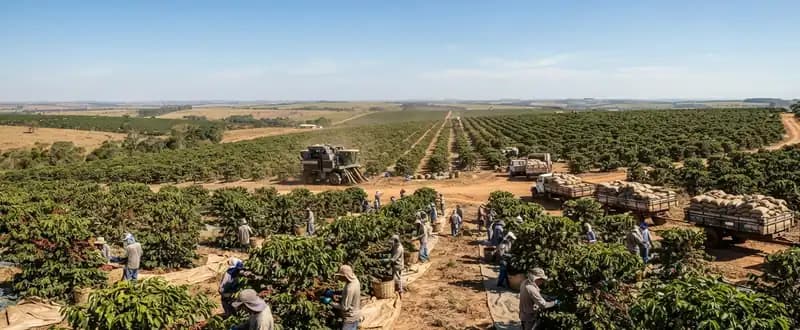
September arabica coffee futures closed down 0.30 percent at 267.00 cents per pound on Monday, while July ICE robusta futures fell 1.40 percent, as drier weather in Brazil allowed the coffee harvest to resume after weeks of disruption. The reopening of the Strait of Hormuz added to the pressure on prices, since lower global shipping rates, insurance costs, fertilizer prices and fuel costs are expected to reduce expenses for coffee importers and roasters.
The pullback followed a sharp reversal the previous Thursday, when coffee prices climbed to five-week highs on persistent rain across Brazil's growing regions that had delayed the harvest and raised concerns about bean quality.
Exchange-certified stock levels have told a different story over the past three months. ICE arabica coffee inventories fell to a two-and-a-quarter-year low of 393,937 bags on Monday, while ICE robusta inventories, which touched a two-year low of 3,631 lots on May 15, jumped to a two-and-a-quarter-month high of 4,032 lots the following Thursday. The combination of tightening certified stocks and swinging weather conditions has kept the market on edge through the second half of June.
Request the Latest Coffee Prices Data - Access Price Insights Now
Weather risk further out has added another layer of concern for growers and traders. The U.S. National Oceanic and Atmospheric Administration has put the probability of a Super El Nino event this year at 67 percent, and the Japan Meteorological Agency confirmed on June 10 that an El Nino pattern had formed across the equatorial Pacific. Such conditions could delay the rains Brazil's coffee trees depend on for flowering between September and October, a period that shapes the following season's crop.
On the supply side, the U.S. Department of Agriculture's Foreign Agricultural Service forecast on June 3 that Brazil's 2026-27 coffee crop will reach a record 71.9 million bags, up 14 percent from the prior year. That outlook pushed arabica futures to a 19-month low and robusta to a two-month low on June 9. Rabobank then raised its 2026-27 global arabica surplus estimate to 9.5 million bags from 7.0 million bags, while Brazil's exporter association Cecafe reported on June 11 that the country's May green coffee exports rose 4.2 percent from a year earlier to 2.73 million bags.
Robusta prices face separate pressure from Vietnam, the world's largest producer of that variety. Vietnam's National Statistics Office reported on June 2 that the country's coffee exports for the January through May period rose 7.9 percent from a year earlier to 922,000 metric tons, building on a 17.5 percent jump in full-year 2025 exports to 1.58 million metric tons. Vietnam's 2025-26 production is projected to climb 6 percent to a four-year high of 1.76 million metric tons, or 29.4 million bags. For coffee buyers, the combination of a record Brazilian crop forecast, growing Vietnamese export volumes and thinning certified stocks points to a market that could swing in either direction through the rest of the third quarter.
Assistant Manager: Business Insights and Content
Supporting procurement teams with category intelligence, market research, price trends, supply-demand analysis, and strategic sourcing insights across key industries.


We are Just a Text away