Prakhar Panchbhaiya
Assistant Manager: Business Insights and Content
Supporting procurement teams with category intelligence, market research, price trends, supply-demand analysis, and strategic sourcing insights across key industries.

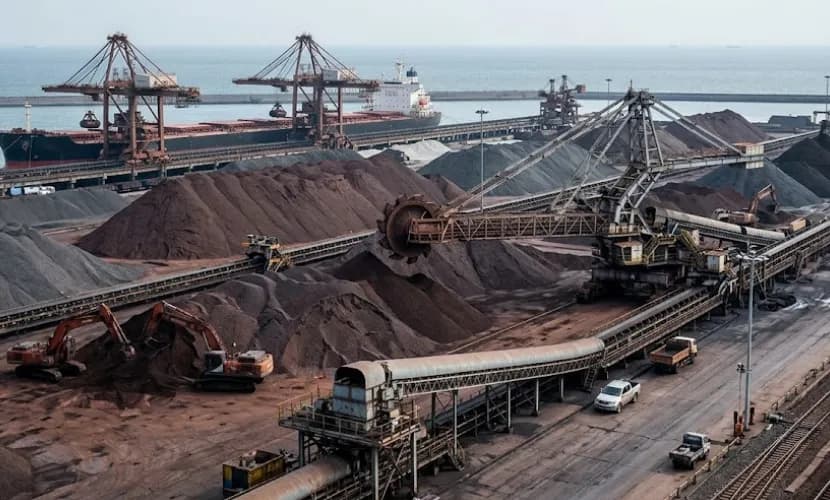
Chinese iron ore markets reopened after the Golden Week holiday with sharp losses, as thin steel mill margins and expectations of higher global supply drove the Dalian benchmark to its weakest reading in 18 months. On October 8, the most traded Dalian iron ore contract closed daytime trade down about 3.12 percent at around 682.5 yuan per tonne, its weakest level since April 2025. The move marked the first working day after the week long holiday and reflected pent up selling as mills returned to a market already running at low profitability. Singapore benchmark November iron ore held above the Dalian pullback, trading at about 91.3 to 92.3 dollars per tonne through the first part of October after touching 90.95 dollars on October 5, a reading not seen since September 2024.
The main driver was Chinese steel mill margin stress. Only about 7 percent of Chinese steelmakers were profitable at the end of September, and average daily hot metal output fell to a six month low of about 2.34 million tonnes. Several steelmakers started or planned equipment maintenance programs as losses deepened, cutting the pace of blast furnace iron ore demand. Industry data showed that physical trading at Chinese ports was thin through the first days back from the holiday, with buyers waiting for policy signals on fourth quarter stimulus before committing to large volumes.
Request the Latest Iron Ore Prices Data - Access Price Insights Now
Supply side pressure built further. Shipments out of Australian and Brazilian ports were running close to multi year highs for this time of year, with vessel loading schedules at Port Hedland and Tubarao broadly on plan. Lower bulk freight rates and softer bunker fuel prices during the week added to margin pressure on seaborne ore. Coking coal and coke moved in the opposite direction on the Dalian exchange, with coking coal up about 2.73 percent and coke up about 1.23 percent, reflecting local supply tightness in Shanxi province rather than any wider demand recovery.
Shanghai steel futures mirrored the ore weakness. Rebar fell about 1.06 to 1.77 percent through the week, hot rolled coil dropped about 0.91 to 1.22 percent, and stainless steel pulled back about 1.28 to 1.82 percent. Steel mill losses, combined with growing inventories built up during the holiday break, prompted traders to position for further weakness through the balance of October before any Chinese stimulus or seasonal restocking could lift demand.
For procurement teams in steel, construction, mining service, and heavy manufacturing supply chains, the near term action is to use the pullback to secure October and November iron ore and steel semi finished coverage. Rebar and coil buyers in Southeast Asia and the Middle East should confirm bilateral volumes while Chinese export offers remain soft. Automotive and appliance OEMs should stress test fourth quarter cost models against a scenario where Dalian iron ore stays in the 680 to 720 yuan per tonne band and Singapore benchmark values hold near 90 to 95 dollars per tonne through the end of October.
Assistant Manager: Business Insights and Content
Supporting procurement teams with category intelligence, market research, price trends, supply-demand analysis, and strategic sourcing insights across key industries.


We are Just a Text away
.webp&w=1080&q=75)
.webp&w=1080&q=75)