
Prakhar Panchbhaiya
Assistant Manager: Business Insights and Content
Supporting procurement teams with category intelligence, market research, price trends, supply-demand analysis, and strategic sourcing insights across key industries.
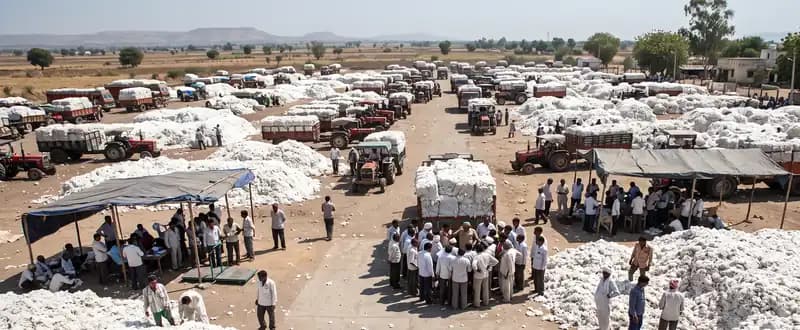
India is directing INR 5,659 crore towards a cotton productivity programme covering farm output, fibre quality, traceability and international competitiveness. The programme seeks to improve the performance of the cotton supply chain from cultivation through ginning and market access. For textile manufacturers, the plan could increase access to cotton with more consistent fibre properties and clearer information about its origin and production methods.
The Cotton Corporation of India has procured more than 522 lakh quintals of seed cotton through close to 24 lakh farmer transactions. Payments worth INR 41,530 crore have been transferred under the minimum support price system. The support price for the coming season has also been raised by around 7%, providing growers with a higher protected return but creating the possibility of firmer raw-material costs for spinners and textile mills.
Four agreements have been signed to address quality standards, sustainability, traceability and market access. The work includes government agencies, agricultural research bodies, development organisations and private companies. Planned activities cover better ginning practices, climate-smart cultivation and certified production under the Kasturi Cotton Bharat programme.
Request the Latest Cotton Prices Data - Access Price Insights Now
Improved ginning can reduce contamination and fibre damage, two issues that affect yarn quality and processing efficiency. Better bale identification and traceability can help mills verify origin, farming practices and quality claims before accepting deliveries. Export-oriented manufacturers may also find certified cotton useful when customers request proof of origin or environmental information.
The higher support price creates a separate procurement consideration. Mills may face higher purchase costs if market prices follow the revised floor. Buyers will need to assess whether improvements in fibre consistency, cleanliness and traceability justify any premium. Longer contracts with qualified ginners could protect access to suitable grades, though buyers may still prefer flexible volumes when crop output and market prices remain uncertain.
The programme could also change supplier selection. Ginners and traders that adopt traceability systems and recognised quality controls may gain access to more formal textile and export supply chains. Smaller suppliers that do not update processing or documentation practices could find it harder to meet buyer requirements. Procurement teams are likely to place more weight on test reports, bale-level records, contamination controls and certification when comparing cotton offers.
Assistant Manager: Business Insights and Content
Supporting procurement teams with category intelligence, market research, price trends, supply-demand analysis, and strategic sourcing insights across key industries.





We are Just a Text away