Udeesha Tomar
AVP - Strategy and Solutions
Leading procurement research solutions across chemicals, materials, and food & beverages, with expertise in price forecasting and market analytics.

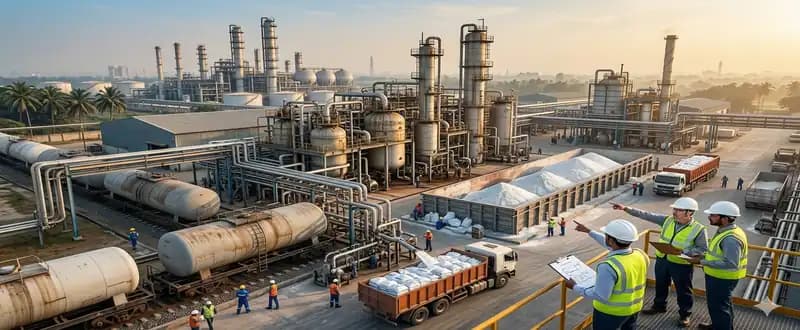
Buyers of aluminium sulfate are confronting a sharp cost shock that originates not in the coagulant itself but in its most important chemical input. Sulfuric acid, one of the two principal feedstocks used to make the product, has been driven to record levels through April and into May, and the increase is now the dominant force shaping delivered costs for water treatment and paper sector purchasers.
The trigger lies in the Middle East. A naval blockade of the Strait of Hormuz has drastically cut the flow of elemental sulfur, the raw material for most sulfuric acid, out of the Gulf region. Sulfur shipments through the Strait of Hormuz collapsed from 1.27 million tonnes per month before the Iran conflict to 30,000 tonnes in April 2026, removing a huge share of seaborne supply at a stroke, given that around half of global seaborne sulfur trade normally moves through that corridor. The squeeze was then compounded by policy, as Beijing implemented significant restrictions on sulfur exports effective May 1, 2026, prioritising domestic agricultural and industrial consumption, creating a second simultaneous shock to the acid market.
Request the Latest Sulfuric Acid Prices Data - Access Price Insights Now
The price response has been extreme. Assessments placed sulfuric acid CFR US Gulf at $400/mt on May 6, up from the pre-war level of $155/mt on Feb. 25, and sulfur FOB US Gulf at $1,060/mt. Some regional acid quotations climbed even higher, and analysts have described both sulfur and acid as reaching record highs, with the acid picture worsened by the loss of Chinese export volumes. The economics are unforgiving because the sulfur burning route sets the marginal price, and roughly a third of a tonne of sulfur is needed for each tonne of acid, so any jump in sulfur feeds through almost immediately.
For aluminium sulfate, this matters because acid is a core ingredient combined with an aluminium bearing material to produce the finished coagulant. The second feedstock chain, rooted in bauxite and alumina, has been moving the other way, with seaborne bauxite values weak on heavy supply, which provides a partial cushion. But the scale of the acid move outweighs that relief and is lifting the cost floor under aluminium sulfate production.
The practical message for procurement teams is to treat acid availability as the binding constraint for the months ahead. Water treatment operators and paper producers cannot easily substitute away from aluminium sulfate, so buyers should secure coverage where terms allow, build modest inventory buffers against further acid tightness, and monitor both Hormuz shipping conditions and Chinese export policy as the two variables most likely to determine whether costs ease or climb further.
AVP - Strategy and Solutions
Leading procurement research solutions across chemicals, materials, and food & beverages, with expertise in price forecasting and market analytics.


We are Just a Text away