
Prakhar Panchbhaiya
Assistant Manager: Business Insights and Content
Supporting procurement teams with category intelligence, market research, price trends, supply-demand analysis, and strategic sourcing insights across key industries.
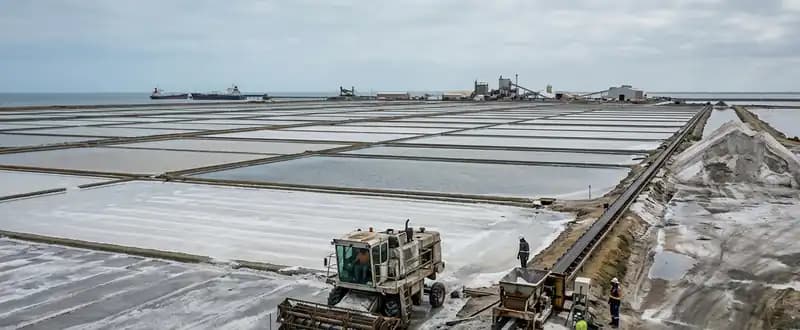
Salt production at Rio Tinto’s Dampier Salt operations recovered during the second quarter of 2026 but remained below the volume produced one year earlier. Output reached 1.72 million tonnes during the three months to June, up from 1.392 million tonnes in the first quarter. The quarter-on-quarter increase was close to 24 percent.
Second-quarter output was below the 2.012 million tonnes reported for the same period in 2025, a reduction of about 14.5 percent. First-half production totalled 3.111 million tonnes, compared with 3.235 million tonnes during the first half of last year. The six-month reduction was about 3.8 percent.
Dampier Salt operates solar salt sites at Dampier and Port Hedland in Western Australia. Rio Tinto owns 68 percent of the business, with Marubeni and Sojitz holding the remaining shares. The operations harvest salt through seawater evaporation and serve the seaborne industrial market.
The second-quarter recovery improves the volume available after a slower opening to the year. The year-on-year decline still matters for buyers that depend on fixed loading periods or large vessel parcels. Industrial salt supply chains require coordination between harvesting, washing, stockpiling, port handling and vessel scheduling. A production reduction can limit the flexibility available when customers request changes to loading dates.
Request the Latest Production Cost Report – Access Market Cost Insights
Salt is a basic feedstock for chlor-alkali plants producing caustic soda and chlorine. Buyers also use industrial grades in water treatment and other chemical processes. Procurement decisions depend on sodium chloride content, moisture, insoluble matter and delivered freight rather than tonnage alone.
Customers purchasing Western Australian solar salt should compare contracted allocation with expected consumption during the second half. Buffer stocks can protect continuous chemical production where a late vessel would force a plant rate reduction. Contracts should define moisture adjustments, quality rejection procedures, demurrage responsibility and alternative loading windows.
The increase from the first quarter shows that output has improved, but first-half production remains below last year. Buyers should monitor whether the recovery continues through the third quarter before assuming full-year availability has returned to its previous level.
Assistant Manager: Business Insights and Content
Supporting procurement teams with category intelligence, market research, price trends, supply-demand analysis, and strategic sourcing insights across key industries.



We are Just a Text away